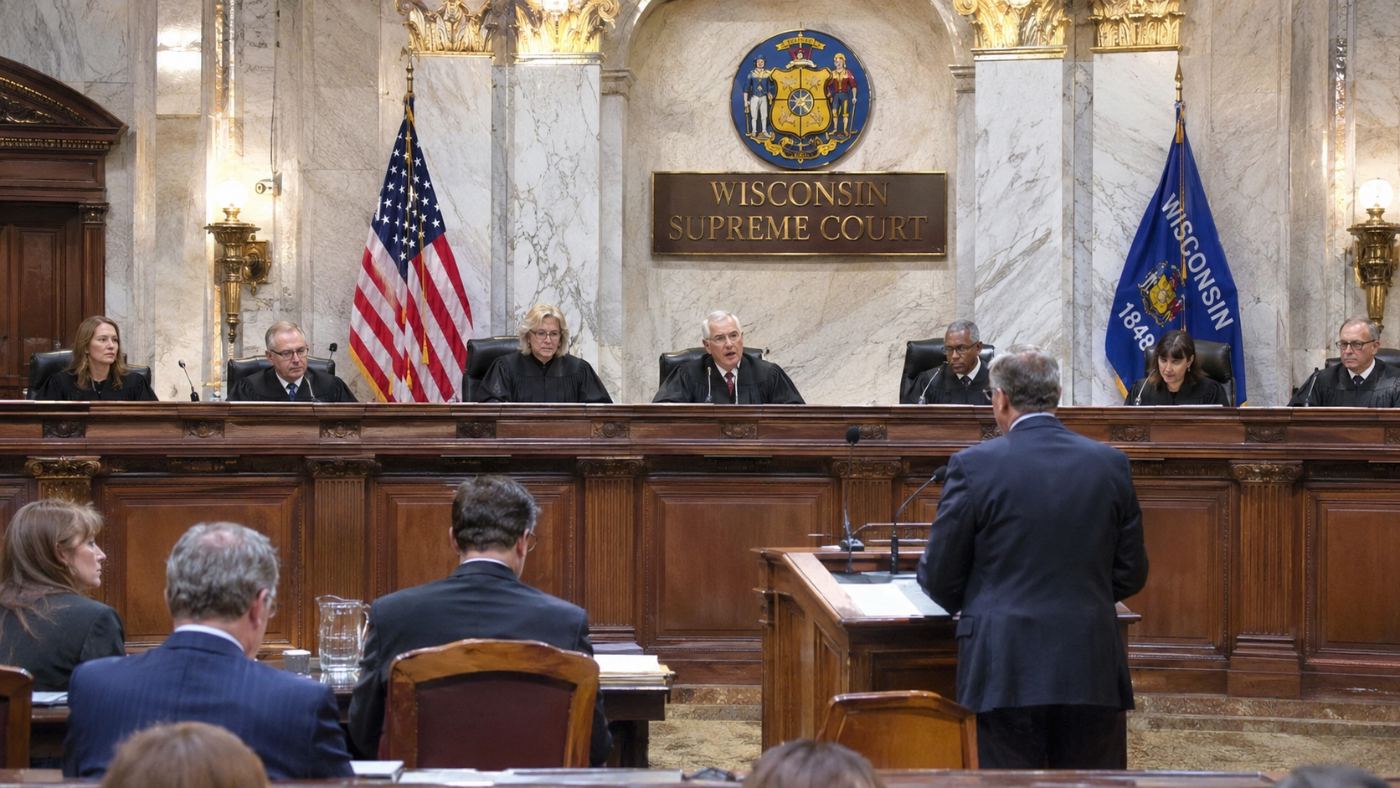
On December 3, 2020, the Wisconsin Supreme Court rejected President Donald Trump's attempt to bring an election challenge directly before the state's highest court, delivering another procedural setback to his efforts to overturn Joe Biden's presidential victory.
In a 4–3 decision, the justices ruled that Trump's campaign must pursue its challenge through the lower courts rather than bypass Wisconsin's established election appeals process.
The ruling came as Trump continued contesting results in several battleground states following his November defeat.
Trump Targets More Than 220,000 Ballots
Trump's campaign sought to invalidate more than 220,000 absentee ballots cast in Milwaukee and Dane counties, two heavily Democratic areas of Wisconsin.
The campaign challenged several categories of ballots, including those involving absentee ballot applications, witness-address corrections, voters claiming indefinitely confined status, and ballots collected during Madison's Democracy in the Park events.
Trump's attorneys argued that election officials had improperly administered voting procedures and that the challenged ballots should not have been counted.
Biden had won Wisconsin by approximately 20,700 votes.
Invalidating the disputed ballots could have changed the state's election outcome.
Attempting to Bypass the Normal Legal Process
Rather than beginning in a circuit court, Trump's attorneys asked the Wisconsin Supreme Court to exercise its original jurisdiction and hear the case immediately.
They argued that time was running out before the Electoral College met on December 14.
Attorneys representing Wisconsin Governor Tony Evers and election officials maintained that state law required challenges to recount determinations to begin in circuit court.
The Supreme Court agreed that Trump should follow that established process.
A Conservative Justice Joins the Majority
The decision was notable because Justice Brian Hagedorn, a conservative, joined the court's three liberal justices in rejecting Trump's request.
Hagedorn emphasized that election disputes must follow the legal procedures established by the state legislature.
He acknowledged the importance of reviewing election challenges but explained that the urgency of a presidential election did not justify abandoning ordinary judicial rules.
Three conservative justices dissented, arguing that the court should take up the case immediately.
The disagreement concerned whether the Supreme Court should hear the challenge directly, not whether Trump's allegations had been proven.
The Election Results Remain Certified
Wisconsin had certified Biden's victory on November 30 following recounts in Milwaukee and Dane counties.
Those recounts produced only minor changes and did not reverse the outcome.
The December 3 Supreme Court ruling left the certification intact.
Trump remained free to pursue his claims in the appropriate lower courts, but the decision prevented his campaign from obtaining immediate intervention from Wisconsin's highest court.
Trump's Challenge Ultimately Fails
Trump subsequently pursued the case through Wisconsin's circuit courts.
After a lower court rejected his arguments, the dispute returned to the Wisconsin Supreme Court.
On December 14, the justices rejected Trump's attempt to invalidate the disputed ballots.
The court found that one category of claims lacked merit and that the remaining challenges had been brought too late.
Biden retained Wisconsin's ten electoral votes.
A Significant Moment in the 2020 Election Disputes
The December 3 ruling illustrated the limits of Trump's efforts to accelerate election challenges through the courts.
Although his campaign argued that the approaching Electoral College deadline required immediate action, the Wisconsin Supreme Court declined to bypass established procedures.
The decision did not settle every disputed legal question, but it reinforced the requirement that presidential election challenges follow the same judicial framework established by state law.
December 3, 2020, remains an important date in the legal history of Trump's unsuccessful efforts to reverse Wisconsin's certified presidential election results.