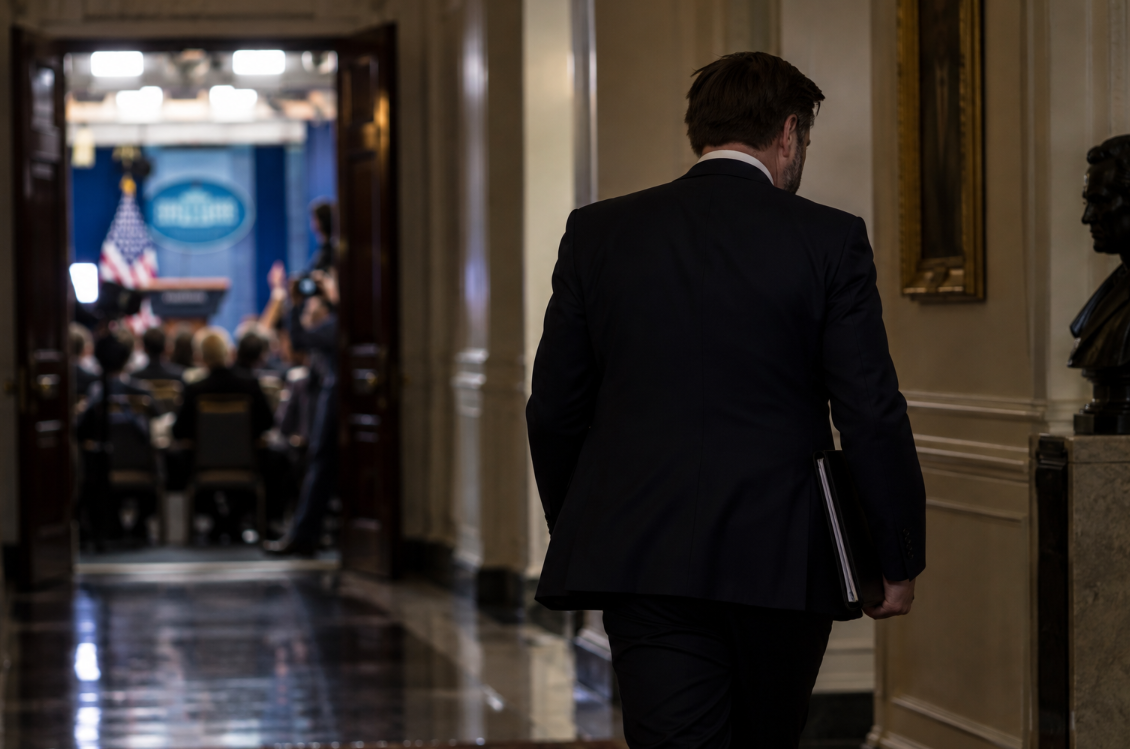
The Trump administration's escalating war with the press has produced a remarkable new contradiction: one of the anonymous sources behind a Politico story the White House used to justify banning the outlet was reportedly Vice President JD Vance.
And the anonymity wasn't Politico's idea.
According to reporting by Status and The Washington Post, the controversial comments originated during an official White House-organized press briefing about negotiations with Iran.
Before the briefing began, reporters were explicitly instructed that the conversation was on background and that the speaker could be identified only as a "senior administration official."
In other words, the White House required the anonymity.
During the briefing, the official told reporters that the chances of reaching a preliminary agreement with Iran had risen to approximately 80 to 85 percent.
Politico reported the comments using exactly the attribution reporters had been instructed to use.
Other news organizations also reported comments from the briefing.
Months later, however, the Trump administration cited the Politico article while attempting to justify its decision to strip Politico of White House access.
The administration accused the outlet of publishing stories that had threatened national security and/or spread false information. The Iran story was included among six examples provided by the White House.
There was just one major problem with that argument.
The information hadn't come from a rogue employee secretly leaking sensitive information to Politico.
It had come from an official White House press briefing.
And now Status reports that the anonymous "senior administration official" speaking during that briefing was Vice President JD Vance.
The White House has declined to comment on Status' identification of Vance, and the identification has not been independently confirmed.
But the circumstances surrounding the briefing itself are much less disputed. The Washington Post reviewed both an invitation to the White House-organized call and a recording establishing that reporters had been instructed to keep the speaker's identity anonymous.
That creates an extraordinary situation.
The White House organized the briefing.
The White House selected the official who spoke.
The White House instructed journalists to describe that person anonymously.
Politico followed those instructions.
Then the White House cited Politico's resulting story as part of its justification for banning the outlet.
Adding another layer to the controversy, Vance publicly defended the administration's decision to ban Politico, CNN and MS NOW from the White House, calling the move "totally appropriate."
If Status' identification is correct, the vice president was therefore defending a punishment imposed partly over reporting based on information he himself provided during an administration-authorized briefing.
The episode also raises another obvious question: Why Politico?
Politico wasn't the only news organization reporting information from the briefing. The Associated Press, Bloomberg and CNBC also reported comments attributed to the unnamed senior administration official.
Yet those organizations weren't subjected to the same ban.
The controversy comes as CNN, MS NOW and Politico challenge the administration's restrictions in federal court, arguing that the White House retaliated against them because of their coverage.
Whatever ultimately happens in that lawsuit, the Vance revelation complicates one of the administration's own examples for why Politico supposedly deserved to lose access.
The White House portrayed anonymous reporting as part of the problem.
But in this case, the anonymity came directly from the White House.
And according to Status, so did the source.
His name was JD Vance.