For months, Donald Trump's presidential campaign had been treated as something between a political insurgency and a spectacle.
He had never served as a mayor, governor, member of Congress or cabinet official.
He had never held elected office of any kind.
He was a real-estate developer and television personality whose business career had included bankruptcies involving several of his companies, extensive litigation and years of disputes over his business practices.
Critics questioned whether he had the temperament, experience or organization necessary to survive a presidential campaign.
Then came New Hampshire.
On February 9, 2016, Republican voters gave Donald Trump his first electoral victory.
And it wasn't close.
Trump Wins Big
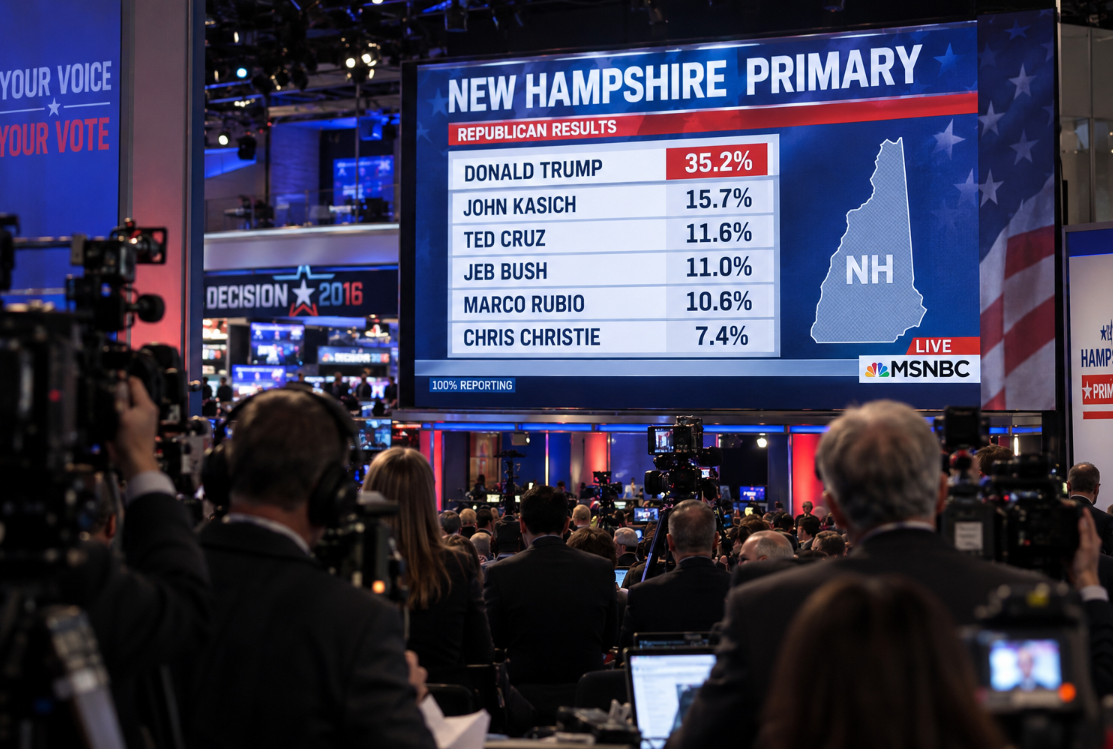
Trump received 100,735 votes in the New Hampshire Republican primary — 35.23 percent of the vote.
Ohio Governor John Kasich finished second with 44,932 votes, or 15.72 percent.
Ted Cruz, who had defeated Trump in Iowa only eight days earlier, finished third with 33,244 votes, or 11.63 percent.
Jeb Bush and Marco Rubio followed behind.
Trump had received more than twice as many votes as his nearest competitor.
The businessman and reality television star who had never held political office had just defeated a field filled with senators and governors.
This was no longer theoretical.
Donald Trump could win elections.
The Candidate Many Had Dismissed
When Trump descended the escalator at Trump Tower in June 2015, there was widespread skepticism about whether his campaign would last.
He had flirted with presidential campaigns before.
His public persona had been built as much around celebrity as politics.
His name appeared on hotels, casinos, golf courses and television programs.
And his business record was hardly free of controversy.
Trump-associated casino companies had gone through multiple corporate bankruptcies. Trump University had been the subject of lawsuits alleging that students had been misled about what they were purchasing. Trump denied wrongdoing and defended his business record.
To his critics, these controversies were evidence that voters should be deeply skeptical of the businessman now asking to run the federal government.
To many of his supporters, they appeared to matter far less than political observers expected.
Trump presented himself not as another politician but as the opposite of one.
His lack of government experience wasn't something he tried to conceal.
It was part of the sales pitch.
Experienced Politicians Couldn't Stop Him
Consider the Republican field Trump was defeating.
Jeb Bush had served two terms as governor of Florida and belonged to one of America's most prominent political families.
John Kasich had served in Congress for nearly two decades before becoming governor of Ohio.
Chris Christie was governor of New Jersey and a former federal prosecutor.
Marco Rubio and Ted Cruz were sitting United States senators.
Trump had none of those qualifications.
He had never written legislation.
He had never administered a state government.
He had never served in Congress.
He had never held a diplomatic or military position.
He had never even run a local government.
Yet in New Hampshire, Republican voters overwhelmingly chose him.
Something Was Happening Inside the Republican Party
Trump's victory demonstrated that a significant portion of the Republican electorate was looking for something very different from the traditional presidential résumé.
Political experience could even become a liability.
Trump portrayed Washington as corrupt, incompetent and controlled by wealthy donors and special interests.
That argument allowed him to transform his greatest conventional weakness — his complete lack of political experience — into one of his greatest political advantages.
His opponents could say they understood government.
Trump could respond that those same people had been running it.
For voters dissatisfied with Washington, that distinction was powerful.
Iowa Hadn't Stopped Him
Trump's defeat in Iowa had raised an obvious question.
Maybe his enormous rallies and television audiences weren't translating into votes.
Ted Cruz had built a sophisticated Iowa organization and defeated him.
Perhaps Trump's campaign had finally encountered the limits that skeptics had predicted from the beginning.
New Hampshire demolished that theory.
Eight days after losing Iowa, Trump didn't merely recover.
He dominated.
The Republican Establishment Had a Problem
The Republican presidential race was still crowded, and Trump's opponents continued splitting the anti-Trump vote among themselves.
Bush had money and an established political organization.
Rubio was viewed by many party leaders as a potential standard-bearer for a new generation of Republicans.
Kasich had just finished second in New Hampshire.
Cruz had won Iowa.
But Trump now had something none of them could dismiss.
A decisive victory.
The argument that Trump was merely a celebrity candidate who would disappear once voters began casting ballots had become much harder to sustain.
The voters had started voting.
And Donald Trump was winning them.
From Curiosity to Contender
New Hampshire represented an important turning point in the 2016 Republican presidential campaign.
Before February 9, Trump was the candidate dominating the polls, television coverage and rallies.
After February 9, he was something more.
He was an election winner.
The businessman with no political experience — a candidate whose business record and rhetoric had generated controversy after controversy — had defeated some of the Republican Party's most experienced politicians.
The political establishment had spent months waiting for Donald Trump's campaign to collapse.
New Hampshire delivered a very different message.
It might be everyone else who was in trouble.