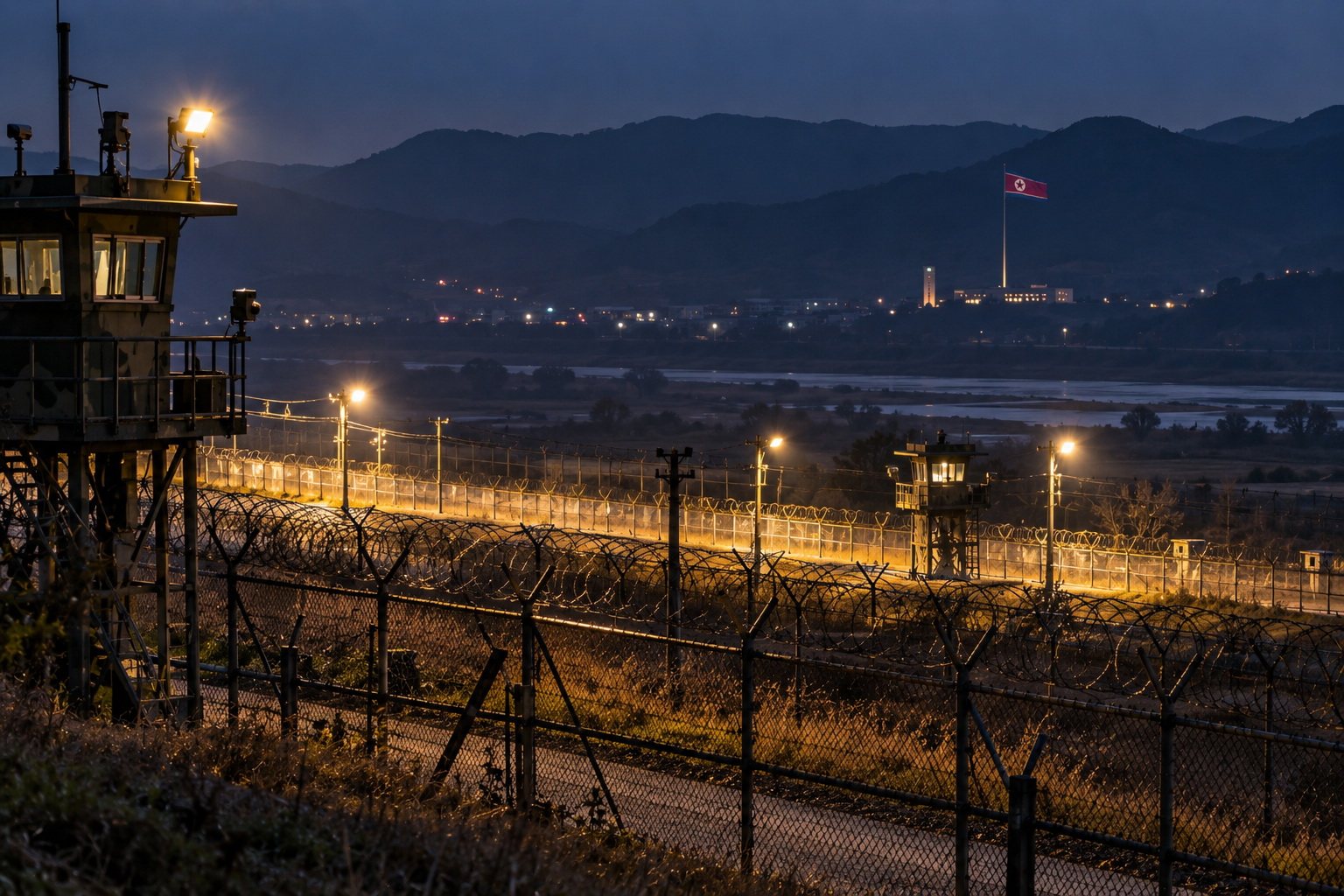
On October 7, 2017, President Donald Trump escalated an already tense confrontation with nuclear-armed North Korea, declaring that decades of diplomacy had failed and warning that “only one thing will work.”
Trump did not explain what that “one thing” was.
The deliberately vague statement came during a period when Trump and North Korean leader Kim Jong Un were exchanging increasingly hostile rhetoric while North Korea rapidly advanced its nuclear weapons and ballistic missile programs.
“Presidents and their administrations have been talking to North Korea for 25 years,” Trump wrote on Twitter, arguing that agreements and negotiations had repeatedly failed.
He concluded with the ominous declaration:
“Sorry, but only one thing will work!”
Trump Leaves the Meaning Unexplained
Trump's statement immediately raised an obvious question: What exactly did the president mean?
He didn't say.
But the comment came after months of increasingly aggressive rhetoric toward North Korea.
In August, Trump warned that additional North Korean threats against the United States could be met with “fire and fury.”
Then, during a September speech before the United Nations General Assembly, Trump warned that the United States could “totally destroy North Korea” if forced to defend itself or its allies.
Trump had also begun referring to Kim Jong Un as “Rocket Man” and later “Little Rocket Man.”
Kim responded with insults and threats of his own as relations between Washington and Pyongyang deteriorated.
Against that backdrop, Trump's statement that “only one thing will work” was widely interpreted as another suggestion that military options remained on the table — although Trump himself did not explicitly say that was what he meant.
“The Calm Before the Storm”
The uncertainty was heightened by another cryptic comment Trump had made only two days earlier.
On October 5, Trump gathered at the White House with senior American military leaders and their spouses for a formal photograph.
Standing among the commanders, Trump suddenly asked reporters:
“You guys know what this represents?”
He then answered his own question:
“Maybe it's the calm before the storm.”
Reporters immediately asked what storm he was talking about.
Trump refused to explain.
“You'll find out,” he said.
The White House offered little additional clarification.
When reporters again asked Trump about the comment on October 7, he still declined to explain it.
“Nothing to clarify,” Trump said.
Pressed further, he responded that reporters would “figure that out pretty soon.”
Tensions With North Korea Were Already Extremely High
The comments were particularly consequential because they weren't occurring in a vacuum.
North Korea had conducted its sixth nuclear test on September 3, 2017, claiming it had successfully tested a hydrogen bomb.
It had also demonstrated increasingly capable ballistic missiles, including missiles potentially capable of reaching portions of the United States.
The United States and its allies were confronting the possibility that North Korea could eventually possess both nuclear warheads and reliable intercontinental ballistic missiles capable of delivering them.
Meanwhile, Trump was publicly expressing frustration with diplomatic efforts.
Only days before his October 7 remarks, Trump had criticized Secretary of State Rex Tillerson for pursuing diplomatic contacts with North Korea.
Trump wrote that Tillerson was “wasting his time trying to negotiate with Little Rocket Man.”
“Save your energy Rex,” Trump added. “We'll do what has to be done!”
The World Was Left Guessing
That combination of statements created extraordinary uncertainty.
The president had threatened “fire and fury.”
He had warned at the United Nations that North Korea could be destroyed.
He had told his secretary of state that negotiations were a waste of time.
He had described a gathering of America's senior military leadership as potentially representing “the calm before the storm.”
And now he was saying that “only one thing will work.”
But he still wouldn't say what that one thing was.
For Americans, U.S. allies in Asia and governments around the world, the question was whether Trump's rhetoric represented a negotiating strategy designed to pressure North Korea — or whether the United States was actually moving closer to military confrontation.
The Confrontation Would Take an Unexpected Turn
The crisis ultimately did not produce the war many feared in 2017.
Instead, the relationship between Trump and Kim underwent a dramatic transformation the following year.
Trump met Kim in Singapore in June 2018, becoming the first sitting American president to meet with a North Korean leader.
Additional meetings followed in Vietnam and at the Korean Demilitarized Zone.
The summits produced extraordinary images and temporarily reduced the hostile rhetoric between the two leaders, but negotiations did not result in North Korea giving up its nuclear arsenal.
That later diplomatic relationship makes October 7, 2017 even more striking in retrospect.
Months before Trump would sit across a table from Kim Jong Un, the president of the United States was publicly declaring that 25 years of negotiations had failed.
Then he left the world with four unexplained words:
“Only one thing will work.”