Three weeks after Hurricane Maria devastated Puerto Rico, President Donald Trump warned the U.S. territory that FEMA, the military and federal first responders could not remain there “forever,” adding another controversy to an already heavily criticized response to the disaster.**
Hurricane Maria struck Puerto Rico on September 20, 2017, destroying homes, crippling communications, and knocking out the island's electrical grid.
By October 12, the emergency was nowhere near over.
Only about 10 percent of Puerto Rico's electricity customers had power. Roughly 64 percent of customers served by the island's water authority had potable water. Hospitals and other critical facilities were relying heavily on generators, while communities continued struggling with shortages of food, fuel, medicine and drinking water.
Puerto Rico's 3.4 million residents were American citizens facing a humanitarian disaster.
That morning, Trump turned his attention not simply to the destruction caused by Maria, but to Puerto Rico itself.
He complained that the island's electrical system and infrastructure had already been a “disaster before hurricanes” and pointed to Puerto Rico's existing financial crisis.
Then came the warning:
“We cannot keep FEMA, the Military & the First Responders, who have been amazing (under the most difficult circumstances) in P.R. forever!”
Technically, no federal disaster response can continue indefinitely. But the timing and tone of Trump's statement were extraordinary. Puerto Rico was still in the middle of an emergency, not approaching the end of one.
From Paper Towels to “Forever”
The October 12 comments also came only nine days after one of the most memorable images of Trump's response to Hurricane Maria.
Trump traveled to Puerto Rico on October 3 to survey the destruction.
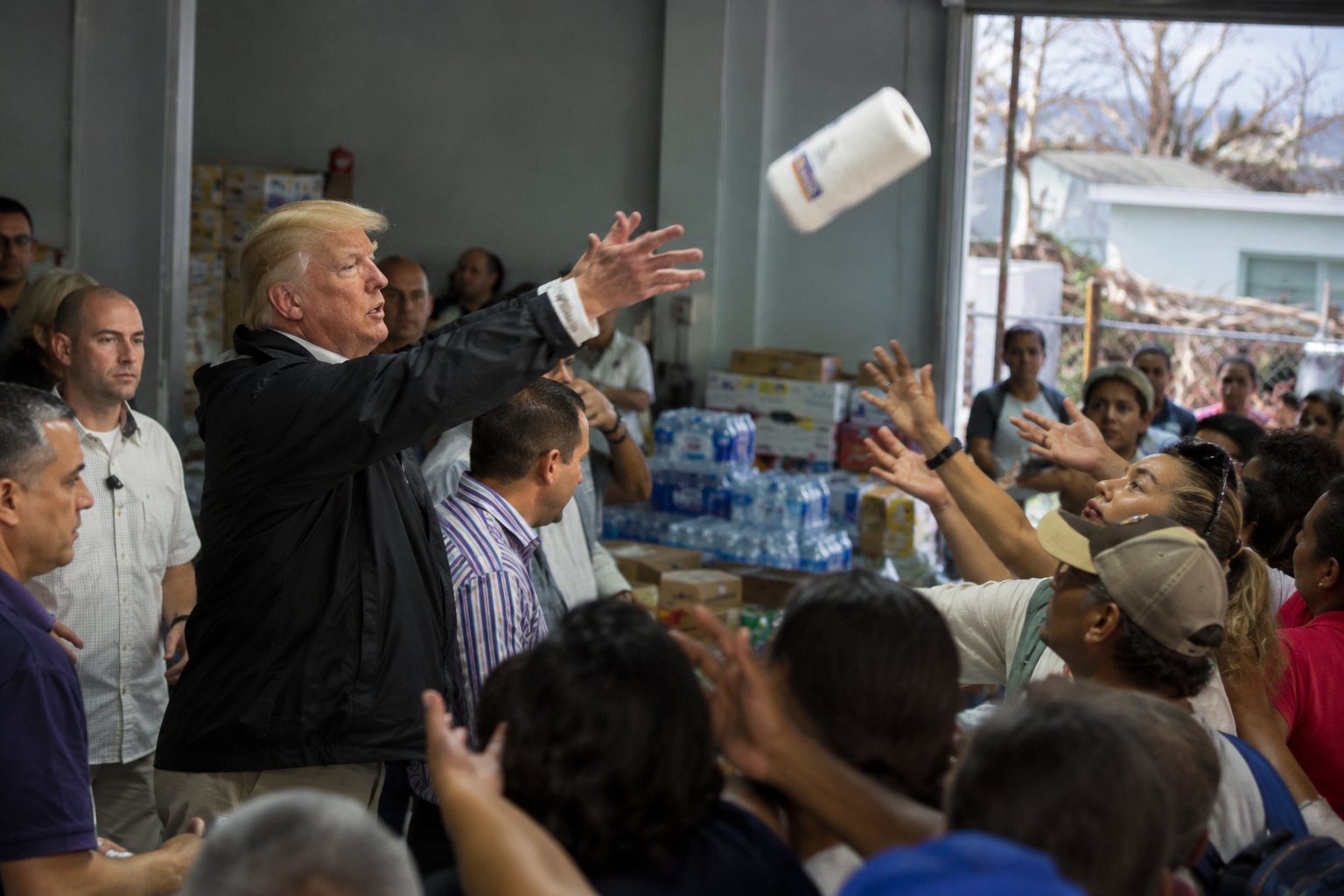
During a stop at Calvary Chapel in Guaynabo, Trump helped distribute relief supplies to hurricane survivors. At one point, television cameras captured the president picking up rolls of paper towels and tossing them into a crowd.
The scene quickly became symbolic to Trump's critics.
Residents were confronting destroyed homes, an electrical grid in ruins, shortages of clean water and an enormous long-term rebuilding effort. Against that backdrop, the sight of the president casually tossing rolls of paper towels into a crowd struck many as bizarre and insensitive.
That wasn't the only controversy during the visit.
Trump also told Puerto Rican officials that the disaster had thrown the federal budget “a little out of whack” because the government had spent so much money responding to the hurricane.
He then contrasted Puerto Rico's reported death toll at the time with Hurricane Katrina, describing Katrina as a “real catastrophe.”
The official death count available during Trump's visit was still extremely incomplete. Subsequent analysis would show that Hurricane Maria's human toll was vastly greater than those early numbers suggested.
Nine days after the paper-towel spectacle, Trump was now publicly discussing how long federal responders would remain.
Puerto Rican Leaders Fire Back
The president's comments drew immediate criticism.
Puerto Rico Gov. Ricardo Rosselló responded that the American citizens of Puerto Rico were simply requesting the same support that Americans elsewhere in the country would expect following a catastrophic natural disaster.
San Juan Mayor Carmen Yulín Cruz, who had already clashed publicly with Trump over the federal response, was considerably harsher.
She accused Trump of adding “insult to injury” and said his comments demonstrated an inability to understand the humanitarian crisis unfolding on the island.
Members of Congress also criticized the president's remarks.
The fundamental question was difficult to ignore: Would a president have publicly warned Texas or Florida that FEMA and federal first responders couldn't remain “forever” just three weeks after a catastrophic hurricane?
Puerto Rico Was Part of the United States
Trump's rhetoric repeatedly created the impression that Puerto Rico was a foreign country asking Washington for assistance.
It wasn't.
Puerto Rico is a U.S. territory, and Puerto Ricans have been U.S. citizens since 1917.
The federal government wasn't providing foreign aid. It was responding to a natural disaster affecting millions of American citizens.
And those citizens were still in desperate need of help.
The irony was particularly striking because only days earlier Trump had promised that his administration would remain committed to Puerto Rico's recovery.
Now the president was publicly emphasizing the limits of that commitment.
A Defining Image of the Maria Response
The Trump administration would defend its Hurricane Maria response, pointing to the enormous logistical challenges involved in supplying an island whose electrical, transportation and communications infrastructure had suffered catastrophic damage. FEMA ultimately mounted a massive and lengthy recovery operation in Puerto Rico.
But Trump's own words and actions repeatedly overshadowed that work.
The paper towels became one enduring image.
The October 12 warning became another.
Less than a month after Hurricane Maria tore through an American territory, millions of Americans were still living with the consequences of a destroyed electrical grid and disrupted access to basic necessities.
Their president's message that morning wasn't simply that help was coming.
It was that the help couldn't stay forever.