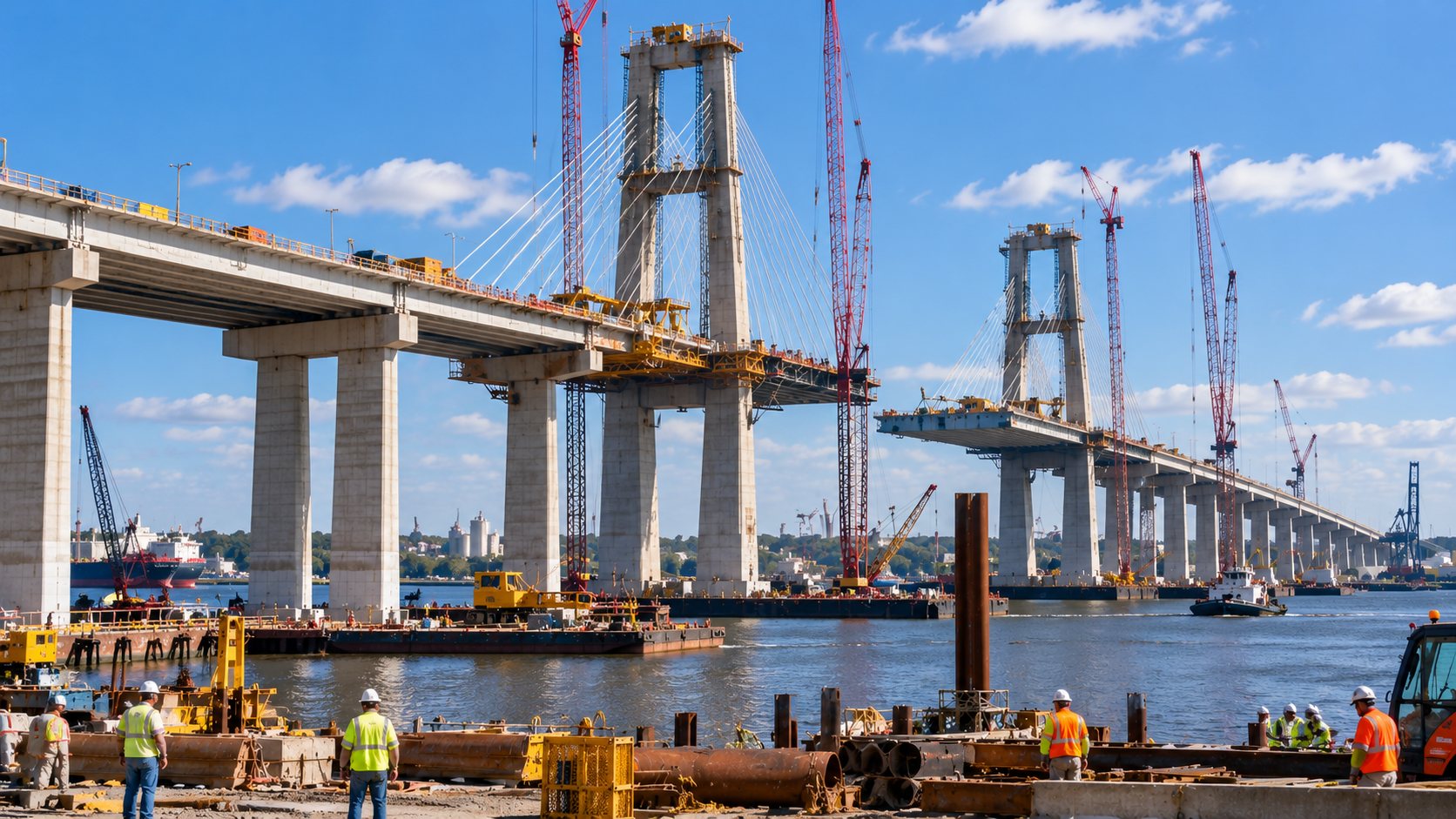
Donald Trump has an idea for Alabama's massive new Mobile River Bridge.
Name it after Donald Trump.
There's just one inconvenient piece of history worth remembering before anyone starts ordering the signs:
Joe Biden's infrastructure law helped pay for it.
Speaking Friday night at a rally in Mobile, Trump celebrated the $3.2 billion Mobile River Bridge and Bayway project, which will create a new Interstate 10 crossing over the Mobile River and dramatically expand one of the Gulf Coast's most important transportation corridors.
Trump credited his administration with helping move the enormous project forward.
Then he suggested Alabama might want to return the favor.
“Maybe they'll name the damn bridge after me,” Trump told the crowd.
There's no question that Trump's current administration has played an important role in getting the project into construction.
But anyone listening to Trump's speech without knowing the history could easily miss something important.
The project received one of its most significant federal grants under President Joe Biden.
And the money came through an infrastructure law Trump opposed.
Biden's $550 Million Investment
On July 17, 2024, the Biden administration announced that Alabama would receive a $550 million federal grant for the I-10 Mobile River Bridge and Bayway project.
That wasn't a promise for some distant future.
It was an actual federal grant award.
The money came through the Federal Highway Administration's Bridge Investment Program, created and funded through the Bipartisan Infrastructure Law signed by President Biden in 2021.
The Federal Highway Administration described it at the time as part of more than $5 billion being invested in major bridges around the country.
Alabama Gov. Kay Ivey celebrated the funding.
“This federal funding will be a game-changer, not just for Mobile and Baldwin Counties, but for our entire state and region,” Ivey said when the award was announced.
She added:
“This is exactly how our infrastructure dollars should be spent.”
That was July 2024.
Joe Biden was president.
Pete Buttigieg was transportation secretary.
And Donald Trump was trying to return to the White House.
Trump Opposed the Law That Provided the Money
This is the part that shouldn't disappear from the story.
Trump opposed Biden's Bipartisan Infrastructure Law.
He didn't merely disagree with portions of it.
Trump publicly attacked Republicans who helped Democrats pass it.
After 13 House Republicans voted for the legislation in 2021, Trump complained about their support and said Republicans who helped pass Biden's infrastructure package should be “ashamed of themselves.”
At a Republican congressional campaign event that year, Trump singled them out again.
“I don't love the 13 that voted for Biden's infrastructure plan,” Trump said.
The legislation passed anyway.
Biden signed it.
And three years later, $550 million authorized through that infrastructure program was awarded to Alabama's Mobile River Bridge and Bayway project.
Now Trump would like the bridge named after himself.
That's a piece of history Alabama shouldn't forget.
Trump Administration Deserves Its Share of Credit Too
Giving Biden credit doesn't require pretending Trump had nothing to do with the project.
That's not what happened either.
Trump's current Transportation Department recently announced a $2.52 billion federal TIFIA loan for the project.
Transportation Secretary Sean Duffy described it as the largest infrastructure project in Alabama history.
That financing is enormously important.
A $2.52 billion loan is substantially larger than the $550 million Biden-era grant.
Trump's administration therefore has a legitimate claim to having helped push the project across the finish line.
But a loan and a grant aren't the same thing.
The $550 million Biden-era award is federal grant funding.
The $2.52 billion announced under Trump is financing through the federal Transportation Infrastructure Finance and Innovation Act program.
Both administrations played a role.
Only one of them, however, is currently suggesting that the bridge might bear his name.
“All Made Possible” By Trump?
Trump's version Friday night was considerably simpler.
He praised Transportation Secretary Duffy for helping break ground on the new I-10 corridor and bridge project.
Then Trump declared it was:
“All made possible by $3 billion dollars in funding from the Trump administration.”
That leaves out the $550 million Biden-era federal grant.
Rep. Shomari Figures, an Alabama Democrat, made a point of correcting the historical record during Friday's groundbreaking.
Figures thanked the Trump administration for helping move the project forward.
Then he added something important:
“But I would be remiss not to thank the Biden administration as well.”
He specifically cited the $550 million investment Biden's administration made in the project.
That's the accurate way to describe what happened.
This isn't exclusively Trump's bridge.
It wasn't exclusively Biden's bridge.
It's an Alabama transportation project that has been developing for decades and has received support from state officials and multiple presidential administrations.
This Bridge Didn't Suddenly Appear in 2026
There's another problem with treating the project as though Trump simply arrived and built it.
Planning for a new Mobile River crossing goes back decades.
According to the Federal Highway Administration, the project began with a feasibility study in 1997.
That's nearly 30 years ago.
Alabama officials, local governments, federal agencies and multiple presidential administrations have wrestled with how to finance and construct it.
Previous versions stalled.
Plans changed.
Toll proposals generated controversy.
Funding remained a persistent obstacle.
Then came a major breakthrough in 2024.
The Biden administration awarded Alabama the $550 million Bridge Investment Program grant.
Federal records at the time estimated the total project cost at roughly $2.67 billion and listed additional federal funding associated with the project.
The current plan has evolved further, with costs and financing arrangements changing as construction approaches.
Infrastructure projects this large rarely belong to one politician.
They span years.
Sometimes decades.
Presidents come and go while engineers, transportation departments and local officials continue working.
But Biden's Name Shouldn't Be Erased
Presidents routinely take credit for projects that began before they entered office.
Democrats do it.
Republicans do it.
Politicians like cutting ribbons.
That's politics.
But there's a difference between celebrating your administration's contribution and rewriting how the project was funded.
The Biden administration didn't merely hold a press conference about this bridge.
It awarded $550 million toward it.
That money came from the infrastructure law Biden fought to pass.
And Trump fought against that law.
Those facts don't disappear because Trump is president again.
Then Name the Bridge After Trump?
Trump's suggestion appeared partly humorous.
“Maybe they'll name the damn bridge after me,” he said.
He then joked that if they did, he'd be more forgiving about cost overruns and would want them to make it “the greatest bridge in the world.”
But Trump's interest in putting his name on public landmarks has become a recurring feature of his second presidency.
And this particular example comes with an unusually awkward historical footnote.
If Alabama someday decides to put Donald Trump's name on the Mobile River Bridge, drivers crossing it should at least know how the project reached construction.
The Trump administration helped secure billions in federal financing.
That deserves to be part of the story.
But so does this:
President Joe Biden signed the infrastructure law that provided a $550 million federal grant for the bridge in 2024.
Donald Trump opposed that law.
Trump attacked Republicans who voted for it.
And now Trump is suggesting that the bridge it helped fund should carry his name.
Political credit can be debated.
The funding record cannot.
Before anyone names this bridge after Donald Trump, Alabama should remember who helped pay for it — including the president whose infrastructure law Trump tried to stop.
Source: Federal Highway Administration, U.S. Department of Transportation, Alabama state records and contemporary reporting.