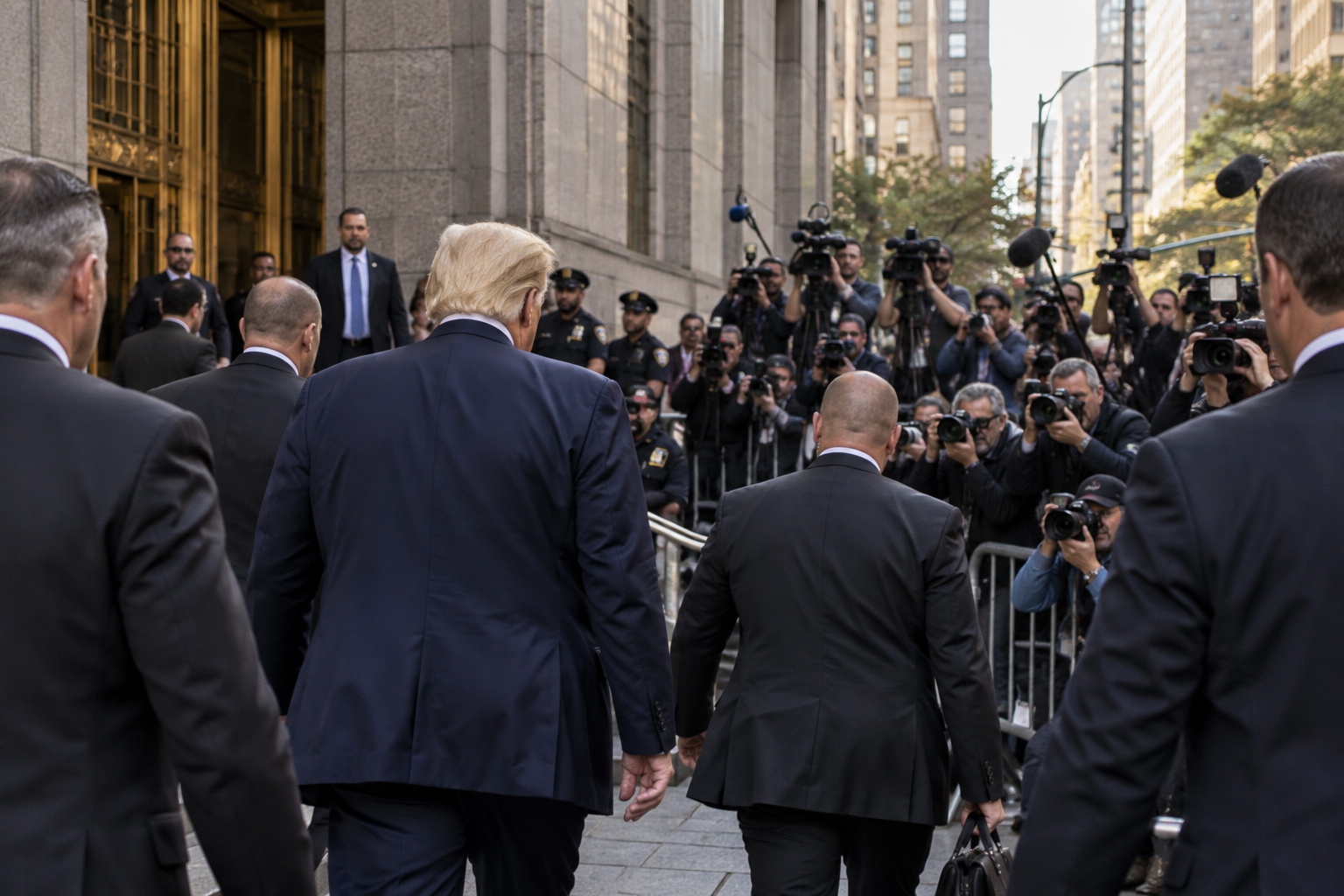
Donald Trump walked into a Manhattan courtroom Monday morning for the opening of a civil fraud trial that threatens the business empire at the center of his public identity.
The former president was not required to attend.
He came anyway.
Before entering the courtroom, Trump attacked New York Attorney General Letitia James, denounced the case as politically motivated and called the proceeding a “witch hunt.”
But Trump entered the trial having already suffered a major legal defeat.
Last week, New York Supreme Court Justice Arthur Engoron ruled that Trump and other defendants had committed persistent fraud by submitting financial statements containing false and misleading valuations of properties and other assets.
Monday's trial will determine the remaining claims against Trump and his company and what additional penalties they may face.
James is seeking $250 million and restrictions on Trump's ability to conduct business in New York.
For a businessman who spent decades presenting his wealth as evidence of his success, the stakes are enormous.
The Judge Has Already Found Fraud
The October 2 proceeding is unusual because one of the central questions in the case has already been decided.
Engoron ruled on September 26 that Trump and other defendants were liable for persistent fraud.
The judge found repeated instances in which Trump's statements of financial condition contained valuations that did not accurately reflect the properties they described.
The ruling came in response to a lawsuit filed by James after a years-long investigation into the Trump Organization's business practices.
Her office alleges that Trump and company executives repeatedly inflated the value of assets in financial statements used in dealings with banks and insurers.
The attorney general argues that the inflated numbers helped Trump obtain favorable financial terms.
Trump denies the allegations and maintains that his financial statements accurately represented the enormous value of his properties.
From Trump Tower to Mar-a-Lago
The case examines some of the best-known properties associated with Trump's business empire.
Among them are Trump Tower in Manhattan and Trump's Mar-a-Lago estate in Palm Beach, Florida.
One frequently cited example involves Trump's own Trump Tower triplex.
Financial statements listed the apartment as approximately 30,000 square feet.
Its actual size is roughly 10,996 square feet.
The larger square footage dramatically increased the reported value of the property.
Engoron highlighted the discrepancy in his ruling.
The case also involves disputes over valuations assigned to Mar-a-Lago and other real estate holdings.
Trump and his attorneys argue that real estate valuation is subjective and that premium properties associated with the Trump name can command extraordinary values.
The attorney general's office argues that the case isn't merely about reasonable differences of opinion between appraisers.
It alleges repeated misrepresentations of underlying facts.
Trump Says There Were No Victims
Speaking before entering court Monday morning, Trump argued that the transactions harmed no one.
“Everything was perfect,” Trump said.
“There was no crime.”
His attorneys are expected to emphasize that banks and other institutions involved in Trump's transactions were sophisticated financial organizations capable of conducting their own evaluations.
They also argue that lenders were repaid and that Trump's financial statements contained disclaimers instructing recipients to perform their own analysis.
Trump attorney Christopher Kise told the court that there was no single correct method for valuing many real estate assets and argued that the valuations reflected legitimate business judgments rather than fraud.
“There was no nefarious intent,” Kise argued.
That defense will be central to the trial.
New York Says Trump Profited From False Numbers
The attorney general's office presented a very different picture Monday.
Kevin Wallace, an attorney representing James' office, told the court that the evidence would show the defendants intentionally falsified financial information.
State lawyers argue that the inflated valuations allowed Trump to receive better terms from banks and insurers than he otherwise might have obtained.
The state alleges that those financial advantages were substantial.
James has accused Trump of repeatedly exaggerating his wealth and using those exaggerated numbers as a business tool.
“For years, Donald Trump falsely inflated his net worth to enrich himself and cheat the system,” James said as the trial began.
Trump vehemently disputes that characterization.
Trump Attends in Person
Trump's decision to attend immediately transformed the opening of the trial into a major media event.
Television cameras surrounded the courthouse.
Reporters packed the hallways.
Trump spoke to journalists before entering the courtroom and again during breaks.
Inside, he sat at the defense table with his attorneys.
At various points during the state's opening argument, Trump crossed his arms, shook his head and quietly spoke with members of his legal team.
The proceeding is a bench trial.
There is no jury.
Engoron will decide the remaining issues himself.
That places Trump in the unusual position of publicly attacking the same judge who will determine important aspects of the case against him.
A Business Empire Under Scrutiny
The lawsuit strikes directly at the mythology surrounding Trump's business career.
Long before entering politics, Trump built his public identity around wealth.
Trump Tower, luxury hotels, golf courses, casinos and other properties became part of a carefully cultivated image of extraordinary business success.
That image eventually helped transform Trump from a New York real estate developer into a television celebrity and then a presidential candidate.
Now a New York courtroom is examining the financial statements behind that empire.
James' office alleges that Trump's reported net worth wasn't simply promotional exaggeration.
The state argues that inaccurate valuations were repeatedly incorporated into financial documents used in actual business transactions.
Trump's attorneys say the state is attempting to criminalize ordinary disagreements about real estate valuation in a civil case where lenders made money and loans were repaid.
The Stakes Go Beyond $250 Million
James is seeking approximately $250 million in financial penalties.
But money isn't the only issue.
The attorney general is also seeking restrictions on Trump and other defendants conducting business in New York.
Engoron's September 26 ruling has already ordered the cancellation of certain business certificates associated with Trump entities and called for the appointment of receivers to oversee the process.
Exactly how broadly that ruling will affect Trump's New York businesses remains a major question as the case proceeds.
Trump's attorneys are fighting the decision.
For Trump, the case therefore threatens something potentially more consequential than another large legal bill.
It threatens his ability to maintain control over portions of the business organization that bears his name.
Politics Follows Trump Into the Courthouse
The proceeding is taking place against an extraordinary political backdrop.
Trump is simultaneously fighting multiple legal cases while campaigning to return to the White House in 2024.
He has consistently portrayed the investigations and prosecutions against him as politically motivated attempts to interfere with the presidential election.
James, a Democrat, campaigned for attorney general while criticizing Trump and promising to investigate his business practices.
Trump repeatedly cites those statements as evidence that the case is politically motivated.
James rejects that characterization and says the lawsuit is based on years of evidence collected during her office's investigation.
Those competing narratives were on display outside the courthouse Monday.
Trump portrayed himself as the victim of a political prosecution.
James portrayed the case as a straightforward matter of enforcing New York law.
Inside the courtroom, however, the arguments will ultimately revolve around financial statements, property valuations, accounting records and the intentions of the people who prepared and approved them.
The Trial Begins
The first witness called Monday was Donald Bender, a longtime accountant who worked on financial statements for Trump and the Trump Organization.
His testimony began what is expected to be a lengthy examination of the documents underlying Trump's reported wealth.
Accountants, bankers, appraisers, company executives and other witnesses are expected to play important roles as the case unfolds.
Trump's attorneys will attempt to demonstrate that the valuations reflected legitimate estimates, that financial institutions conducted their own evaluations and that no fraudulent scheme existed.
James' attorneys will attempt to prove that the financial statements were intentionally manipulated to benefit Trump and his businesses.
But one major question has already been answered.
Before Donald Trump walked into the courthouse on October 2, Judge Arthur Engoron had already ruled that persistent fraud occurred.
Now the courtroom battle turns to the remaining allegations — and to what consequences Donald Trump and his business empire may face.