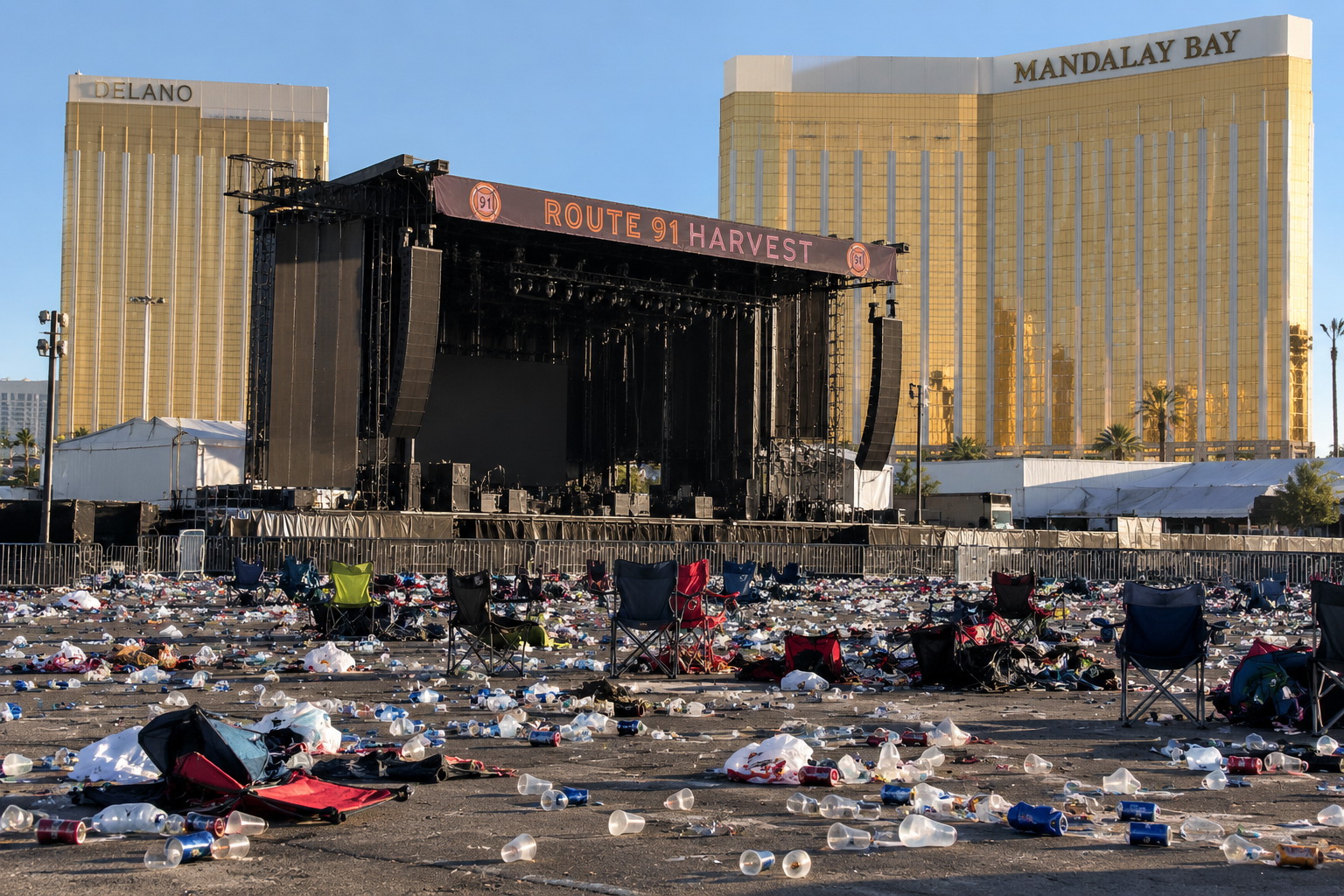
Three days after a gunman opened fire on thousands of people attending the Route 91 Harvest music festival in Las Vegas, President Donald Trump arrived in Nevada to meet survivors, doctors, police officers and first responders.
The October 1 massacre killed 58 people in the immediate aftermath, with the death toll later rising as additional victims died from their injuries, and wounded hundreds more.
Trump's October 4 visit focused heavily on the extraordinary response to the shooting.
At University Medical Center, Trump met patients who had survived the attack and praised the doctors and nurses who treated the enormous influx of casualties. He also met police officers and other first responders, repeatedly emphasizing their bravery and professionalism.
But when Trump was confronted with a question about the larger issue behind the tragedy—gun violence in America—he declined to discuss it.
"We're Not Going to Talk About That Today"
After visiting wounded survivors at University Medical Center, a reporter asked Trump whether America had a gun-violence problem.
Trump responded:
> "Well, we're not going to talk about that today. We won't talk about that."
It was a revealing moment in a visit otherwise filled with praise for the people who responded after the bullets began flying.
The president spoke extensively about the courage of police officers, doctors, nurses, ambulance crews, taxi drivers and ordinary citizens. He praised people who risked their own lives to save strangers.
What he did not offer that day was a proposal for preventing another gunman from carrying out a similar massacre.
The day before his Las Vegas visit, Trump had said that the administration would discuss gun laws "as time goes by." But made no further committment about gun control.
A Massacre That Raised Immediate Questions About Gun Laws
The Las Vegas attack inevitably intensified the national debate over firearms.
The gunman fired from the 32nd floor of the Mandalay Bay hotel into the enormous outdoor concert crowd below. Investigators discovered an arsenal in his hotel suite, including rifles equipped with bump stocks.
Those devices allowed semiautomatic rifles to fire much more rapidly than they otherwise could.
The shooting therefore presented Washington with an immediate policy question: whether the federal government should restrict or prohibit the devices and whether broader changes to federal gun laws should follow.
Trump chose not to engage that debate during his October 4 visit.
Trump Would Eventually Act on Bump Stocks
It would be inaccurate, however, to say that Trump never took any action connected to the weapons used in Las Vegas.
Several months later, Trump directed the Justice Department to pursue a federal prohibition on bump stocks.
In February 2018, Trump issued a presidential memorandum directing the attorney general to move forward with a regulation banning devices that effectively allow legal weapons to function like machine guns.
The Justice Department ultimately issued a final rule banning bump stocks in December 2018.
It was one concrete gun restriction enacted by the Trump administration, and the administration explicitly connected the decision to the Las Vegas massacre.
But it was a narrowly targeted response rather than a broader overhaul of America's gun laws.
The Larger Gun Debate Continued
The Las Vegas massacre became another moment in America's long-running political battle over guns.
Supporters of stronger gun laws argued that mass shootings demonstrated the need for measures such as expanded background checks and restrictions on certain weapons and accessories. Gun-rights advocates countered that additional restrictions could burden lawful gun owners without necessarily stopping determined attackers.
Trump generally aligned himself politically with gun-rights advocates, even as his administration pursued the bump-stock prohibition.
And on October 4, 2017, none of those policy arguments were part of the president's public message in Las Vegas.
His focus remained on mourning the dead, comforting survivors and praising those who had responded to the massacre.
Standing inside the hospital where victims of one of the worst mass shootings in American history were still recovering, Trump was given an opportunity to address whether the United States had a gun-violence problem.
His answer was simple:
"We're not going to talk about that today."