Thirteen days after Hurricane Maria tore across Puerto Rico, President Donald Trump arrived on the island to see the devastation firsthand.
Much of Puerto Rico was still without electricity. Communications remained severely disrupted. Communities were struggling with shortages of fuel, food and clean water. Roads remained damaged or blocked, and the destruction of the electrical grid had created a crisis that would take months to resolve.
Trump's October 3 visit was an opportunity for the president to demonstrate the federal government's commitment to the roughly 3.4 million American citizens living on the island.
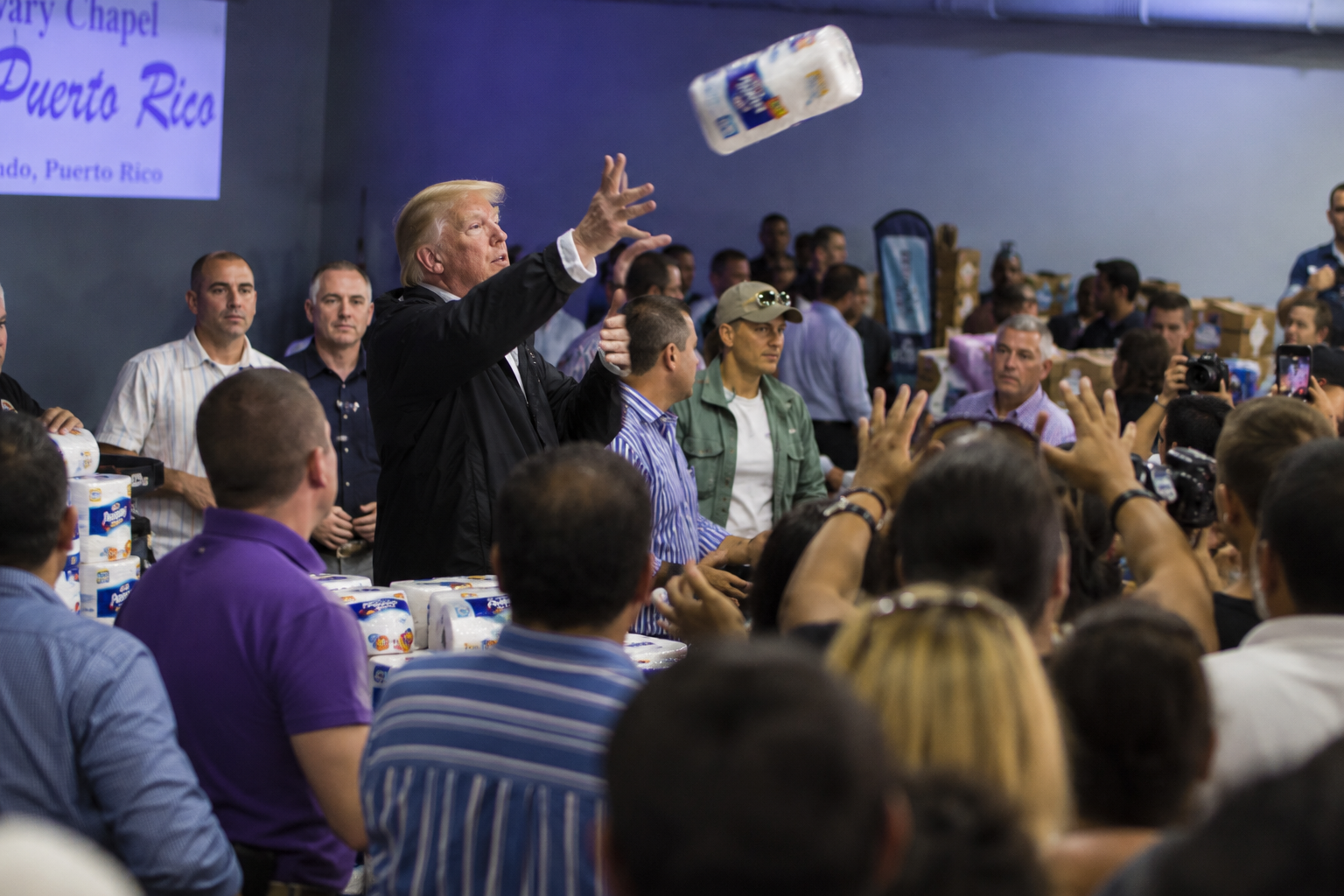
Instead, the trip produced several moments that would become enduring parts of the story of Hurricane Maria — particularly Trump's comparison of the disaster's death toll with Hurricane Katrina, his comments about Puerto Rico's effect on the federal budget and images of the president tossing rolls of paper towels into a crowd at a relief center.
The paper towels themselves were a small part of a much larger visit.
But the images would prove impossible to forget.
Trump Arrives in Puerto Rico
Trump and First Lady Melania Trump traveled to Puerto Rico on October 3, landing at Muñiz Air National Guard Base outside San Juan.
The president met with Governor Ricardo Rosselló, federal emergency officials, military personnel, local officials and residents affected by the storm.
Trump repeatedly praised federal personnel and described the government's response as successful.
The administration had mobilized FEMA, the military and other federal agencies while delivering food, water, generators and other supplies to the island.
But nearly two weeks after Maria, conditions remained extraordinarily difficult.
The electrical system had been devastated, telecommunications were crippled and the geography of the island complicated the distribution of relief supplies.
Criticism of the federal response was also growing.
San Juan Mayor Carmen Yulín Cruz had publicly pleaded for additional assistance and warned that people were dying while waiting for help.
Trump had responded before his visit by criticizing Cruz and other Puerto Rican officials on Twitter, accusing them of poor leadership and saying they wanted everything done for them rather than helping themselves.
The political fight surrounding the disaster had already begun before Air Force One landed.
“You've Thrown Our Budget a Little Out of Whack”
During a briefing with Puerto Rican and federal officials, Trump praised the emergency response.
Then he made a remark that immediately attracted attention.
“I hate to tell you, Puerto Rico, but you've thrown our budget a little out of whack,” Trump said.
He added that the federal government had spent considerable money responding to the disaster but said that was acceptable because American lives had been saved.
The comment came as Puerto Rico faced catastrophic infrastructure damage and an enormous long-term reconstruction effort.
Trump had previously raised the island's financial problems as part of the discussion surrounding recovery. Puerto Rico was already burdened by roughly $70 billion in public debt and had entered a bankruptcy-like restructuring process months before Maria.
The administration argued that the island's preexisting financial and infrastructure problems made recovery substantially more difficult.
Trump Compares Maria With Katrina
Another moment from the briefing would become even more controversial.
Trump compared Maria's death toll with Hurricane Katrina, which devastated New Orleans and other parts of the Gulf Coast in 2005.
“Every death is a horror,” Trump said.
But he suggested that Puerto Rico should be proud that the number of deaths then officially attributed to Maria was far smaller than Katrina's toll.
At the time, Puerto Rican officials were reporting 16 deaths.
That number was nowhere close to the hurricane's eventual human cost.
The problem was that the full scale of Maria's mortality could not possibly have been known less than two weeks after the storm.
Many deaths associated with Maria occurred indirectly as prolonged power failures and disruption to medical care affected hospitals, nursing homes and people dependent upon electrically powered medical equipment.
Puerto Rico would eventually adopt an official estimate of 2,975 excess deaths associated with the period following Hurricane Maria.
Trump's comparison therefore aged particularly poorly as the scale of the disaster became clearer.
The Paper Towels
Later that day, Trump visited Calvary Chapel in Guaynabo, where relief supplies were being distributed.
The president stood behind a table containing emergency supplies as residents gathered in front of him.
Trump began handing out items.
At one point, he picked up rolls of paper towels and tossed them into the crowd.
Television cameras captured the scene.
The images quickly spread across television news and social media.
There was nothing inherently unusual about a president helping distribute supplies during a disaster visit. Presidents frequently visit relief centers and meet residents following hurricanes, floods, wildfires and other emergencies.
What made the moment memorable was the visual.
Puerto Rico was experiencing a massive humanitarian and infrastructure crisis.
Its electrical grid had collapsed.
Communities remained isolated.
Residents were struggling to obtain necessities.
And television viewers saw the president casually tossing paper towels into a crowd.
For critics of the administration's response, the image became a symbol of what they considered Trump's failure to grasp the seriousness of Puerto Rico's suffering.
Trump and his defenders rejected that interpretation, arguing that residents at the relief center had been enthusiastic and that a brief moment distributing supplies was being presented without the broader context of the visit.
But the symbolism had already taken hold.
A Growing Fight With San Juan's Mayor
The visit also occurred amid Trump's increasingly personal dispute with San Juan Mayor Carmen Yulín Cruz.
Days earlier, Cruz had appeared on television asking for dramatically greater federal assistance.
“We are dying here,” she said during one emotional appeal.
Trump responded on Twitter by criticizing her leadership and saying Puerto Rican officials needed to do more themselves.
When Trump and Cruz met during the October 3 visit, the encounter was brief.
The disagreement highlighted a broader dispute over the federal response.
The Trump administration emphasized the enormous logistical operation underway, including thousands of federal personnel and military resources.
Puerto Rican officials and residents pointed to communities that remained without adequate food, drinking water, medical assistance, communications and electricity.
Both facts could exist simultaneously.
The federal government was conducting a massive response.
And enormous needs remained unmet.
A Disaster Unlike Texas or Florida
Maria also presented logistical problems that differed significantly from the hurricanes that had recently struck Texas and Florida.
Puerto Rico is an island approximately 1,000 miles from the continental United States.
Relief supplies could not simply be driven into the disaster zone from neighboring states.
Ports and airports became critical.
Damaged roads complicated distribution once supplies arrived.
The destruction of communications infrastructure made coordinating deliveries more difficult.
And unlike disasters that damaged portions of Texas or Florida while leaving surrounding regions functioning, Maria affected virtually all of Puerto Rico simultaneously.
The people who would normally help respond to a disaster were themselves victims of it.
Police officers, municipal employees, utility workers and emergency personnel had damaged or destroyed homes and families requiring assistance.
The federal government acknowledged many of those difficulties during briefings about the response.
The Image That Survived
Trump's October 3 trip included meetings with officials, briefings on recovery operations, conversations with hurricane victims and praise for first responders.
Yet history often reduces complicated events to a handful of images.
For George W. Bush after Hurricane Katrina, one of those images was the president viewing the devastation from Air Force One.
For Donald Trump after Hurricane Maria, it became a roll of paper towels flying through the air.
The image did not explain the entire federal response.
It did not measure how many supplies FEMA delivered.
It did not show military operations or electrical crews rebuilding the grid.
Nor did it, by itself, establish whether the federal response was adequate.
But politically, none of that prevented the moment from becoming symbolic.
Puerto Rico's Crisis Was Far From Over
When Trump departed Puerto Rico on October 3, the island remained deep in crisis.
Most customers still lacked electricity.
The electrical grid would take months to restore, with some remote customers remaining without service well into 2018.
Questions about the death toll would continue.
Congress would appropriate billions of dollars for disaster recovery.
Investigations and