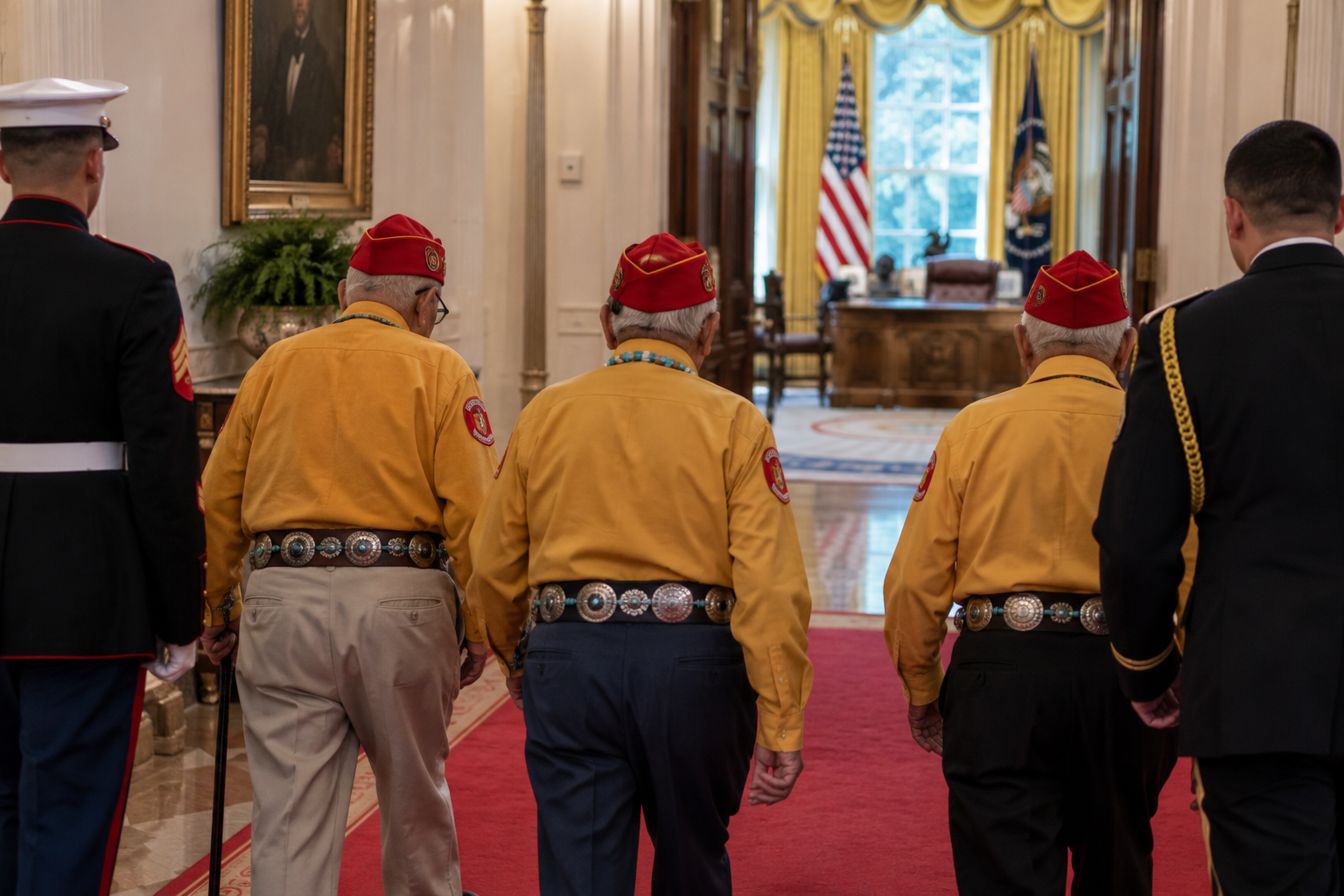
The ceremony was supposed to be about three elderly Marines and the extraordinary contribution they and other Navajo Code Talkers had made during World War II.
Instead, President Donald Trump inserted one of his favorite political attacks.
On November 27, 2017, Trump welcomed surviving Navajo Code Talkers to the White House to honor the Native American Marines whose language had helped create a military communications code the Japanese never broke.
Standing only feet from the veterans, Trump began thanking them for their service.
Then he brought up Democratic Sen. Elizabeth Warren.
“You were here long before any of us were here,” Trump told the Code Talkers. “Although we have a representative in Congress who, they say, was here a long time ago. They call her ‘Pocahontas.’”
Trump had repeatedly used “Pocahontas” to mock Warren over her claims of Native American ancestry.
This time, however, he wasn't speaking at a campaign rally.
He was standing beside Native American veterans who had been invited to the White House specifically to honor their service to the United States.
The reaction was immediate.
Native American organizations criticized Trump's remark and argued that the political insult had overshadowed the very men the ceremony was supposed to celebrate.
The White House denied that Trump intended to use a racial slur.
The Navajo Code Talkers
The men standing beside Trump represented one of the most remarkable chapters in Marine Corps history.
During World War II, the United States needed a method of transmitting battlefield communications that Japanese forces could not decipher.
The Marine Corps found part of the solution in the Navajo language.
Beginning in 1942, Navajo Marines developed a sophisticated communications system based on their language.
It was more complicated than simply speaking Navajo over a radio.
The Code Talkers developed special Navajo terms for military words and equipment that did not have direct equivalents in the language.
Different Navajo words represented letters of the English alphabet.
Military terminology was transformed into coded Navajo expressions.
The resulting system allowed Marines to rapidly transmit sensitive battlefield information without relying on conventional encryption methods that could take considerably longer.
The code was used throughout the Pacific.
Navajo Code Talkers served during some of the Marine Corps' most important battles, including Guadalcanal, Bougainville, Saipan, Guam, Peleliu and Iwo Jima.
Their work remained classified after the war, preventing many of them from publicly discussing what they had done.
Decades later, their contribution finally received broad national recognition.
Three Veterans Come to the White House
Three surviving Navajo Code Talkers attended the November 27 ceremony:
Peter MacDonald.
Fleming Begaye Sr.
Thomas Begay.
These were not simply ceremonial guests.
They were men with remarkable military histories.
Fleming Begaye had survived the Battle of Tarawa after his landing craft was destroyed and later served in the campaigns for Saipan and Tinian.
Thomas Begay had served as a Code Talker during the Battle of Iwo Jima with the 5th Marine Division. He later served in the U.S. Army during the Korean War.
Peter MacDonald had entered the Marine Corps as a teenager in 1944. He served with Marines on Guam and later went to North China after Japan's surrender.
MacDonald spoke during the White House ceremony about what the Code Talkers had accomplished.
He explained that Japanese forces had been successfully breaking American military codes early in the Pacific War.
The Navajo language provided a solution.
MacDonald also explained that the surviving Code Talkers still had a mission: creating a national Navajo Code Talker museum so future generations would understand their contribution.
He spoke about something larger than the code itself.
America contained people with different languages, backgrounds, talents and religions, MacDonald said, but when the country was threatened, Americans came together.
Then Trump spoke.
“They Call Her Pocahontas”
Trump initially praised the veterans.
He described them as “very, very special people.”
But almost immediately, the president pivoted to Elizabeth Warren.
Trump had been feuding with the Massachusetts senator for years.
Warren had previously said that family stories described Native American ancestry in her background, and the issue had become controversial during her political career.
Trump turned it into a recurring nickname.
“Pocahontas.”
He used it repeatedly during the 2016 campaign and continued using it after becoming president.
But using it during a ceremony honoring actual Native American veterans created a very different scene.
The Code Talkers were standing directly beside him.
Trump told them they had been in America long before others.
He then transitioned into the Warren attack.
After delivering the line, Trump returned his attention to the veterans.
“But you know what?” he said.
“I like you.”
Native American Leaders Object
The National Congress of American Indians responded the same day.
Its president, Jefferson Keel — himself a decorated Army officer and Vietnam veteran — said the organization regretted that Trump's use of Pocahontas's name as an insult was overshadowing the purpose of the ceremony.
The organization emphasized that the day should have been about the extraordinary courage and contributions of Native American Code Talkers.
It also noted that Navajo Marines represented only part of a much larger Native American contribution.
Native people from numerous tribes had served as Code Talkers during the world wars.
The organization specifically called on Trump to stop using Pocahontas's name to attack political opponents.
The Navajo Nation also objected.
A spokesman said it was unfortunate that Trump had used Pocahontas in a joking manner and argued that a Native American historical figure should not be turned into the punchline of a political joke.
Families of Code Talkers criticized the remark as well.
The concern was not simply that Trump had attacked Warren.
It was where he had chosen to do it.
The White House Defends Trump
The White House rejected accusations that Trump intended a racial insult.
Press Secretary Sarah Huckabee Sanders was asked about the controversy during the White House briefing.
She said using a racial slur was “certainly not the president's intent.”
Instead, Sanders redirected the criticism toward Warren.
The White House argued that the more offensive issue was Warren's claims about her Native American heritage.
The administration therefore treated Trump's comment as a political attack against Warren rather than an attack against Native Americans.
That explanation did little to satisfy the Native American organizations criticizing the remark.
Their objection was broader.
Regardless of Trump's intended target, they argued, using the name of a Native American historical figure as a derogatory nickname was inappropriate — particularly during a ceremony honoring Native American veterans.
The Andrew Jackson Backdrop
The setting created another controversy.
The ceremony took place in the Oval Office near a prominent portrait of President Andrew Jackson.
Jackson had signed the Indian Removal Act of 1830, the law that helped produce the forced removal of Native peoples from their ancestral lands in the southeastern United States.
The resulting removals included the Cherokee Trail of Tears.
Trump admired Jackson and had placed his portrait prominently in the Oval Office.
There is no evidence that the Code Talker ceremony was deliberately positioned near Jackson's portrait to send a message about Native Americans.
But visually, the juxtaposition was striking.
Three elderly Navajo veterans were being honored beneath the image of a president whose legacy was inseparable from one of the darkest periods of federal Indian policy.
Then the sitting president used “Pocahontas” to attack a political opponent.
For critics, the combination made an already awkward moment considerably worse.
The Political Fight Overshadows the Veterans
Elizabeth Warren responded angrily.
She said the White House event should have been about honoring American war heroes and accused Trump of turning it into another opportunity for a political attack.
But there was also a danger in the reaction.
The controversy over Trump and Warren could itself overshadow the Code Talkers.
That was precisely what Native American leaders feared.
The three men had not traveled to Washington to become background figures in another partisan argument.
They had come to represent hundreds of Native Americans whose military service had remained secret for decades.
The story deserved to be about them.
A Code the Enemy Never Broke
The effectiveness of the Navajo Code Talkers was extraordinary.
During combat, commanders needed to transmit coordinates, troop movements, requests for ammunition and other tactical information quickly.
Conventional coding systems could require messages to be encoded before transmission and decoded after reception.
Code Talkers could communicate rapidly in Navajo using the specialized system they had developed.
At Iwo Jima, Navajo Code Talkers handled hundreds of messages during the opening days of the battle.
Their work became an important component of Marine communications in the Pacific.
The Japanese never succeeded in breaking the Navajo code.
For decades after the war, however, the Code Talkers received relatively little public recognition because their work remained classified.
The program was finally declassified in 1968.
National recognition followed gradually.
In 2001, the original 29 Navajo Code Talkers received Congressional Gold Medals, while hundreds of additional Code Talkers received Congressional Silver Medals.
By the time Trump hosted the November 2017 ceremony, only 13 Navajo Code Talkers were reported to remain alive.
Three were able to attend.
A Ceremony That Should Have Been Simple
There was little political complexity required of the president that afternoon.
Three elderly veterans had come to the White House.
They had served their country during a world war.
Their language had been transformed into a battlefield communications system that America's enemy could not break.
Some had fought in places whose names were permanently embedded in Marine Corps history.
Tarawa.
Saipan.
Guam.
Iwo Jima.
They had waited decades for their service to receive the recognition it deserved.
The White House had invited them there to say thank you.
Instead, one of the most widely remembered moments from the ceremony became Donald Trump's attack on Elizabeth Warren.
The president's defenders argued that his remark was directed at a political opponent, not at the veterans standing beside him.
Native American organizations argued that using Pocahontas's name as an insult was itself disrespectful and especially inappropriate in that setting.
Either way, the result was the same.
A ceremony intended to celebrate the remarkable service of Navajo Marines became another political controversy.
The Code Talkers had spent decades waiting for Americans to hear their story.
On November 27, 2017, three of the surviving Marines stood in the Oval Office.
They deserved to be the story.