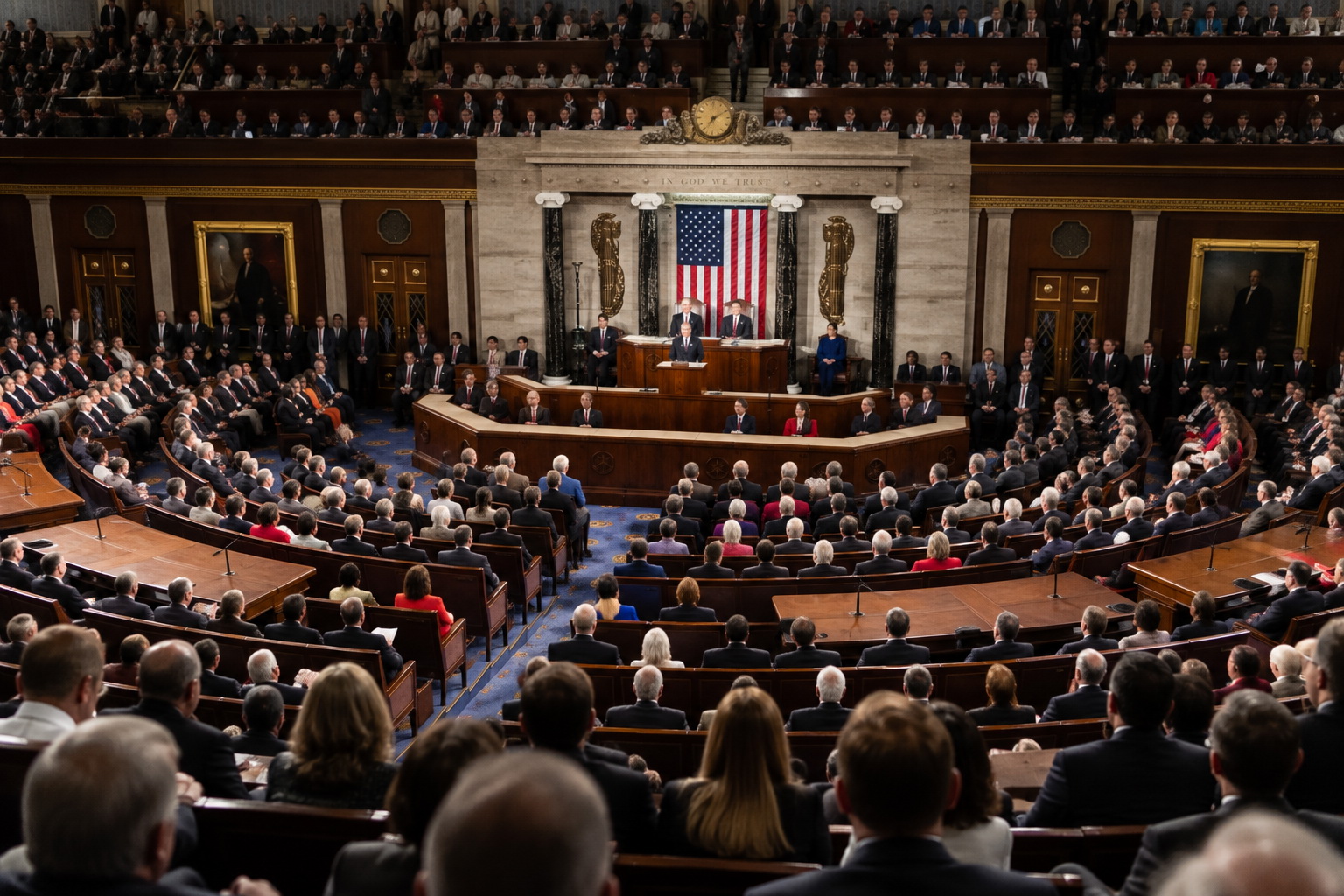
One year into his presidency, Donald Trump stood before Congress and presented his vision of what the next phase of his administration should look like.
In his first State of the Union address on January 30, 2018, Trump celebrated the tax cuts Republicans had enacted weeks earlier, demanded sweeping changes to immigration policy, called for a massive infrastructure program and promised continued investment in the U.S. military.
“The state of our union is strong because our people are strong,” Trump declared.
The speech offered one of the clearest snapshots yet of the administration's priorities after its turbulent first year.
Trump Celebrates His Tax Cuts
Trump devoted significant attention to the Tax Cuts and Jobs Act, which he had signed into law in December.
He promoted the law as relief for middle-class families and businesses, pointing to the increased standard deduction, expanded child tax credit and reduction of the corporate tax rate from 35 percent to 21 percent.
Trump also highlighted job creation, manufacturing employment and the stock market as evidence that his economic policies were working.
The tax law had become the administration's signature legislative accomplishment.
Now Trump was making it a centerpiece of his argument for the presidency's first year.
A $1.5 Trillion Infrastructure Proposal
Trump then turned toward something presidents of both parties had talked about for years: America's aging infrastructure.
He called on Congress to produce legislation capable of generating at least $1.5 trillion in infrastructure investment.
Trump proposed combining federal spending with money from state and local governments and private investment. He also called for dramatically shortening the permitting process for major projects.
“We will build gleaming new roads, bridges, highways, railways, and waterways,” Trump said.
The sweeping infrastructure program he described that night would not ultimately emerge from Congress in the form Trump envisioned.
Trump's Four-Part Immigration Plan
Immigration occupied a major portion of the address.
Only ten days earlier, the federal government had shut down amid a political confrontation that included the unresolved status of immigrants protected by DACA.
Trump now presented Congress with a four-part immigration proposal.
The first component offered a potential 12-year path to citizenship for approximately 1.8 million immigrants brought illegally to the United States as children, subject to requirements.
The second called for increased border security, including Trump's promised wall along the southern border.
The third would end the diversity visa lottery and move toward a more merit-based immigration system.
The fourth would restrict family-based immigration, which Trump routinely referred to as “chain migration.”
Trump described the package as a compromise.
But the proposal combined protection for Dreamers with several immigration restrictions Democrats strongly opposed, and Congress would remain deeply divided over the issue.
Military Strength and “America First”
Trump also emphasized rebuilding the American military and confronting international threats.
He discussed North Korea extensively, using the presence of North Korean defector Ji Seong-ho in the House chamber to highlight the brutality of Kim Jong Un's government.
Trump also criticized Iran and reiterated his administration's determination to confront terrorism.
The speech reflected the broader “America First” philosophy Trump had just carried to the World Economic Forum in Davos.
At home, that meant lower taxes, deregulation, tougher immigration enforcement and protection of American industries.
Abroad, Trump described an America willing to trade and cooperate while demanding what he considered greater reciprocity from other countries.
The Agenda After Year One
Trump's first year had been extraordinarily turbulent.
His administration had endured the firing of FBI Director James Comey, the appointment of Special Counsel Robert Mueller, repeated personnel changes, battles over immigration and health care, international confrontations and a government shutdown that had ended only eight days before the State of the Union.
Yet Trump's speech was designed to present a different picture.
He emphasized economic growth, patriotism, military strength and American opportunity.
“Tonight, I want to talk about what kind of future we are going to have, and what kind of nation we are going to be,” Trump said.
The address therefore serves as more than another presidential speech in the chronology of the Trump years.
It was a blueprint.
Tax cuts had already been achieved.
Trump now wanted an immigration overhaul, a border wall, infrastructure investment, tougher trade enforcement and a stronger military.
Some of those ambitions would stall in Congress.
Others would increasingly be pursued through executive power.
And several — particularly immigration and trade — would become defining battles of the Trump presidency.
On January 30, 2018, Trump stood before Congress and told the country where he intended to go next.