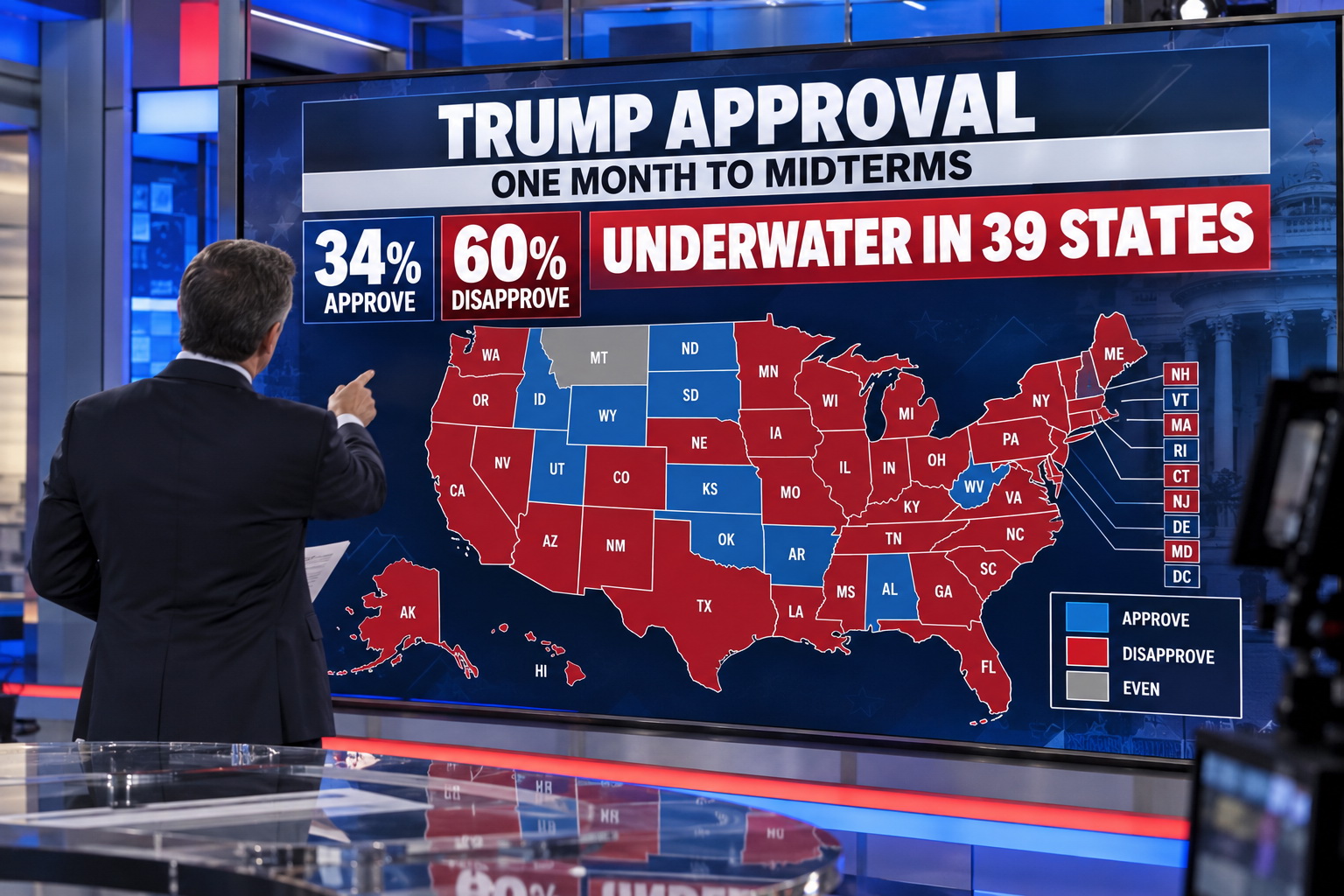
With just one month remaining before the 2026 midterm elections, President Donald Trump's approval ratings have deteriorated across virtually the entire country, leaving him underwater in 39 states and every major battleground state, according to new state-by-state polling.
The numbers come from Civiqs' rolling online tracking poll, which includes more than 133,000 registered-voter responses collected between Trump's inauguration on January 20, 2025, and October 2, 2026.
Nationally, the picture is stark.
34% approve of Trump's job performance.
60% disapprove.
That gives the president a net approval rating of -26 points.
But the national number may not be the most consequential finding.
The state-by-state numbers show how dramatically Trump's political standing has changed since he returned to the White House.
Trump Is Underwater in 39 States
Only 10 states currently give Trump a positive net approval rating.
One more—Montana—is evenly divided.
Everywhere else, more voters disapprove of Trump's performance than approve.
Trump's strongest remaining state is Wyoming, where he has a net approval rating of +18.
That is followed by:
North Dakota: +15
West Virginia: +12
Arkansas: +9
Idaho: +8
Alabama: +6
South Dakota: +5
Oklahoma: +4
Kansas: +3
Utah: +2
Montana sits at exactly even, with 46% approving and 46% disapproving.
Even those numbers contain a warning for the president.
When Trump began his second term, his net approval rating in Wyoming was +47.
It is now +18.
North Dakota has fallen from +34 to +15.
West Virginia has dropped from +35 to +12.
Trump remains popular in those states—but substantially less popular than he was when he returned to office.
Every Major Battleground State Is Negative
The numbers become more significant when looking at the states where competitive elections are likely to matter most.
Trump is underwater in every major battleground examined by the tracker:
Georgia: -25
Michigan: -24
Nevada: -24
Pennsylvania: -22
Arizona: -18
Wisconsin: -18
Ohio: -17
Florida: -16
North Carolina: -15
Several of those states looked dramatically different when Trump began his second term.
Florida started at +9.
It is now -16.
Ohio began at +8.
It is now -17.
Nevada went from an even rating to -24.
North Carolina went from even to -15.
Those are substantial movements in states where relatively small changes in the electorate can matter in close congressional and statewide contests.
Texas Has Moved 27 Points Against Trump
One of the most striking changes is in Texas.
Trump began his second term with a +6 net approval rating there.
He is now at -21.
That's a 27-point deterioration.
The Texas number is particularly notable because Republicans are simultaneously confronting an unexpectedly competitive U.S. Senate contest.
A recent Fox News poll showed Democrat James Talarico leading Republican Ken Paxton 51%-49% among likely voters, although that two-point difference was within the poll's margin of error.
The Civiqs numbers don't establish that Trump's declining approval caused the Senate race to tighten.
Candidate quality, campaign spending, turnout and local political conditions all matter.
But a president sitting 21 points underwater in Texas creates a very different political environment from the one Republicans might have expected after Trump's comfortable victory there in 2024.
Kentucky Has Seen the Biggest Collapse
The largest movement anywhere in the country has occurred in Kentucky.
When Trump's second term began:
+23
Today:
-10
That's a 33-point decline.
Other traditionally Republican states have experienced similarly large shifts.
Wyoming has fallen 29 points.
Oklahoma has fallen 27.
Tennessee has fallen 27.
Texas has fallen 27.
Idaho has fallen 26.
Alaska, Ohio, Florida and Montana have each fallen 25.
Nevada has fallen 24.
This isn't simply a story about Democratic states disapproving of a Republican president.
Some of the largest declines have occurred in states Trump won comfortably.
Independents Have Moved Sharply Against Trump
The demographic breakdown provides another potentially important warning.
Among independent voters:
27% approve.
65% disapprove.
Republicans remain substantially more supportive of the president, with 78% approving and 12% disapproving.
But Trump's difficulties outside his Republican base are considerable.
The numbers are particularly poor among younger voters.
Among voters ages 18 to 34:
20% approve.
73% disapprove.
Among voters ages 35 to 49:
26% approve.
66% disapprove.
Trump performs better among older voters, although he remains underwater there as well.
Among voters ages 50 to 64, 44% approve and 51% disapprove.
Among voters 65 and older, 44% approve and 52% disapprove.
Women Give Trump Especially Poor Marks
The gender gap is also substantial.
Among women:
29% approve.
65% disapprove.
Among men:
39% approve.
54% disapprove.
Trump therefore remains underwater with both groups, although considerably more so among women.
The education divide also remains visible.
Approval stands at 24% among voters with postgraduate education, 32% among college graduates and 37% among voters without a college degree.
In all three groups, however, more voters disapprove than approve.
Trump's National Numbers Are Weak Across Multiple Polls
Civiqs isn't the only pollster finding significant dissatisfaction with Trump's presidency.
A late-September Quinnipiac University poll found Trump at 34% approval and 61% disapproval among registered voters.
Reuters/Ipsos measured his approval at 32% in September after finding 33% in August.
CNN polling put Trump's approval at 33%.
Emerson College found 39%.
Harvard CAPS/Harris produced a somewhat stronger 42%.
Different polling organizations use different methodologies, populations and weighting methods, so their precise numbers shouldn't be treated as interchangeable.
But the broader pattern is consistent:
Trump's job approval is substantially underwater nationally as the midterm elections approach.
The Economy May Be the Bigger Problem
The president's difficulties appear particularly pronounced when Americans are asked about the economy.
An AP-NORC poll released this week found just 26% approving of Trump's handling of the economy.
His rating on the cost of living was even lower.
Only 17% approved of his handling of living costs.
And 65% said Trump deserved at least some blame for persistently high prices.
Those numbers matter because voters don't experience presidential approval as an abstract political statistic.
They experience it through grocery bills, gasoline and diesel prices, electricity bills, housing costs and employment.
And economic dissatisfaction is arriving at precisely the moment Republicans need voters to decide whether they want the party to retain control of Congress.
The White House Points to 2024
The Trump White House has repeatedly pushed back against unfavorable polling.
White House spokesman Davis Ingle has argued that the most important measure of Trump's support was the 2024 presidential election, when voters returned him to office.
"The ultimate poll was November 5th 2024," Ingle said.
The administration says Trump received a mandate to implement his agenda and maintains that its economic policies are producing progress on jobs, inflation and housing affordability.
There is an important distinction, however.
The 2024 election measured what voters thought in November 2024.
These polls measure what voters say in the fall of 2026.
And those numbers have changed considerably.
This Isn't an Election Prediction
There is one major caution when interpreting the map.
Presidential approval ratings do not tell us who will win individual congressional races.
Voters can disapprove of a president while still voting for candidates from his party.
Candidate quality matters.
Campaign spending matters.
Turnout matters.
Individual House districts can also behave very differently from statewide electorates.
And Civiqs' figures come from a rolling online tracking model rather than 50 independent statewide polls conducted simultaneously.
The numbers therefore shouldn't be interpreted as predicting a Democratic victory—or a Republican defeat—in November.
What they measure is the political environment in which those elections are occurring.
And that environment looks dramatically different from the one Trump entered after winning the presidency in 2024.
A Very Different Map
Trump began his second presidency with positive approval ratings across much of Republican America and competitive numbers in several battleground states.
Twenty months later, the map has changed.
He is underwater in 39 states.
He is underwater in every major battleground state.
His rating has declined in every state in the country compared with the beginning of his second term.
Texas has moved 27 points against him.
Kentucky has moved 33.
Florida and Ohio have moved 25.
And nationally, roughly six in ten registered voters in the Civiqs tracker now disapprove of his performance.
That doesn't tell us who will control Congress after November 3.
But with one month remaining before Americans vote, it tells us something significant about the environment Republicans will face:
Donald Trump may still command the loyalty of much of the Republican base, but the electorate surrounding that base has become substantially less supportive of his presidency.