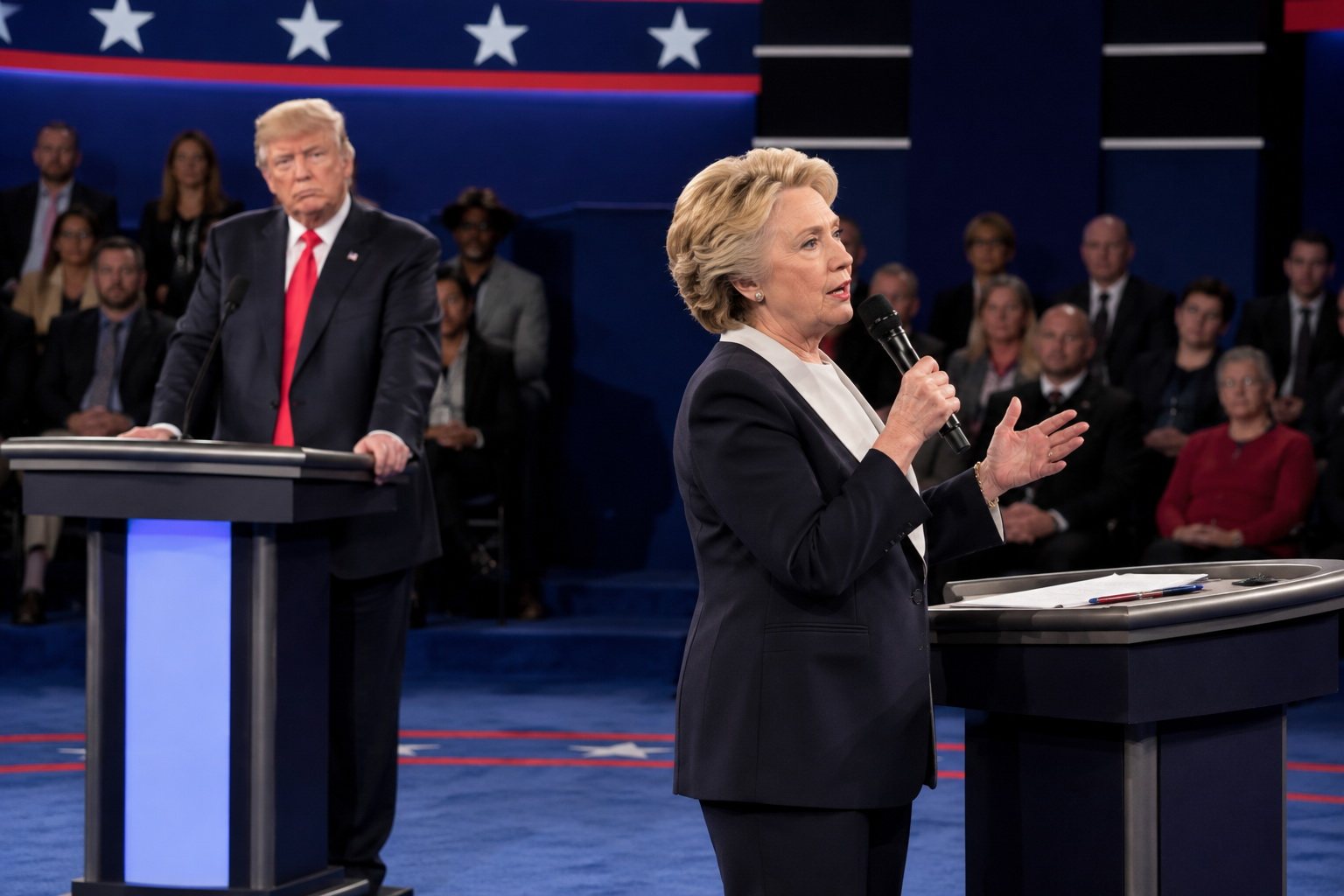
Two days after Americans heard Donald Trump brag on a hot microphone about kissing and grabbing women without their consent, the Republican presidential nominee walked onto one of the biggest stages in American politics.
He wasn't withdrawing from the race.
He wasn't disappearing from public view.
Instead, Trump arrived at the second presidential debate prepared to fight.
Before the debate even began, Trump appeared publicly with women who had accused former President Bill Clinton of sexual misconduct and other wrongdoing. Once onstage with Hillary Clinton, Trump repeatedly dismissed his own recorded remarks as “locker room talk,” attacked Bill Clinton's conduct, accused Hillary Clinton of wrongdoing and declared that if he became president, he would appoint a special prosecutor to investigate her.
Then came one of the most memorable exchanges of the entire 2016 campaign.
Clinton said it was fortunate that someone with Trump's temperament wasn't responsible for enforcing American law.
Trump responded:
“Because you'd be in jail.”
The audience applauded.
It was an extraordinary moment in a presidential debate: a major-party nominee telling his opponent that if he controlled the federal government, she could end up behind bars.
The Access Hollywood Tape Had Exploded 48 Hours Earlier
Trump entered the debate facing a crisis unlike anything his campaign had previously experienced.
On October 7, The Washington Post published a 2005 recording made while Trump was preparing for an appearance on Access Hollywood.
In the recording, Trump spoke crudely about women and described kissing women without waiting for consent and grabbing them sexually.
The recording immediately created a political firestorm.
Republican officials condemned the comments.
Some withdrew their endorsements.
Others called on Trump to leave the presidential race entirely.
Trump refused.
He released an apology video but quickly attempted to redirect attention toward Bill and Hillary Clinton.
By October 9, that strategy was unmistakable.
Trump Appears With Bill Clinton's Accusers
Shortly before the debate, Trump held a surprise appearance with Paula Jones, Juanita Broaddrick and Kathleen Willey, women who had accused Bill Clinton of sexual misconduct. Trump also appeared with Kathy Shelton, whose alleged rapist Hillary Clinton had represented as a court-appointed defense attorney decades earlier.
The allegations involving Bill Clinton varied substantially, and Clinton denied some of the most serious accusations against him.
But the political purpose of Trump's appearance was clear.
Trump was entering a debate where he knew he would be questioned about his own comments concerning women.
His campaign responded by putting Bill Clinton's accusers directly into the national spotlight.
The women were then seated in the debate audience.
It transformed what was supposed to be a presidential town hall into something considerably more personal.
The Debate Immediately Turns to Trump's Comments About Women
The moderators didn't wait long.
CNN's Anderson Cooper confronted Trump about what Americans had heard on the recording.
Trump denied that he had actually committed the conduct he described and repeatedly characterized his remarks as:
“Locker room talk.”
He said he was embarrassed by the recording and apologized for his words.
But Trump quickly changed subjects.
Within moments he was discussing ISIS.
Then he turned toward Bill Clinton.
Trump argued that his comments had merely been words while Clinton's alleged behavior involved actions.
He pointed toward the women attending the debate and attacked Hillary Clinton's treatment of her husband's accusers.
The debate had barely begun, and the presidential campaign had already descended into accusations of sexual misconduct involving both candidates' families and histories.
Then Trump Threatens a Special Prosecutor
The confrontation soon moved from personal attacks to the power of the presidency itself.
Trump returned to Hillary Clinton's use of a private email server while secretary of state.
The FBI had investigated Clinton's handling of classified information. FBI Director James Comey had described her handling of sensitive information as “extremely careless,” but federal prosecutors did not charge her.
Trump told Clinton that if he became president, he would instruct his attorney general to appoint a special prosecutor to investigate her.
The statement was remarkable because Trump wasn't simply criticizing his opponent's conduct.
He was explicitly saying that after taking control of the executive branch, he intended to use the Justice Department to investigate the woman running against him.
Clinton responded that it was fortunate Trump wasn't in charge of American law.
Trump shot back:
“Because you'd be in jail.”
It instantly became one of the defining lines of the election.
“Lock Her Up” Moves Onto the Presidential Debate Stage
Trump's comment didn't appear from nowhere.
“Lock her up” had already become a recurring chant at Trump rallies and at the Republican National Convention.
Crowds of Trump supporters regularly demanded Clinton's imprisonment.
But the October 9 debate brought that rhetoric directly onto the presidential debate stage.
The Republican nominee himself was now telling the Democratic nominee that she would be jailed if he controlled the government.
It illustrated how dramatically political rhetoric had changed during the 2016 campaign.
Disagreement over policies had become something much more personal.
The opponent wasn't merely wrong.
The opponent was someone supporters demanded be imprisoned.
That style of politics would become an enduring feature of the movement that eventually became known as MAGA.
The Debate Becomes Intensely Personal
The hostility continued throughout the evening.
Trump repeatedly interrupted Clinton and argued with moderators Martha Raddatz and Anderson Cooper.
He accused the moderators of treating him unfairly.
At one point, after complaining about interruptions and questions, Trump described the situation as:
“One on three.”
Clinton accused Trump of attempting to divert attention from his campaign's crisis.
Trump attacked Clinton's record as secretary of state, her emails, her judgment and her honesty.
The candidates disagreed over health care, immigration, Syria, Russia, Supreme Court appointments, taxes and foreign policy.
But those traditional policy discussions were repeatedly overshadowed by the extraordinary personal confrontation taking place between the nominees.
At various points the moderators had to remind the audience not to applaud or speak.
Trump Was Fighting Members of His Own Party Too
Trump wasn't merely fighting Hillary Clinton that weekend.
He was fighting Republicans.
The Access Hollywood recording had created panic inside the GOP.
Prominent Republican politicians condemned Trump's comments, withdrew endorsements or urged him to abandon the race.
Trump made clear that he wasn't leaving.
He also lashed out at Republicans who abandoned him.
The episode exposed a division that would ultimately reshape the Republican Party.
There was still, in October 2016, a substantial Republican establishment willing to publicly condemn Trump.
But Trump's supporters remained with him.
Trump survived the crisis.
He remained the Republican nominee.
And one month later, he won the presidency.
A Preview of the Politics That Followed
Viewed years later, the October 9 debate is significant for more than its insults.
Many features that would later become associated with Trump's political movement were visible that night.
Personal grievance.
Attacks on political institutions.
Accusations that moderators and the media were aligned against him.
Claims that political opponents had committed crimes.
Promises to investigate those opponents.
Crowds applauding the prospect of an opponent being jailed.
And a political strategy that frequently responded to allegations against Trump by immediately accusing his opponents of something worse.
The MAGA movement was still developing.
But much of its political language was already there.
Sixty-Six Million Americans Watched
Approximately 66.5 million people watched the debate.
They saw a presidential contest unlike the traditional campaigns that preceded it.
Trump had entered the evening facing what appeared to be an extraordinary political crisis.
A recording had surfaced in which he spoke about women in terms that prompted members of his own party to abandon him.
His response wasn't retreat.
It was escalation.
He brought Bill Clinton's accusers to the debate.
He dismissed his recorded comments as locker-room talk.
He promised to appoint a special prosecutor to investigate Hillary Clinton.
And when Clinton questioned the idea of Trump controlling American law enforcement, Trump delivered the line that captured the atmosphere surrounding the entire evening:
“Because you'd be in jail.”
The October 9, 2016 debate wasn't simply another contentious night in a presidential campaign.
It was an early demonstration of the confrontational political style that Trump and the movement surrounding him would carry into the White House—and into American politics for years afterward.