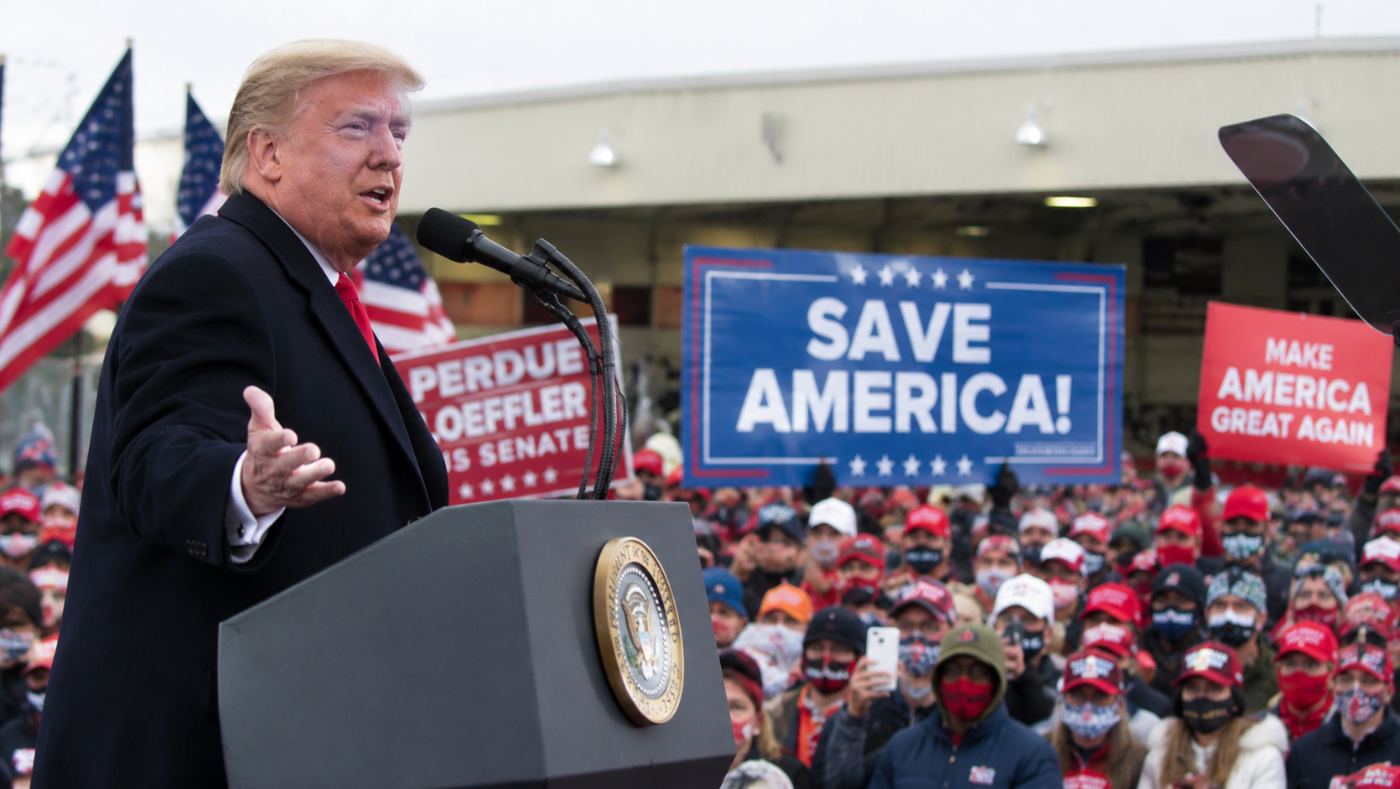
President Donald Trump traveled to Valdosta, Georgia, on December 5, 2020, to campaign for two Republican senators fighting to retain their seats. Instead, much of his speech focused on false allegations that the presidential election had been stolen from him.
The rally, held at Valdosta Regional Airport, was Trump's first major campaign appearance since losing the November election to Joe Biden.
With control of the United States Senate at stake, Republican leaders needed Trump to encourage supporters to vote in the upcoming runoff elections.
But Trump repeatedly returned to his own defeat.
Two Senate Seats at Stake
Republican Senators David Perdue and Kelly Loeffler faced January 5 runoff elections against Democrats Jon Ossoff and Raphael Warnock.
The contests would determine which party controlled the Senate.
Republicans hoped Trump's popularity among Georgia conservatives would motivate voters to return to the polls.
First Lady Melania Trump introduced the president and encouraged supporters to participate in the runoffs.
However, Trump quickly shifted attention toward his presidential election grievances.
Trump Falsely Claims He Won Georgia
Despite Georgia having certified Biden's victory, Trump insisted that he had actually carried the state.
"We won Georgia, just so you understand," he told supporters.
The statement was false.
Biden had defeated Trump in Georgia by approximately 12,000 votes.
A statewide hand audit had confirmed the result, and election officials reported no evidence of widespread fraud capable of changing the outcome.
Trump nevertheless continued asserting that voting irregularities had deprived him of victory.
Election Conspiracy Theories Dominate
Throughout the rally, Trump repeated allegations involving mail-in ballots, voting machines, and election workers.
He promoted misleading surveillance footage from Atlanta's State Farm Arena, suggesting that election workers had secretly counted fraudulent ballots.
Georgia investigators subsequently determined that the footage did not demonstrate illegal ballot counting.
Trump also attacked Republican Governor Brian Kemp and Secretary of State Brad Raffensperger, both of whom had defended the integrity of Georgia's election.
His criticism placed the state's Republican leadership in conflict with the president during a crucial Senate campaign.
A Contradictory Message to Republican Voters
Trump faced an unusual political challenge.
He wanted Republican voters to participate in the January runoffs while simultaneously telling them that Georgia's election system could not be trusted.
He warned supporters that Democrats would attempt to manipulate the upcoming contests.
Yet he also urged the crowd to vote for Perdue and Loeffler.
The conflicting messages raised concerns among Republicans that attacks on election integrity could discourage participation.
Even Trump's Attorney General Disagreed
Four days earlier, Attorney General William Barr had publicly stated that the Justice Department had not uncovered widespread election fraud sufficient to change the presidential outcome.
Trump's campaign had also suffered numerous defeats in court.
Nevertheless, the president continued presenting unsupported allegations as established facts.
The Associated Press and other news organizations documented multiple false or misleading claims from the Valdosta speech.
Republicans Ultimately Lose Both Runoffs
On January 5, 2021, Ossoff defeated Perdue and Warnock defeated Loeffler.
Their victories gave Democrats effective control of the Senate through Vice President Kamala Harris's tie-breaking vote.
The results did not establish that Trump's rally caused the Republican defeats. Numerous factors influenced the runoff elections.
However, the December 5 event illustrated the tension between Trump's campaign to overturn his presidential loss and Republican efforts to retain congressional power.
A Rally Overshadowed by Election Denial
What was intended as a campaign event for two Republican senators became another platform for Trump's rejected election allegations.
The president attacked election officials from his own party, disputed certified results, and continued insisting he had won an election he had lost.
December 5, 2020, remains a significant moment in the aftermath of the presidential election and the political struggle over Georgia's Senate seats.