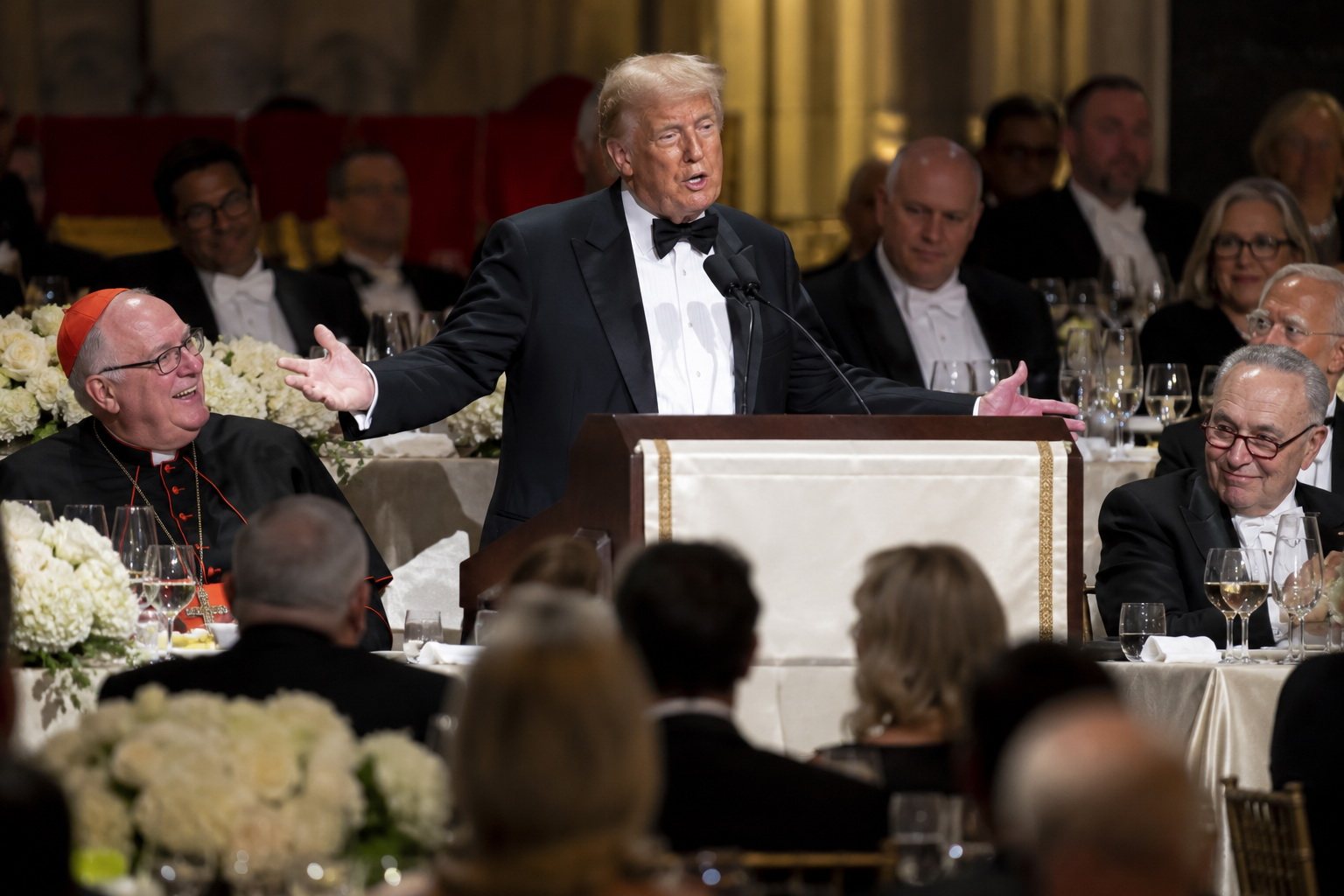
A longstanding American political tradition took an unusually confrontational turn on October 17, 2024, when former President Donald Trump used the annual Alfred E. Smith Memorial Foundation Dinner in New York City to deliver a series of personal insults directed at Vice President Kamala Harris, prominent Democrats, and other political opponents.
The white-tie charity event, which raises money for Catholic charitable organizations, has traditionally offered presidential candidates an opportunity to temporarily set aside partisan hostilities, exchange good-natured jokes, and demonstrate that political opponents can share a stage without treating one another as enemies.
Trump's remarks included jokes, familiar campaign attacks, personal criticism, and comments that drew both laughter and disapproval from the audience.
But perhaps the most revealing moment came when Trump acknowledged the dinner's tradition of self-deprecating humor and announced that he had no jokes to make about himself.
While his opponents were frequent targets, the former president declined to participate meaningfully in the one tradition that requires candidates to make themselves the punchline.
A Dinner Built Around Humor and Bipartisanship
The Alfred E. Smith Memorial Foundation Dinner is named for Al Smith, the former governor of New York who became the first Catholic nominated for president by a major American political party in 1928.
The dinner, first held in 1946, raises funds for Catholic charitable causes serving vulnerable children, families, and other New Yorkers in need.
Since 1960, it has also become an important presidential election tradition.
In election years, candidates from opposing parties are frequently invited to share a stage, exchange jokes, and demonstrate a degree of civility that is often missing from the campaign trail.
The humor can be sharp, but the event traditionally emphasizes good sportsmanship, personal humility, and the charitable mission behind the evening.
In 2008, Barack Obama and John McCain exchanged jokes at the dinner despite being engaged in a fiercely contested presidential campaign.
In 2012, Obama and Mitt Romney participated in the same tradition, poking fun at themselves and each other.
The underlying expectation was simple: Even bitter political rivals could spend one evening laughing together.
The 2024 dinner took place less than three weeks before the presidential election, with political tensions already running high.
Harris Skips the Dinner but Appears by Video
Vice President Kamala Harris, the Democratic presidential nominee, did not attend the event in person.
Instead, she continued campaigning in Wisconsin and submitted a prerecorded comedy video.
The video featured comedian Molly Shannon reprising her Saturday Night Live character Mary Katherine Gallagher.
Harris used the segment to make jokes about Trump and the campaign, including a reference to his false claims about the 2020 election results.
Trump criticized Harris for missing the dinner, suggesting that her absence showed disrespect toward Catholic voters.
Her decision was unusual. The last time a major-party presidential candidate had attended the dinner without the opposing nominee present in person was 1984, when President Ronald Reagan attended without Democratic nominee Walter Mondale.
However, Harris had not ignored the event entirely. Her prerecorded appearance was played for attendees.
The distinction did little to soften Trump's criticism.
Trump Targets Harris With Personal Insults
During his remarks, Trump repeatedly returned to Harris as the subject of his jokes and criticism.
He mocked her intelligence, speaking ability, and laugh, and repeatedly mispronounced her first name.
At one point, Trump declared that Harris had no intelligence whatsoever.
He also made jokes involving her husband, Doug Emhoff, including a reference to Emhoff's acknowledged extramarital affair during a previous marriage.
The remarks moved beyond disagreements over immigration, inflation, foreign policy, or other issues central to the presidential campaign.
Instead, much of the humor relied on personal attacks and familiar lines from Trump's political rallies.
Trump also criticized Harris's running mate, Minnesota Governor Tim Walz, with a joke invoking transgender people and menstruation.
The audience responded with a mixture of laughter, applause, and disapproval throughout the speech.
Supporters regarded the remarks as the kind of aggressive political humor that had become a defining feature of Trump's public appearances.
Critics argued that the speech was closer to a campaign rally than the lighthearted exchange traditionally associated with the charity dinner.
Chuck Schumer Becomes Another Target
Senate Majority Leader Chuck Schumer, a New York Democrat, was seated near Trump during the event.
Trump used the opportunity to direct several jokes toward him.
He recalled having contributed to Schumer's political career years earlier and joked about how their relationship had changed.
Trump also delivered a joke suggesting that Schumer could become the first female president if Harris lost the election, another reference to transgender identity.
The remarks drew reactions from the audience and illustrated the sharp-edged nature of the evening's humor.
Cardinal Timothy Dolan, the archbishop of New York, was seated between Trump and Schumer.
The setting placed political rivals alongside senior Catholic leadership at an event intended to raise money for charitable work.
That contrast became one of the evening's defining images: a formal charity banquet providing the setting for campaign-style attacks.
Trump Uses Profanity at a Catholic Charity Event
Trump also directed criticism toward former New York City Mayor Bill de Blasio.
During the remarks, he used profanity while dismissing concerns about whether his comments were appropriate comedy.
The language stood out because of the setting: a formal white-tie dinner attended by Catholic clergy, political leaders, business executives, and charitable donors.
Trump also took aim at former President Barack Obama, former House Speaker Nancy Pelosi, and President Joe Biden.
Several of the remarks closely resembled material he regularly used at campaign rallies.
The result was a speech that alternated between conventional political jokes and the confrontational language that had characterized Trump's campaigns.
Some attendees laughed and applauded.
Others booed.
The divided reaction reflected the unusual mixture of comedy and partisan confrontation taking place in the ballroom.
The One Person Trump Would Not Roast: Himself
One of the most widely discussed moments came when Trump addressed the tradition of self-deprecating humor.
Presidential candidates attending the Al Smith Dinner have historically made jokes about their own shortcomings, reputations, campaign difficulties, and public images.
The practice helps establish that no politician, regardless of position or popularity, should be above a little ridicule.
Trump acknowledged that expectation.
He then announced that he had nothing.
The line drew laughter and applause, and Trump followed it by explaining that he saw little reason to criticize himself when so many others had already attacked him.
It was a joke in its own right, but it also marked a departure from the sustained self-mockery that has often distinguished memorable speeches at the dinner.
Trump did make passing references to his legal problems and the criticism he had received.
Nevertheless, the bulk of his remarks remained focused on other people.
The contrast was particularly noticeable because the dinner's humor traditionally depends on candidates demonstrating that they can laugh at themselves as readily as they laugh at their opponents.
Trump Claims He Has Been Treated Worse Than Other Presidents
During the speech, Trump also returned to a familiar theme: his belief that he had been subjected to extraordinary mistreatment.
He compared his treatment with that of previous American presidents, including Abraham Lincoln.
Trump claimed that no president had been treated as badly as he had.
The comparison was notable given that Lincoln led the country through the Civil War and was assassinated in 1865.
Trump's comments reflected a recurring element of his political messaging, in which criminal prosecutions, investigations, political criticism, and media scrutiny were presented as evidence that he had been unfairly targeted.
At the time of the dinner, Trump had already been convicted in New York of 34 felony counts of falsifying business records.
He also faced other criminal proceedings connected to his handling of classified documents and his efforts to overturn the 2020 election, although those cases had not resulted in convictions.
Trump denied wrongdoing and characterized the prosecutions as politically motivated.
His references to personal mistreatment brought the legal controversies surrounding his candidacy into a setting traditionally devoted to humor and charitable fundraising.
The Dinner Revives Memories of Trump's 2016 Appearance
Trump had previously generated controversy at the Al Smith Dinner during the 2016 presidential campaign.
That year, he appeared alongside Democratic nominee Hillary Clinton.
His speech began with conventional jokes but shifted toward accusations against Clinton, including claims about corruption and her attitudes toward Catholics.
Some of those remarks drew boos from the audience.
The episode attracted attention because the dinner was traditionally regarded as an opportunity for candidates to temporarily set aside the hostility of a presidential campaign.
Eight years later, Trump acknowledged that his 2016 appearance had provoked an angry response.
His return in 2024 demonstrated how little the basic style of his political humor had changed.
Personal criticism, sharp insults, and attacks on political opponents remained central features of his remarks.
A Different Kind of Political Comedy
Political humor has always included mockery, exaggeration, and uncomfortable jokes.
The Al Smith Dinner has never required candidates to avoid criticizing their opponents.
Indeed, some of its most memorable speeches have included pointed attacks delivered with careful timing and a sense of shared amusement.
What distinguished Trump's 2024 appearance was the extent to which his remarks incorporated familiar campaign rhetoric into a traditionally bipartisan event.
His comments about Harris's intelligence, Emhoff's personal history, and the gender identities of political figures generated laughter among some attendees while drawing criticism from others.
The evening also highlighted the difference between political satire and personal insult.
Both can provoke laughter, but the Al Smith Dinner's reputation was built partly on the expectation that candidates would subject themselves to the same treatment they directed toward others.
Trump's decision to largely avoid that aspect of the tradition became a central part of the reaction to his appearance.
Charity Takes a Back Seat to Campaign Politics
Despite the political controversy, the dinner continued to serve its primary purpose of supporting Catholic charitable organizations.
The event brought together prominent figures from politics, business, entertainment, and religious institutions to raise money for programs assisting vulnerable New Yorkers.
That charitable mission was the reason the dinner existed long before it became a presidential campaign tradition.
Trump thanked Cardinal Dolan and acknowledged the importance of the event.
But coverage of the evening focused heavily on his insults, his criticism of Harris, and the mixed response from attendees.
The controversy illustrated how difficult it had become to separate major public events from the confrontational atmosphere of the 2024 presidential campaign.
Even an occasion specifically designed to encourage humor across political divisions became another venue for partisan conflict.
An Evening That Reflected a Divided Political Culture
By the conclusion of Trump's October 17 appearance, the Al Smith Dinner had produced a mixture of laughter, applause, boos, and political controversy.
Harris had participated remotely through a comedy video, while Trump delivered an extended speech that combined jokes with attacks on his opponents.
His supporters saw the remarks as an example of his willingness to challenge political conventions and speak without restraint.
Critics viewed the evening as another example of his tendency to turn public appearances into confrontations with political rivals.
The most revealing contrast was between the dinner's tradition and the nature of the remarks delivered.
For decades, the Al Smith Dinner had offered presidential candidates an opportunity to show that political competition did not have to eliminate humor, humility, or mutual respect.
On October 17, 2024, that tradition was tested again.
The evening demonstrated how a charity dinner designed to bring political opponents together could instead become another stage for the personal attacks and divisions of a presidential campaign.