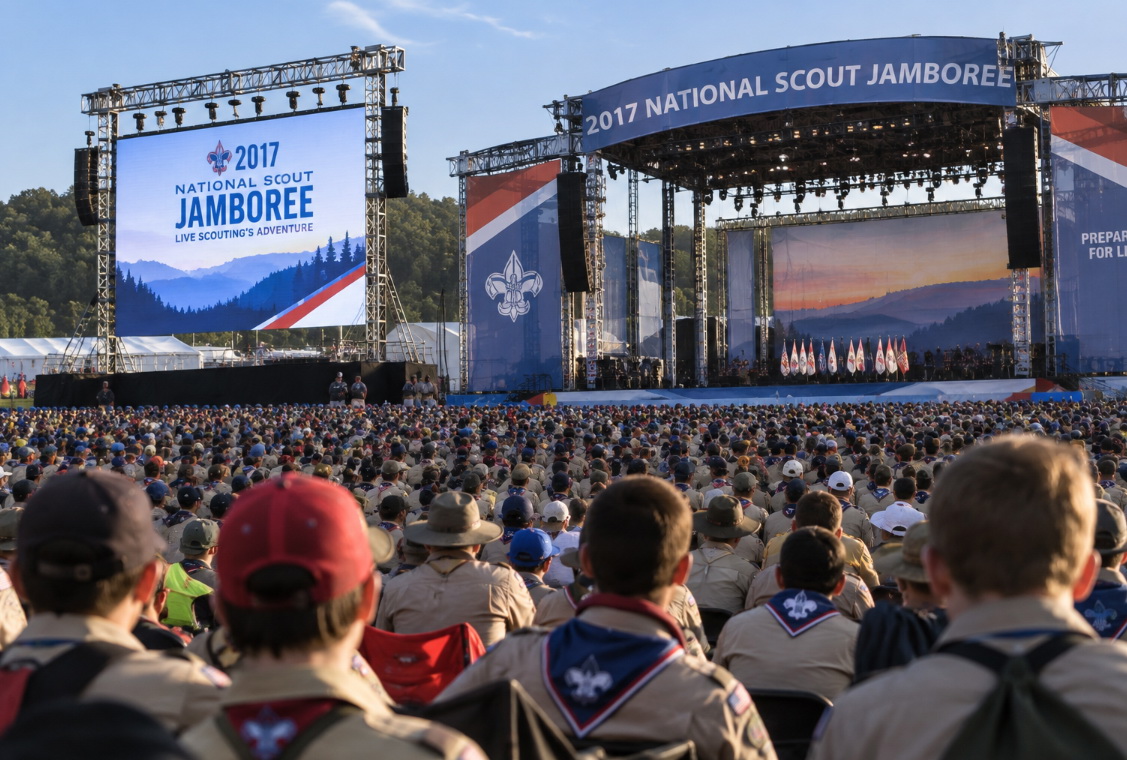
Donald Trump arrived at the National Scout Jamboree in West Virginia with an audience unlike the crowds at his campaign rallies.
Tens of thousands of Boy Scouts, adult leaders and volunteers had gathered at the Summit Bechtel Family National Scout Reserve for an event centered on Scouting, outdoor activities, leadership and service.
Presidents had been invited to address national jamborees for generations.
Trump initially suggested that he understood the distinction between a Scout gathering and a political event.
“Who the hell wants to speak about politics when I'm in front of the Boy Scouts?” he asked.
Then he spent substantial portions of the speech talking about politics.
Over the course of his remarks, Trump discussed his election victory, criticized the news media, revisited the electoral map, talked about Hillary Clinton's campaign, discussed efforts to repeal the Affordable Care Act, criticized Washington and invoked his familiar imagery of the capital as a “swamp.”
The crowd frequently cheered him.
But the political nature of the speech also produced complaints from members of the Scouting community.
Three days later, the Boy Scouts' chief executive apologized.
A Presidential Tradition
Presidential appearances before the Boy Scouts were nothing new.
The tradition stretched back decades, and the president of the United States serves as the organization's honorary president.
The invitation to Trump was therefore not unusual.
The Boy Scouts later emphasized that inviting a president to the National Jamboree did not constitute an endorsement of the president, his political party or his policies.
The organization described itself as nonpartisan.
Trump's appearance on July 24 began largely in keeping with the occasion.
He praised the Scouts.
He talked about character, service, patriotism and perseverance.
He recognized members of his administration who had participated in Scouting, including Secretary of State Rex Tillerson.
He encouraged the young people before him to pursue their ambitions.
Those portions of the address resembled the type of presidential speech traditionally associated with the gathering.
But Trump repeatedly returned to political subjects.
“The Fake News”
The political tone appeared almost immediately.
Looking at the enormous crowd, Trump joked that the press would report that only about 200 people were present.
It was a familiar subject.
Since his inauguration six months earlier, Trump had repeatedly complained about news coverage of crowd sizes and regularly attacked news organizations as “fake news.”
He brought the phrase to the jamboree as well.
Trump told the Scouts that he intended to put Washington's policy fights aside, including what he called “the fake news and all of that.”
Then came his declaration that he did not want to talk politics in front of the Boy Scouts.
But politics soon returned to the speech.
Back to Election Night
Trump spent part of the address recounting the 2016 presidential election.
He described watching the electoral map change on election night.
He talked about Republicans being represented by red and Democrats by blue.
He recalled winning Florida, South Carolina, North Carolina and Pennsylvania.
He discussed campaigning in Maine.
He talked about winning Wisconsin and Michigan.
And he contrasted his campaigning with that of his opponent, Hillary Clinton.
Some members of the audience booed when Trump referred to his opponent.
Trump continued recounting his victory.
“We won and won,” he said.
It sounded less like a traditional presidential address to a youth organization and more like themes Trump regularly used before political audiences.
Health Care Enters the Speech
Trump also turned to one of the largest political battles then underway in Washington.
Republicans were attempting to repeal or substantially rewrite the Affordable Care Act.
Trump recognized Health and Human Services Secretary Tom Price, who had been a Scout.
Then he asked Price whether Republicans were going to obtain enough votes for the health-care legislation.
“He better get 'em,” Trump said.
Then Trump joked about the consequences if Price failed.
“Otherwise, I'll say, ‘Tom, you're fired.’”
The line referenced Trump's television persona from The Apprentice, but it also brought an active legislative fight directly into the jamboree address.
The Washington “Swamp”
Trump eventually returned to another familiar political theme.
Washington, he told the Scouts, was filled with politicians and the “swamp.”
He suggested that perhaps the word wasn't strong enough.
Maybe, he said, it should instead be called a “cesspool” or a “sewer.”
These were not passing references inserted into an otherwise apolitical speech.
Taken together, the remarks covered many of the subjects that dominated Trump's political appearances: his election victory, the electoral map, his defeated opponent, the news media, health-care legislation and Washington politicians.
And all of it was being delivered before an organization that deliberately tried to stay outside partisan politics.
The Scouts Respond
The reaction did not end when Trump left West Virginia.
Some Scouts and parents enjoyed the president's appearance and the crowd could frequently be heard cheering him.
Others objected to the political content of the speech and complained to the Boy Scouts of America.
The organization initially emphasized its nonpartisan status.
Then, on July 27, Chief Scout Executive Michael Surbaugh issued a more direct statement.
He apologized to members of the Scouting community who had been offended by the political rhetoric.
“That was never our intent,” Surbaugh wrote.
He said the organization sincerely regretted that politics had been inserted into the Scouting program.
Surbaugh also stressed that inviting presidents to jamborees was a longstanding tradition rather than a political endorsement.
The organization, he said, remained committed to being nonpartisan.
The White House Saw It Differently
The Trump administration did not agree that the speech required an apology.
At a July 27 White House briefing, incoming press secretary Sarah Huckabee Sanders was asked whether Trump should apologize to the Scouts.
She pointed instead to the reaction inside the venue.
Sanders said she had attended the event and heard tens of thousands of Scouts cheering Trump throughout his remarks.
She described it as one of the most energetic crowds she had seen in front of the president.
That response highlighted an important distinction.
Trump's audience had indeed frequently responded enthusiastically.
But the Boy Scouts' objection was not that nobody in the crowd enjoyed the speech.
It was that partisan political rhetoric had been introduced into an organization that explicitly sought to remain outside partisan politics.
Both things could be true.
Trump could receive an enthusiastic response from many Scouts while the organization's leadership could still object to the political nature of his remarks.
The Speech Is Preserved in Trump's Own Words
The controversy surrounding the jamboree speech does not depend on interpreting anonymous reports or reconstructing a private conversation.
There is a transcript.
Trump said he didn't want to discuss politics before the Boy Scouts.
Then he discussed politics.
He talked about his election.
He discussed states he had won.
He referred to his opponent.
He criticized the media.
He discussed health-care legislation.
He criticized Washington.
And he invoked the political imagery that had helped define his presidential campaign.
That is what made the episode significant.
The controversy wasn't primarily about whether Trump was permitted to speak to the Scouts.
Presidents had been invited to do so for decades.
It was about what a president chose to do with that invitation.
A Jamboree Becomes a Political Story
The National Scout Jamboree was supposed to be about Scouting.
For thousands of young people who attended, most of it undoubtedly was.
They camped.
They climbed.
They traded patches.
They participated in outdoor activities.
They met Scouts from across the country and around the world.
Trump's appearance occupied only one portion of the event.
Yet for several days afterward, national attention focused on the president's speech rather than the Scouts themselves.
That was precisely what the Boy Scouts' leadership ultimately regretted.
The organization had invited the president of the United States as part of a tradition dating back generations.
Donald Trump arrived as president.
For significant portions of the speech, however, he spoke in much the same way he did before political crowds.
Three days later, the Boy Scouts of America found itself doing something extraordinary:
Apologizing because politics had been brought into the jamboree.