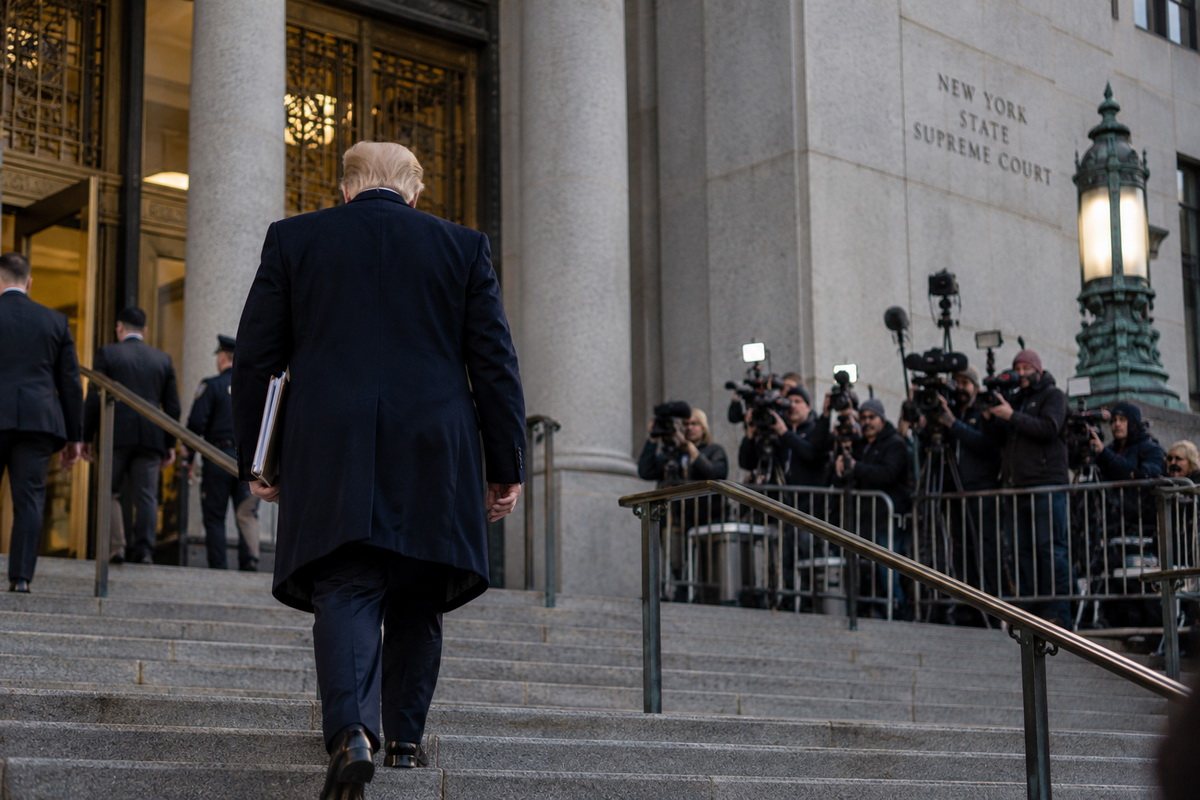
Donald Trump wanted his New York civil fraud trial stopped.
Five days into the proceeding, his attorneys went to an appeals court seeking emergency intervention that could have brought the trial to a halt.
The answer on October 6, 2023, was no.
A New York appellate judge refused Trump's request to suspend the trial, allowing the case brought by Attorney General Letitia James to continue.
Trump did receive one important temporary victory: the appeals court paused enforcement of the portion of Judge Arthur Engoron's earlier ruling involving the cancellation of certain New York business certificates and the potential dissolution of Trump-controlled companies while the appeal proceeded.
But the trial itself?
That would continue.
And Trump entered it with an enormous problem.
On the central fraud claim in the case, Judge Engoron had already ruled against him.
The Judge Had Already Found Fraud
This point is sometimes lost when the case is described simply as Trump's “fraud trial.”
Before the trial even began, Engoron had ruled on one of the most important claims in Attorney General Letitia James' lawsuit.
His September 26 decision found Trump and other defendants liable for persistent fraud involving financial statements that substantially misrepresented the values of various Trump assets.
This wasn't merely an accusation waiting to be proven at trial.
On that central claim, the judge had already examined the evidence and ruled.
Trump had committed fraud under New York civil law.
The trial beginning in October would determine additional claims and, ultimately, what penalties Trump and the other defendants would face.
A Penthouse That Somehow Became Three Times Larger
Some of the discrepancies identified by Engoron were extraordinary.
One of the most striking involved Trump's own apartment in Trump Tower.
For years, Trump's financial statements listed the triplex penthouse at approximately 30,000 square feet.
Its actual size was about 10,996 square feet.
That wasn't a small difference in professional judgment about the value of luxury real estate.
The apartment had been represented as nearly three times its actual size.
Engoron rejected the defense's suggestion that differences in calculating square footage could explain the discrepancy.
Other properties raised similar issues.
Trump's Seven Springs estate in Westchester County was valued on financial statements at amounts dramatically exceeding outside appraisals.
Rent-regulated apartments were valued as though restrictions affecting their value didn't exist.
And Trump's Mar-a-Lago property was assigned valuations based in part on assumptions that conflicted with restrictions governing how the property could be used.
Trump maintained that his properties were extremely valuable and argued that financial statements contained disclaimers informing lenders to conduct their own evaluations.
Engoron rejected those arguments as a defense to the fraud claim.
Trump Wants the Trial Stopped
The trial began October 2 in Manhattan.
Trump personally attended its first three days, repeatedly speaking to reporters outside the courtroom and denouncing the proceeding as politically motivated.
He denied wrongdoing and accused James and Engoron of targeting him for political reasons.
Then his attorneys sought emergency help from the state's intermediate appellate court.
They wanted the trial suspended while they challenged Engoron's ruling.
Trump attorney Christopher Kise argued that allowing Engoron's order to take effect could cause irreparable damage to Trump's businesses.
The state disagreed.
New York argued that the trial had required extensive preparation and that Trump's arguments did not justify shutting down proceedings that were already underway.
On October 6, Associate Justice Peter H. Moulton declined to stop the trial.
Trump had failed to halt the case.
But Trump Did Win a Temporary Reprieve
The appeals court's decision wasn't a complete loss for Trump.
Engoron's September ruling had ordered the cancellation of certain business certificates and contemplated a process that could result in the dissolution of Trump-controlled business entities.
Exactly how that extraordinary remedy would work had generated considerable uncertainty.
The appeals court temporarily stayed that portion of Engoron's ruling while Trump's appeal continued.
That meant Trump remained in control of his holdings for the time being.
His attorneys portrayed that portion of the ruling as an important victory.
But Attorney General James emphasized the larger result:
The trial wasn't stopping.
Trump would still have to defend himself against the remaining claims.
The Numbers Were Becoming Hard to Explain Away
The case wasn't based simply on whether Trump believed his properties were valuable.
Real estate valuations can legitimately differ.
Experts can disagree.
Markets fluctuate.
Luxury properties can be especially difficult to value.
But Engoron's ruling focused on representations that went far beyond ordinary differences of opinion.
A roughly 11,000-square-foot apartment had been listed as 30,000 square feet.
Restrictions affecting properties had not always been reflected in the values assigned to them.
Values appearing in Trump's financial statements sometimes differed dramatically from outside appraisals and other evidence.
Engoron concluded that the pattern constituted persistent fraud.
Trump disagreed and continued to maintain that lenders were sophisticated institutions capable of conducting their own evaluations and that no bank had suffered losses from its dealings with him.
Those arguments would continue through appeals.
But by October 6, the fraud finding itself was already part of the case.
Trump Calls It a Witch Hunt
Trump responded as he had to many of the investigations and lawsuits surrounding him.
He attacked the proceeding.
He called it a “witch hunt.”
He attacked James.
He attacked Engoron.
And he insisted that his properties were worth considerably more than the values being discussed in court.
Trump's defense also stressed that lenders had been repaid and argued that the transactions had produced no traditional financial victims.
Those arguments would later become important parts of Trump's appeal.
But they didn't stop the trial.
The courtroom continued hearing evidence about how the Trump Organization prepared the financial statements at the center of the case.
What Happened Next
We now know where the case ultimately went.
After a trial lasting more than two months, Engoron issued his final decision in February 2024.
He ordered Trump to pay approximately $355 million in disgorgement before interest, imposed restrictions on his ability to run New York businesses and strengthened independent oversight of the Trump Organization.
Trump appealed the judgment and continued to deny wrongdoing.
The civil fraud case should not be confused with Trump's separate Manhattan criminal prosecution.
In May 2024, a jury in that case convicted Trump on 34 felony counts of falsifying business records.
That criminal conviction did make Trump a convicted felon.
The October 2023 fraud proceeding was different: it was a civil case, and Engoron's fraud determination was a finding of civil liability rather than a criminal conviction.
But it nevertheless represented a remarkable legal finding against a former president and businessman whose public identity had been built largely around his wealth and business success.
October 6, 2023
On this day in 2023, Donald Trump tried to stop his New York civil fraud trial.
The appeals court refused.
It temporarily protected Trump from one of the most dramatic immediate consequences of Engoron's earlier decision—the cancellation of business certificates and possible dissolution of companies—but it allowed the trial itself to continue.
And there was an important reality underneath all of the courtroom maneuvering.
Trump wasn't simply walking into court to answer an unproven accusation of fraud.
On the central claim in the lawsuit, a judge had already reviewed the evidence and found that Trump and his company had repeatedly presented fraudulent financial information.
Trump could appeal that finding.
He could attack the judge.
He could attack the attorney general.
He could insist that his properties were worth more.
But on October 6, he couldn't make the trial go away.
The court told him it would continue.