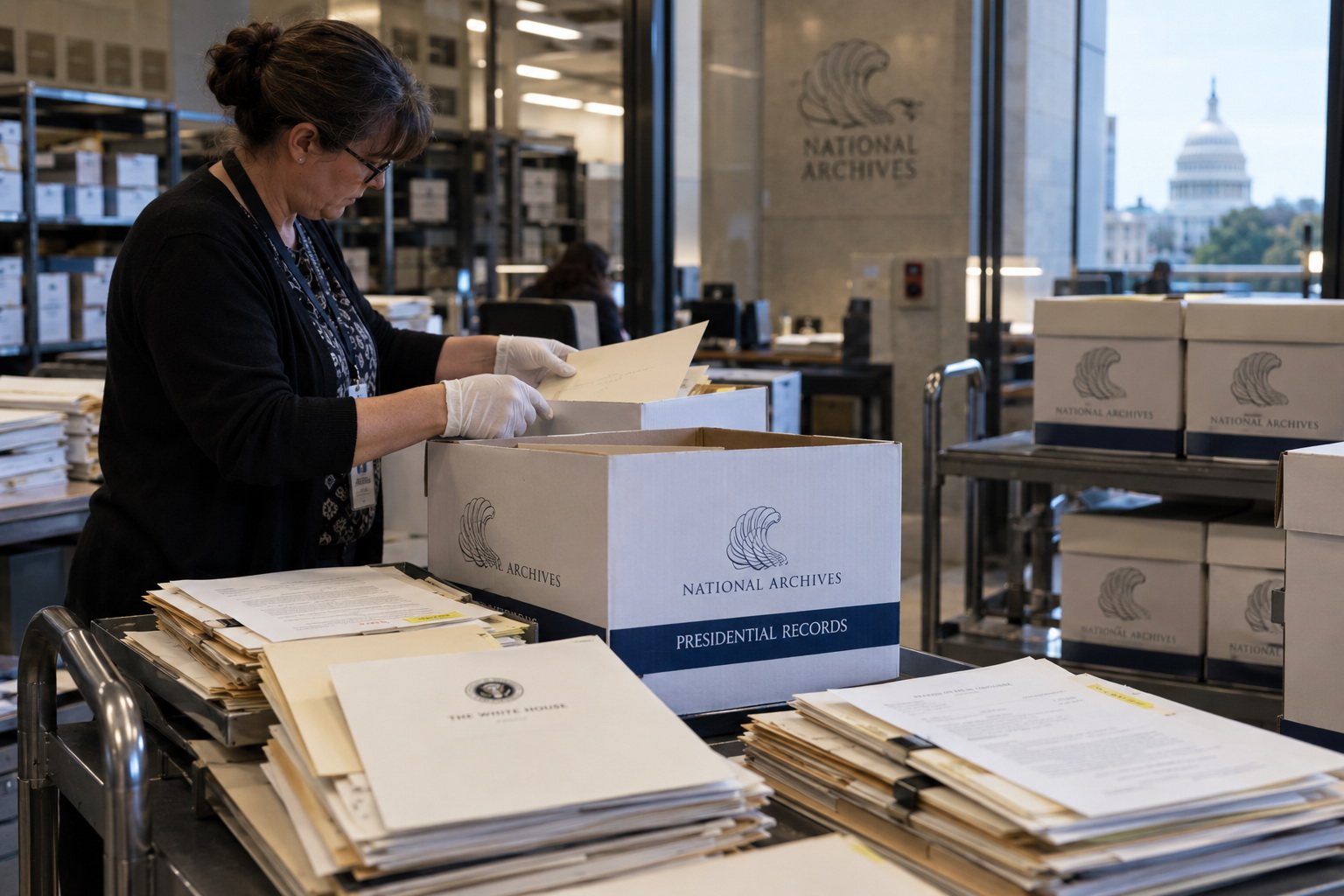
Nine months after a mob attacked the United States Capitol in an effort to disrupt the certification of Joe Biden's presidential victory, investigators wanted to know what had been happening inside Donald Trump's White House.
They wanted documents.
They wanted communications.
They wanted records concerning January 6, Trump's attempts to challenge the 2020 election results and the events leading to the attack on the Capitol.
Donald Trump didn't want them to have those records.
On October 8, 2021, the former president formally asserted executive privilege in an attempt to prevent the National Archives from providing a collection of Trump White House records to the House Select Committee investigating January 6.
But there was a problem.
Trump wasn't president anymore.
Joe Biden was.
And Biden refused to help him keep the records secret.
The January 6 Committee Wanted the White House Paper Trail
The House established the January 6 Select Committee in the summer of 2021 to investigate the attack on the Capitol and the circumstances surrounding it.
On August 25, committee chairman Rep. Bennie Thompson sent an extensive records request to Archivist of the United States David Ferriero.
Investigators sought presidential records involving Trump, senior White House officials and numerous people connected to efforts to challenge the election.
The committee wanted records concerning Trump's claims of election fraud.
It wanted communications about January 6.
It wanted information concerning rallies in Washington.
It wanted records involving efforts to challenge the electoral vote count.
And it wanted to understand what was happening inside the White House while the Capitol was under attack.
The records were no longer sitting inside Trump's White House.
Under the Presidential Records Act, custody of presidential records transfers to the National Archives when an administration ends.
That put the National Archives directly in the middle of the fight.
Trump Claims Executive Privilege
On October 8, Trump sent a letter to Archivist David Ferriero formally asserting executive privilege over a subset of the requested material.
Executive privilege allows presidents, under certain circumstances, to protect confidential communications within the executive branch.
Former presidents can assert claims involving records from their administrations.
But those claims don't automatically control what happens to the records—particularly when the sitting president reaches a different conclusion.
And President Biden did.
Biden Says No
White House Counsel Dana Remus responded to the National Archives that same day.
Biden had reviewed Trump's assertion.
He rejected it.
Remus wrote that Biden had determined that invoking executive privilege was “not in the best interests of the United States.”
The White House pointed to the extraordinary circumstances surrounding January 6 and Congress' need to understand what had happened.
The administration described the Capitol attack as an unprecedented effort to interfere with the peaceful transfer of presidential power.
Biden therefore instructed the National Archives to provide the records to the January 6 Committee.
Trump had asked for a shield.
The sitting president refused to provide one.
These Weren't Ordinary Historical Documents
The fight wasn't simply about historians wanting access to old presidential papers.
Congress was investigating an attack that had occurred only nine months earlier.
Members of Congress had been forced to evacuate or shelter while rioters entered the Capitol.
The electoral vote certification had been interrupted.
Vice President Mike Pence had been evacuated from the Senate chamber.
Trump supporters erected gallows outside the Capitol while some chanted for Pence to be hanged.
Investigators wanted to reconstruct what had happened before, during and after the attack.
That included what Trump was doing.
Who was communicating with him?
Who was communicating with his aides?
What discussions were taking place inside the White House?
What records existed concerning attempts to overturn or challenge Biden's victory?
And what was happening inside the executive branch while Congress was under attack?
Those questions made the White House records potentially critical evidence.
Trump Was Also Trying to Stop Former Aides From Cooperating
The records fight wasn't occurring in isolation.
Trump was simultaneously attempting to prevent former members of his administration from cooperating with the January 6 investigation.
The committee had subpoenaed several former Trump officials and allies.
Among them were former White House chief of staff Mark Meadows, former adviser Steve Bannon, former Defense Department official Kash Patel and former White House social-media director Dan Scavino.
Trump's lawyers argued that executive privilege protected certain communications and testimony.
Bannon ultimately refused to comply with the committee's subpoena.
That decision eventually resulted in his prosecution and conviction for contempt of Congress.
The broader strategy was becoming clear:
The January 6 Committee wanted information from Trump's presidency.
Trump was fighting to keep significant portions of it away from investigators.
Trump Takes the Fight to Court
Trump didn't accept Biden's decision.
He sued.
On October 18, 2021, Trump filed a federal lawsuit seeking to block the National Archives from providing the requested records to the committee.
The case became Trump v. Thompson.
Trump argued that former presidents retained constitutional interests in executive privilege and that the committee's request was excessively broad and politically motivated.
The committee and Biden administration disagreed.
They argued that Congress had a compelling need to investigate an unprecedented attack on the constitutional transfer of presidential power.
The courts would ultimately have to decide whether Trump could stop the documents from being released.
Trump Loses in Federal Court
The first major ruling went against him.
U.S. District Judge Tanya Chutkan rejected Trump's attempt to block the records.
Her ruling contained a sentence that quickly became famous:
“Presidents are not kings, and Plaintiff is not President.”
Trump appealed.
The case moved to the U.S. Court of Appeals for the District of Columbia Circuit.
He lost there too.
The appeals court concluded that Biden's determination that the committee needed the records carried substantial weight and rejected Trump's effort to prevent their disclosure.
Trump then went to the Supreme Court.
The Supreme Court Refuses to Stop the Records
On January 19, 2022, the Supreme Court rejected Trump's request for an emergency order preventing the National Archives from providing the documents.
The Court acknowledged that questions concerning a former president's ability to assert executive privilege against the wishes of a sitting president raised serious constitutional issues.
But Trump's request to stop the documents was denied.
The records could go to Congress.
The National Archives began turning them over to the January 6 Committee.
Trump's months-long attempt to prevent investigators from obtaining that material had failed.
What Investigators Eventually Learned
The January 6 investigation ultimately produced an enormous body of evidence concerning Trump's efforts following the 2020 election.
The committee examined pressure placed on state officials.
It investigated efforts involving alternate slates of Trump electors.
It documented Trump's pressure campaign against Vice President Pence to reject or delay electoral votes.
It examined efforts involving the Justice Department.
It interviewed hundreds of witnesses.
It obtained text messages, emails, White House records, phone logs and testimony from people who had worked inside Trump's own administration.
Public hearings in 2022 featured testimony from Republicans who had worked for Trump or supported him.
Former White House aide Cassidy Hutchinson provided detailed testimony concerning events inside the White House.
Former Justice Department officials described Trump's efforts to persuade the department to support his election claims.
State officials described pressure from Trump and his allies.
Pence advisers described efforts to convince the vice president that he could interfere with the electoral certification.
The committee eventually concluded that Trump had engaged in a multi-part effort to overturn the result of an election he lost.
Trump rejected the committee's conclusions, described the investigation as partisan and continued insisting that the 2020 election had been stolen from him.
October 8 Was the Beginning of a Much Bigger Records Fight
Looking back, the October 8 letters represent an important moment in the January 6 investigation.
At the time, the public didn't yet know everything investigators would eventually uncover.
The committee hadn't held its televised hearings.
Many witnesses hadn't testified.
Thousands of documents hadn't been examined.
The committee's final report was more than a year away.
But investigators already understood something fundamental:
If they wanted to reconstruct what happened on January 6, they needed to know what was happening inside Donald Trump's White House.
Trump understood the significance of those records too.
He asserted executive privilege.
Biden rejected the claim.
Trump sued.
He lost in federal district court.
He lost at the appeals court.
And the Supreme Court refused to rescue his effort.
The records went to investigators.
And many of the events that Trump had fought to keep behind the wall of executive privilege eventually became part of the public record.
On October 8, 2021, that battle was just beginning.