Donald Trump apparently didn't want to leave control of Congress entirely up to the voters.
So Republicans changed the voters.
Or, more accurately, they changed which voters would be grouped together.
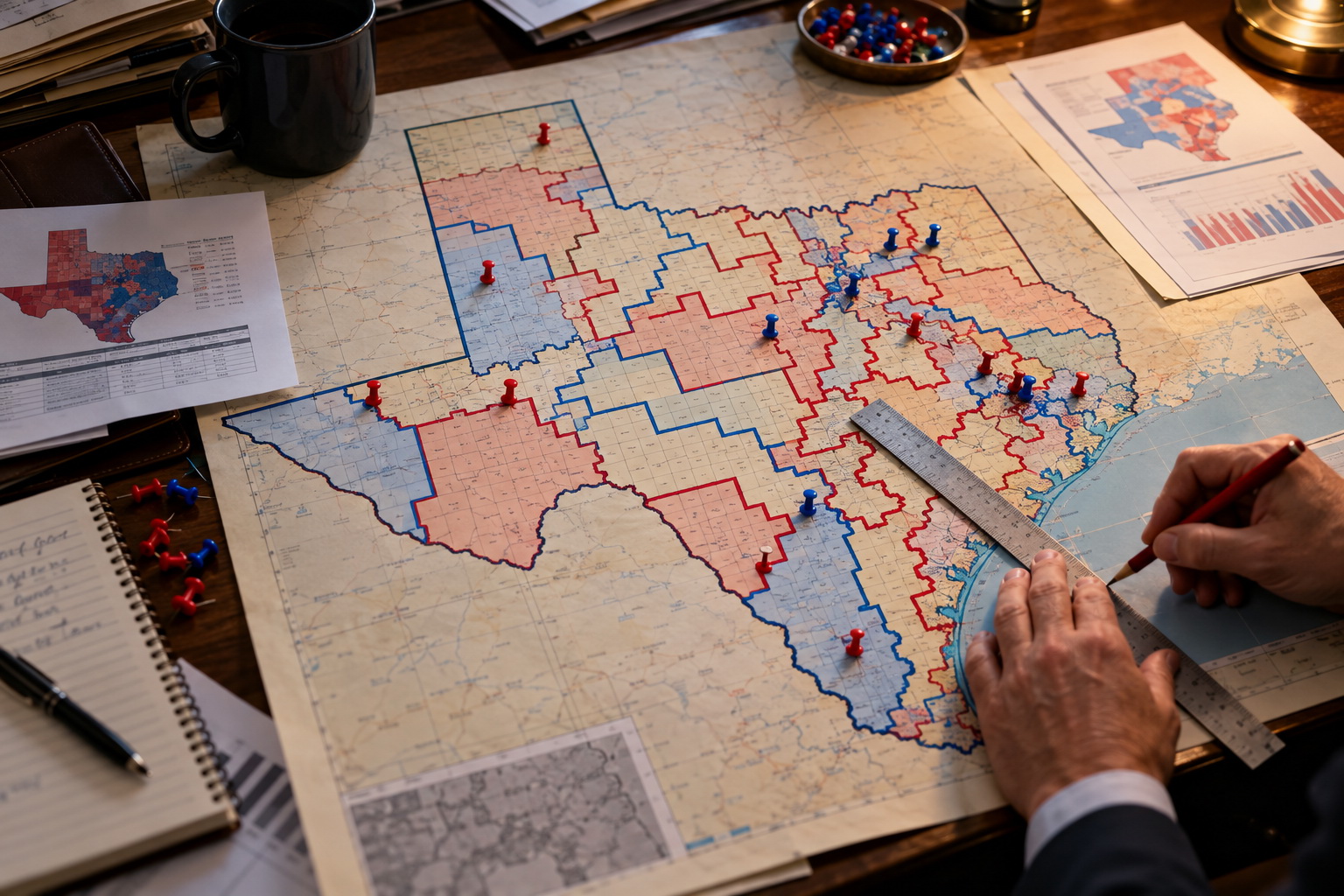
Beginning in 2025, Trump pushed Republican-controlled states to redraw congressional districts in the middle of the decade — an unusual political maneuver designed to give the GOP additional seats in the House of Representatives before the 2026 midterm elections.
Texas became ground zero.
Trump wasn't particularly subtle about what he wanted.
"We have an opportunity in Texas to pick up five seats," Trump said in 2025.
He went even further.
"We are entitled to five more seats."
Texas Republicans responded by redrawing the state's congressional map.
The objective was straightforward: transform a congressional delegation that contained 25 Republicans and 13 Democrats into one containing as many as 30 Republicans.
Five additional Republican seats.
Exactly what Trump had requested.
There was just one problem.
Voters still get to vote.
And now Trump's carefully engineered congressional map may not produce anything close to the Republican windfall its architects expected.
The Great Texas Gerrymander
Congressional districts are normally redrawn following the census every ten years.
Texas Republicans didn't wait.
At Trump's urging, state lawmakers undertook an extraordinary mid-decade redistricting effort in 2025.
The new boundaries specifically targeted Democratic-held congressional districts and attempted to capitalize on Trump's improved performance among Latino voters during the 2024 presidential election.
The strategy was based largely on an assumption:
The voters who moved toward Trump in 2024 would remain Republican voters in 2026.
Republicans therefore rearranged congressional districts to take advantage of that political shift.
It looked clever on paper.
Politics, unfortunately for Republicans, didn't stop in 2024.
The Courts Got Involved
The Texas map immediately faced legal challenges.
In November 2025, a three-judge federal panel blocked the map after concluding there was substantial evidence that Texas had engaged in racial gerrymandering.
One of the judges who reached that conclusion, U.S. District Judge Jeffrey Brown, had been appointed by Donald Trump.
The court distinguished between ordinary partisan mapmaking and what it found had occurred in Texas.
"Politics played a role," Brown wrote, but the court found substantial evidence that race had also been improperly used in constructing the districts.
Texas appealed.
The Supreme Court initially allowed the new map to be used and subsequently reversed the lower court ruling in April 2026, cementing the Republican-drawn districts for the midterm election.
Republicans had their map.
Now they just needed voters to cooperate.
That Part Isn't Going According to Plan
Consider Texas' 34th Congressional District.
Republican Eric Flores appeared to be exactly the kind of candidate Trump's redistricting operation was designed to help.
Flores, a former federal prosecutor and Army National Guard infantry captain, is challenging Democratic Rep. Vicente Gonzalez.
The newly drawn district includes part of the heavily Latino Rio Grande Valley, where Trump made significant gains in 2024.
Under the new boundaries, Trump would have carried the district by roughly 10 percentage points.
Republicans saw an opportunity.
Trump endorsed Flores.
Flores appeared at Trump's midterm convention.
And the Republican Party expected the redesigned district to help knock another Democrat out of Congress.
Instead, the race has become considerably more competitive than Republicans anticipated.
It has become important enough that Vice President JD Vance traveled to Texas to campaign with Flores.
And Flores has made another interesting adjustment.
A promise to "SUPPORT PRESIDENT TRUMP'S AGENDA" that once appeared on his campaign website was removed as he moved toward the general election and attempted to broaden his appeal.
The candidate benefiting from Trump's redistricting plan apparently decided that advertising himself primarily as Trump's candidate wasn't necessarily the best way to win the district Trump helped create for him.
Republicans Made a Huge Assumption About Latino Voters
The Texas strategy depended heavily upon Trump's 2024 gains among Latino voters.
Republicans essentially bet that those voters had permanently realigned with the GOP.
But voters aren't property.
And political coalitions aren't permanent.
The economy has changed.
Prices remain a major concern.
Trump's tariffs have affected businesses and consumers.
The war with Iran has contributed to higher fuel prices.
And Trump's aggressive deportation policies have generated opposition among some Latino voters.
Suddenly, districts constructed using Trump's 2024 performance as a blueprint don't look quite as Republican as they once did.
Another Republican, Rep. Monica De La Cruz, is facing a serious challenge from Democratic candidate and Latin Grammy-winning musician Bobby Pulido.
Republicans designed the map expecting to expand their advantage.
Instead, they're being forced to defend territory they expected to control comfortably.
Florida Isn't Going Exactly as Planned Either
Texas wasn't alone.
Republicans also redrew congressional districts in Florida hoping to increase their advantage there.
Combined, Republicans initially hoped redistricting in Texas and Florida could produce as many as nine additional House seats.
But several Florida races targeted by the redistricting effort have also become competitive.
Republicans attempted to make life considerably more difficult for Democratic representatives including Kathy Castor and Darren Soto.
Yet Democratic candidates continue competing in districts Republicans expected their new maps to lock down.
The political environment changed.
The maps didn't.
Gerrymandering Has One Major Weakness
Politicians can manipulate district boundaries.
They can move neighborhoods from one congressional district into another.
They can split cities.
They can combine distant communities.
They can study election results precinct by precinct and attempt to construct districts producing exactly the partisan outcome they want.
But there is one variable they can never completely control.
Voters.
Gerrymandering works best when politicians can accurately predict how particular communities will vote.
Trump and Texas Republicans looked at the 2024 election and apparently assumed they were looking at the future.
Instead, they may have been looking at a snapshot.
A voter who supported Trump in 2024 doesn't automatically support every Republican in 2026.
A Latino voter who moved toward Republicans because of concerns about inflation doesn't necessarily remain Republican if economic conditions deteriorate.
A district engineered to produce a Republican victory based upon yesterday's electorate can suddenly become competitive when voters change their minds.
Trump Wanted Five Seats
That remains the most remarkable part of the entire episode.
The president of the United States publicly declared that his political party was "entitled" to five additional congressional seats in Texas.
Not because five more Republicans had persuaded voters to elect them.
Not because population changes required Texas to gain additional representation.
But because political leaders had the power to redraw the boundaries.
Texas Republicans then attempted to deliver those seats.
They redrew the map.
They fought for it in court.
They won the right to use it.
And now, after all of that, Republicans are discovering something they apparently failed to include in their calculations.
The people living inside those carefully engineered districts still get the final say.
Donald Trump could redraw the map.
He couldn't redraw the voters.