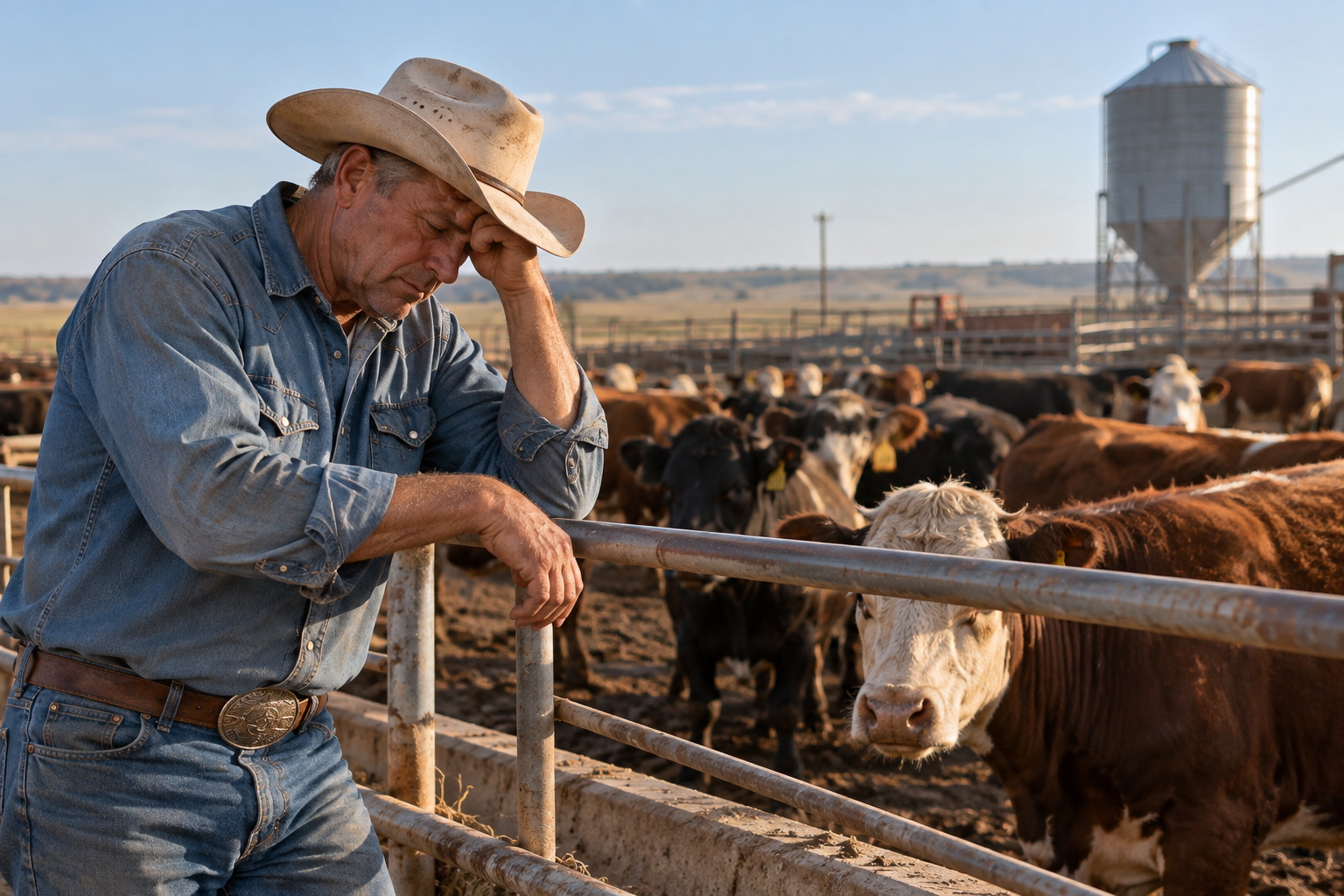
Donald Trump has a beef problem.
Not a political feud. Not an insult hurled at an opponent.
Actual beef.
The price of one of America's most basic grocery staples has climbed to record levels, the nation's cattle supply remains historically tight, and the Trump administration has been scrambling for ways to make hamburgers cheaper.
Its answer has included something that might seem surprising for a president who built much of his economic message around tariffs and "America First":
Import a lot more foreign beef.
In August, Trump temporarily expanded the amount of imported lean beef that can enter the United States at the lower tariff rate by 300,000 metric tons — roughly 661 million pounds.
The White House said the intervention was necessary because beef prices had become too high for American consumers.
But American cattle producers weren't celebrating.
Many warned that flooding the market with cheaper foreign beef could hurt ranchers precisely when the country desperately needs them to rebuild America's depleted cattle herd.
Then another Trump policy collided with the beef supply chain.
Immigration enforcement operations across cattle country in Kansas frightened workers away from meatpacking plants and other agricultural businesses, according to industry groups and local officials.
Beef processing slowed.
Thousands of cattle were delayed.
Industry groups reported millions of dollars in losses.
And cattle organizations in Kansas, Oklahoma and Texas warned that the disruption could ultimately make beef even more expensive.
Trump is trying to make hamburgers cheaper.
But several of his administration's policies are now pulling America's beef industry in opposite directions.
How Did Beef Get So Expensive?
America's beef problem didn't begin with Trump's current policies.
The country simply doesn't have enough cattle.
Years of drought, high feed costs, wildfires and ranchers reducing their herds have left the United States with one of its smallest cattle populations in generations.
USDA reported 94.2 million cattle and calves on American farms as of July 1. The number of beef cows fell another 1 percent from the previous year, while the estimated calf crop declined 2 percent.
The shortage can't be fixed quickly.
A rancher cannot manufacture another steer next month because hamburger prices went up this month.
Breeding cows must produce calves. Those calves must grow. Ranchers must decide whether to retain young females for breeding rather than send them into the beef supply.
Rebuilding a national cattle herd takes years.
Meanwhile, Americans still want beef.
The result is Economics 101:
Tight supply plus strong demand equals higher prices.
Ground beef reached approximately $6.92 per pound in August, according to federal data cited by The Washington Post.
For families already dealing with elevated grocery costs, the hamburger aisle became another painful reminder of the cost of living.
So the White House intervened.
Trump's Solution: Bring In More Foreign Beef
On August 26, Trump signed a proclamation titled "Further Ensuring Affordable Beef for the American Consumer."
The administration's reasoning was straightforward.
There wasn't enough domestic beef available at what it considered reasonable prices.
So increase supply.
Trump expanded the amount of lean beef trimmings eligible for the lower tariff rate by 300,000 metric tons for 2026.
That's approximately 661 million pounds.
The additional imports were divided into three tranches running from September through November.
Lean beef trimmings are particularly important because they can be blended with fattier American beef to produce ground beef.
In theory, bringing hundreds of millions of additional pounds into the market should increase supply and put downward pressure on hamburger prices.
The White House even encouraged importers and retailers to pass savings along to consumers.
There was just one problem.
American ranchers hated the idea.
Ranchers Asked: What About Us?
Cattle producers argued that the administration was attacking the symptom while potentially making the underlying problem worse.
America needs more cattle.
That requires ranchers to expand their herds.
And ranchers are more likely to do that when cattle prices are strong enough to justify the enormous expense and risk involved.
Increasing imports may help provide additional beef in the short term.
But if those imports push domestic cattle prices lower, producers argue, they could weaken the very financial incentive needed to rebuild the American herd.
The American Farm Bureau Federation warned the administration that the move could undermine American ranchers.
The National Cattlemen's Beef Association also criticized the policy.
Mike Johanns — a Republican former Nebraska governor, U.S. senator and Agriculture secretary under President George W. Bush — recently criticized the federal intervention as well.
His argument was essentially that cattle producers had finally reached the profitable portion of a brutal cattle cycle, only to have Washington intervene because retail beef prices were high.
The tension exposes the central problem facing the administration.
Cheap beef for consumers and high cattle prices for ranchers are difficult goals to achieve simultaneously.
America Was Already Importing Enormous Amounts of Beef
There is another important piece of context.
The United States was hardly isolated from foreign beef before Trump acted.
America already imports billions of pounds of beef every year from countries including Canada, Australia, Brazil, Mexico, New Zealand, Uruguay, Nicaragua and Argentina.
Imports had already surged as America's domestic cattle supply declined.
Trump had previously expanded lower-tariff access for Argentine beef in February.
His administration later exempted Brazilian beef from tariffs imposed on a range of Brazilian products.
The August action dramatically expanded the amount of lean beef that could enter under the lower tariff rate.
The administration was effectively using imports as a pressure-release valve while waiting for American cattle supplies to recover.
Then immigration enforcement hit cattle country.
ICE Arrives in Kansas
Southwest Kansas is one of the centers of America's beef industry.
Dodge City, Garden City, Liberal and surrounding communities contain enormous feedlots and meatpacking operations.
They also rely heavily on immigrant labor.
In late September, federal immigration officers increased enforcement activity across the region.
The Department of Homeland Security said agents were not conducting worksite raids.
But that distinction didn't prevent workers from becoming frightened.
Reuters reported that the prospect of arrest caused significant numbers of workers to stay home.
The consequences moved rapidly through the beef supply chain.
Processing plants slowed.
Cattle shipments backed up.
Feedlots were disrupted.
Transportation operations were affected.
The Texas Cattle Feeders Association, Kansas Livestock Association and Oklahoma Cattlemen's Association issued an unusually direct warning.
They said the immigration activity had created a massive chilling effect affecting the workforce that keeps the beef supply chain operating.
Thousands of cattle were delayed.
Producers suffered millions of dollars in losses and additional costs.
And the groups warned consumers could ultimately pay the price.
Slaughter Numbers Suddenly Fell
The disruption wasn't merely anecdotal.
USDA slaughter data showed the impact.
Reuters reported that fed-cattle slaughter dropped approximately 16 percent from the previous week on one day during the disruption and 14 percent the next.
Another industry report put the September 24 decline at nearly 16 percent.
That's a problem when the country already has a shortage of beef.
Cattle sitting in a feedlot aren't steaks sitting in a supermarket refrigerator.
Animals have to move through an enormous interconnected system involving ranches, feedlots, trucks, slaughterhouses, processing plants, warehouses and retailers.
Disrupt one critical part of that chain and the effects move in both directions.
Ranchers can't move their cattle.
Processors produce less beef.
Retail supply tightens.
Costs increase.
And eventually consumers can feel it at the grocery store.
Even Legal Workers Can Stay Home
The cattle groups raised another important point.
Immigration enforcement doesn't necessarily disrupt only undocumented workers.
When aggressive enforcement operations move through immigrant communities, workers who are legally entitled to work may also stay home because they fear being questioned, detained or swept into an enforcement action.
That's why the cattle organizations described the situation as a "chilling effect."
The Trump administration argues that immigration laws must be enforced.
The cattle industry isn't necessarily disputing that.
The industry's warning is about the economic consequences of how enforcement is conducted in communities that supply labor for America's food system.
The beef industry requires workers.
Remove enough of them — or frighten enough of them into staying home — and cattle stop moving.
The Policies Begin Colliding
That brings the entire beef problem together.
America has too few cattle.
The administration wants to rebuild the herd.
Consumers are angry about high beef prices.
Trump increases foreign beef imports to increase supply.
Ranchers warn those imports could reduce the incentive to rebuild domestic production.
Meanwhile, immigration enforcement disrupts workers responsible for processing the domestic cattle that America already has.
And the administration is simultaneously dealing with another supply problem at the southern border.
The spread of New World screwworm in Mexico forced the United States to restrict imports of Mexican livestock — an animal-health measure intended to protect the American herd from a dangerous parasite.
Before those restrictions, the United States regularly imported roughly a million Mexican feeder cattle annually.
Those animals helped supplement domestic supplies.
Protecting the American herd from screwworm is a legitimate agricultural necessity.
But the restriction has nevertheless removed another source of cattle at exactly the moment supply is already tight.
There isn't one policy causing America's beef problem.
There are several policies interacting with an already damaged cattle market.
There Is No Quick Fix
That may be the most important part of this entire story.
Trump cannot executive-order another generation of cattle into existence.
He cannot tariff his way into millions of additional calves.
And importing foreign beef can increase short-term supply, but it cannot rebuild America's domestic cattle herd.
That requires time.
USDA's latest outlook says fed-cattle slaughter remains historically low and forecasts lower beef production in both 2026 and 2027.
In other words, America's beef shortage isn't disappearing next month.
The administration can attempt to soften the impact.
It can import more beef.
It can encourage ranchers to expand.
It can reopen livestock trade with Mexico when animal-health officials determine it is safe.
But ultimately America needs more cattle.
And producing more cattle requires ranchers to believe expanding their herds makes financial sense.
The Hamburger Problem
There is something almost symbolic about the administration finding itself trapped by the price of hamburger.
Beef is quintessentially American.
It comes from ranches across Texas, Nebraska, Kansas, Oklahoma, Montana and the rest of cattle country.
It employs ranchers, truckers, feedlot workers, meatpackers and countless other workers.
And it ends up in something as ordinary as a family's backyard grill.
Yet the effort to make that hamburger cheaper demonstrates how complicated economic policy becomes when campaign slogans meet supply chains.
Protect American producers.
Lower grocery prices.
Restrict imports.
Increase imports.
Enforce immigration laws.
Maintain a reliable agricultural workforce.
Protect the cattle herd from disease.
Encourage ranchers to expand.
Each objective can make sense independently.
The problem is that they don't always work together.
Trump's administration is now discovering that reality in one of America's oldest industries.
The president wants cheaper beef.
American ranchers want a market strong enough to rebuild their herds.
Meatpackers need workers.
Consumers want affordable groceries.
And after months of intervention, America still doesn't have enough cattle.
That is a problem no proclamation can solve overnight.