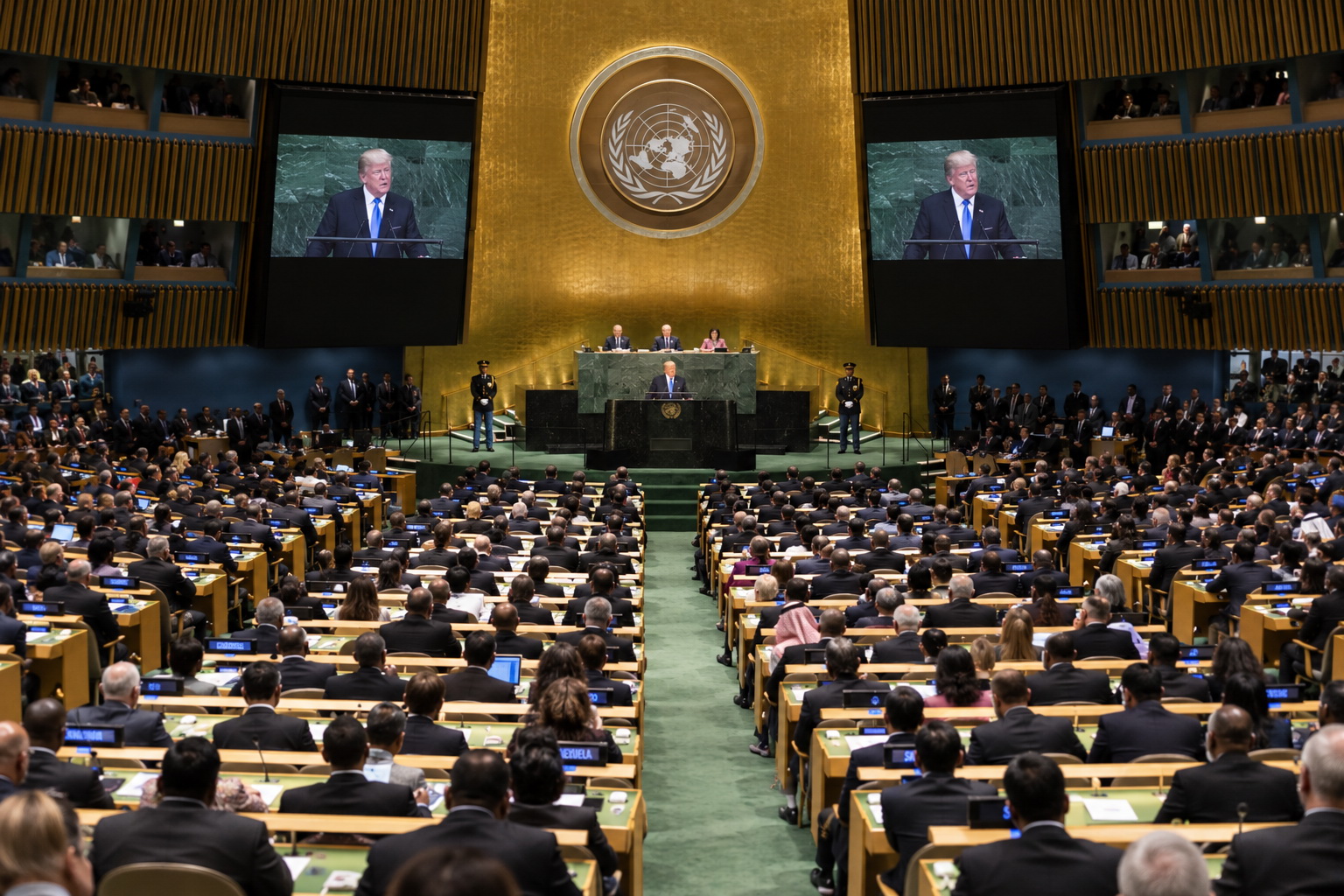
Standing before world leaders at the United Nations, President Donald Trump delivered one of the most extraordinary threats of his first year in office.
If the United States was forced to defend itself or its allies from North Korea, Trump warned, America would be prepared to destroy the country.
It was Trump's first address to the United Nations General Assembly and came during an increasingly dangerous confrontation with North Korean leader Kim Jong Un over the country's rapidly advancing nuclear and ballistic missile programs.
Trump had already adopted increasingly aggressive rhetoric toward Pyongyang.
Now he was taking that language to the world's foremost international diplomatic forum.
“Totally Destroy North Korea”
Trump began the North Korea portion of his speech by condemning the country's government and its treatment of its own people.
He cited the death of American college student Otto Warmbier after his detention in North Korea, the assassination of Kim Jong Un's half-brother Kim Jong Nam and North Korea's history of abducting foreign citizens.
Then Trump turned to the country's nuclear weapons program.
He warned that North Korea's pursuit of nuclear weapons and ballistic missiles threatened the world with potentially catastrophic consequences.
Then came the sentence that would dominate coverage of the speech:
> “The United States has great strength and patience, but if it is forced to defend itself or its allies, we will have no choice but to totally destroy North Korea.”
Trump immediately followed the threat with a nickname for Kim Jong Un that he had begun using publicly.
“Rocket Man is on a suicide mission for himself and for his regime.”
The remarks were remarkable not simply because of their severity, but because of where they were delivered.
The president of the United States was standing at the podium of the United Nations General Assembly openly discussing the potential destruction of another U.N. member state.
A Nuclear Crisis Was Already Escalating
Trump's remarks came during months of rapidly increasing tension on the Korean Peninsula.
North Korea had continued testing ballistic missiles while working toward weapons capable of threatening the United States.
Then, on September 3, North Korea conducted its sixth and most powerful nuclear test to that point.
Pyongyang claimed it had successfully tested a hydrogen bomb capable of being mounted on an intercontinental ballistic missile.
The test intensified international concern over how quickly North Korea's nuclear capabilities were advancing.
The United Nations Security Council responded with another round of sanctions against the country.
But Trump was signaling that sanctions might not be enough.
“Fire and Fury”
The United Nations speech was not Trump's first warning that military action was possible.
Only weeks earlier, Trump had declared that continued North Korean threats would be met with “fire and fury like the world has never seen.”
The rhetoric between Washington and Pyongyang continued escalating.
North Korea threatened possible missile strikes near the American territory of Guam.
Trump responded that American military options were ready if necessary.
By September, what had begun as a long-running international dispute over North Korea's nuclear program increasingly sounded like a personal confrontation between the leaders of two nuclear-armed adversaries.
The United Nations speech pushed that confrontation onto the world stage.
Trump Calls on the World to Isolate Kim
Despite the dramatic military threat, Trump also called for continued international pressure.
He praised the U.N. Security Council for unanimously approving sanctions against North Korea and specifically thanked China and Russia for supporting the measures.
But he argued that more needed to be done.
Trump called on nations to isolate Kim's government until North Korea ended what he described as its hostile behavior and abandoned its nuclear ambitions.
“It is time for North Korea to realize that the denuclearization is its only acceptable future,” Trump said.
The administration was attempting to combine economic pressure, diplomatic isolation and the threat of overwhelming American military force.
North Korea Responds
Pyongyang did not respond by lowering the temperature.
Kim Jong Un subsequently issued an unusually direct personal statement attacking Trump and promising that the American president would “pay dearly” for his remarks.
North Korean officials also suggested the country could conduct additional weapons tests.
The exchange produced another unusual moment in international diplomacy as two national leaders traded personal insults while commanding countries capable of inflicting enormous military destruction.
The confrontation would continue through the remainder of 2017.
From Threats to Diplomacy
What happened next makes the September speech even more striking in retrospect.
Less than a year later, Trump and Kim would meet face-to-face.
Their June 2018 summit in Singapore marked the first meeting between a sitting American president and a North Korean leader.
Trump would eventually describe his relationship with Kim in extraordinarily warm terms, while the two leaders exchanged letters and held additional meetings.
But the diplomatic relationship did not produce the complete denuclearization of North Korea that the Trump administration sought.
The country continued developing its nuclear and missile capabilities.
A Remarkable Moment at the United Nations
Presidents routinely use the United Nations General Assembly to discuss wars, international security and threats posed by hostile governments.
Trump's September 19 speech went considerably further.
In his first appearance before the General Assembly, the president publicly contemplated the complete destruction of another country if the United States or its allies were forced to defend themselves.
The statement reflected Trump's approach to foreign policy during his first year: unpredictability, personal rhetoric and an emphasis on overwhelming American power.
The administration argued that such pressure was necessary to convince North Korea that pursuing nuclear weapons would carry unacceptable consequences.
Critics feared that increasingly personal threats between Washington and Pyongyang could increase the possibility of miscalculation during an already dangerous nuclear confrontation.
For several months in 2017, the possibility of military conflict with North Korea appeared increasingly serious.
And on September 19, from the podium of an institution created in the aftermath of World War II to prevent another catastrophic global conflict, the president of the United States delivered one of his starkest warnings:
If America were forced to defend itself or its allies, Trump said, the United States was prepared to “totally destroy North Korea.”