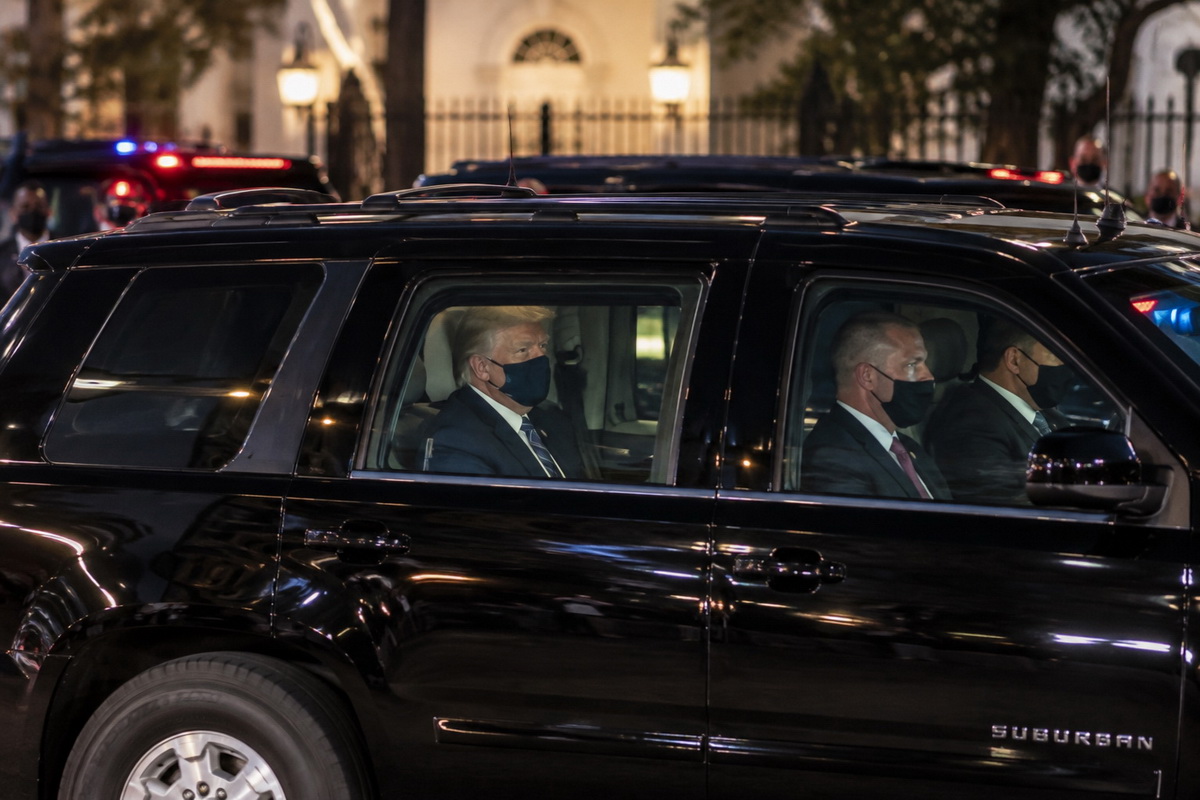
Shortly before 1 a.m. on October 2, 2020, President Donald Trump announced that the coronavirus pandemic that had consumed his presidency had reached him personally.
Trump said that he and first lady Melania Trump had tested positive for COVID-19 and would immediately begin quarantining.
The announcement stunned Washington and threw the presidential campaign into uncertainty just 32 days before Election Day.
By that evening, the 74-year-old president was aboard Marine One, flying from the White House to Walter Reed National Military Medical Center for treatment.
It was an extraordinary moment in a pandemic that had already killed more than 205,000 Americans.
It was also impossible to separate Trump's diagnosis from his own record on the virus.
For months, Trump had repeatedly minimized aspects of the threat in public, predicted the virus would disappear, questioned the importance of some precautions and continued appearing at large political gatherings.
Privately, however, Trump had acknowledged months earlier that the virus was dangerous.
Now the president himself had COVID-19.
The Announcement Comes After Midnight
The chain of events accelerated on October 1 when news emerged that Hope Hicks, one of Trump's closest aides, had tested positive for the coronavirus.
Hicks had traveled with Trump during the week, including aboard Air Force One.
Trump and the first lady were tested.
Then, shortly before 1 a.m. Friday, October 2, Trump announced the results.
“Tonight, @FLOTUS and I tested positive for COVID-19,” Trump wrote.
He said the couple would begin their “quarantine and recovery process immediately.”
Melania Trump also announced that she had tested positive and postponed her upcoming engagements.
The president's schedule was suddenly cleared.
Campaign appearances were canceled.
Questions immediately arose about who else inside the White House might have been exposed.
Trump Had Continued Traveling
Trump's diagnosis followed several days of extensive travel and public appearances.
On September 29, he participated in the first presidential debate against Democratic nominee Joe Biden in Cleveland.
The following day, Trump traveled to Minnesota for campaign events.
Hicks accompanied him on some of the travel that week.
The president had also attended a September 26 White House ceremony announcing Amy Coney Barrett as his nominee for the Supreme Court.
Numerous attendees at that event later tested positive for COVID-19.
The growing outbreak raised questions about infection-control practices surrounding the president and senior administration officials.
Trump had frequently appeared in public without a mask, and masks were not consistently used by people around him.
Months of Minimizing the Virus
Trump's diagnosis immediately brought renewed attention to statements he had made throughout the pandemic.
During the early months of 2020, Trump repeatedly expressed confidence that the virus would soon disappear or remain under control.
On February 26, he said the number of American cases would soon be “down to close to zero.”
He repeatedly compared COVID-19 with influenza and argued that the country could not remain closed indefinitely.
Trump also resisted consistently modeling mask use.
Although he eventually wore a mask publicly and said masks could be useful, he frequently appeared without one and sometimes mocked political opponents for wearing them.
During the September 29 presidential debate, Trump criticized Biden's frequent mask use.
“I don't wear masks like him,” Trump said.
“Every time you see him, he's got a mask.”
Three days later, Trump announced that he had COVID-19.
Trump Privately Understood the Danger
The contrast between Trump's public statements and his private comments had already become a major controversy weeks before his diagnosis.
Journalist Bob Woodward released recordings from interviews conducted for his book Rage.
In a February 7 conversation, Trump told Woodward that the coronavirus was airborne and more dangerous than ordinary influenza.
“This is deadly stuff,” Trump said.
Yet Trump continued publicly minimizing the threat during the weeks that followed.
In another recorded conversation on March 19, Trump acknowledged what he was doing.
“I wanted to always play it down,” he told Woodward.
“I still like playing it down, because I don't want to create a panic.”
Trump later defended those comments by arguing that presidents should project confidence rather than create public panic.
His critics argued that Americans had been denied a clear assessment of the danger at a critical stage of the pandemic.
The President Becomes Ill
Initially, the White House portrayed Trump's condition as relatively mild.
But during October 2, concerns about his health increased.
Trump received an experimental antibody treatment produced by Regeneron.
He was also given other medications and supplements.
Later reporting revealed that Trump experienced a fever and that his blood oxygen level had fallen enough that he received supplemental oxygen at the White House.
By Friday evening, the decision had been made to move him to Walter Reed.
The White House described the hospitalization as precautionary.
Television cameras gathered outside the White House as Trump walked from the residence to Marine One.
Wearing a dark suit and a mask, Trump gave reporters a thumbs-up before boarding the helicopter.
Minutes later, the president was airborne.
Marine One Heads for Walter Reed
The image was extraordinary.
For months, Trump had insisted that America was defeating the virus.
Now the presidential helicopter was carrying him to a military hospital because of it.
Trump would remain at Walter Reed for three nights.
Doctors treated him with remdesivir and dexamethasone in addition to the experimental antibody therapy he had received at the White House.
Questions soon emerged about the severity of his illness and the timeline of his diagnosis.
Trump's medical team and White House officials gave statements that at times created confusion about when he had tested positive, whether he had received oxygen and how seriously ill he had become.
White House Chief of Staff Mark Meadows privately gave reporters a more concerning assessment than Trump's physicians initially presented publicly.
The president, Meadows said, had experienced a “very concerning” period.
An Outbreak Around the President
Trump was not the only person in his orbit to become infected.
The outbreak eventually included multiple White House officials, campaign personnel and Republican political figures.
Among those who tested positive around this period were Hope Hicks, former counselor Kellyanne Conway, campaign manager Bill Stepien and Republican Sens. Mike Lee and Thom Tillis.
Former New Jersey Gov. Chris Christie, who had helped Trump prepare for the presidential debate, also contracted COVID-19 and was hospitalized.
Several infected individuals had attended the September 26 White House event announcing Barrett's Supreme Court nomination.
Dr. Anthony Fauci later described the gathering as a “superspreader event.”
COVID Disrupts the Presidential Campaign
Trump's illness immediately changed the presidential campaign.
Campaign events were canceled.
The president was temporarily removed from the campaign trail.
Questions surrounded the remaining presidential debates.
Trump's age and weight placed him in categories associated with greater risk of severe illness.
Meanwhile, Biden's campaign faced its own urgent concern: whether the Democratic nominee had been exposed during the September 29 debate.
Biden subsequently tested negative.
The pandemic had already dominated the election.
Now one of the candidates was hospitalized because of it.
Trump Returns to the White House
Trump left Walter Reed on October 5.
After arriving at the White House aboard Marine One, he climbed the stairs to the Truman Balcony.
Then, while still being treated for COVID-19, Trump removed his mask in front of television cameras.
He later released a video urging Americans not to allow the virus to control their lives.
“Don't be afraid of Covid,” Trump said.
“Don't let it dominate your life.”
The remarks immediately generated controversy.
By then, more than 210,000 Americans had died during the pandemic.
Millions had been infected.
Many patients did not have access to the level of medical care and experimental treatments available to the president.
The Virus Reaches the President
October 2 became one of the defining days of Trump's first term.
COVID-19 had already closed businesses, emptied schools, overwhelmed hospitals, devastated families and transformed everyday American life.
For months, Trump had tried to project confidence that the crisis would soon pass.
He had privately acknowledged that the virus was dangerous while publicly attempting to reassure Americans and, by his own admission, playing down the threat to avoid panic.
Then the pandemic reached the president himself.
Shortly before 1 a.m., America learned that Donald Trump had COVID-19.
Before the day was over, Marine One was lifting off from the White House lawn.
Its destination was Walter Reed.