Donald Trump hadn't taken office yet, but America's largest defense contractors were already discovering that a single message from the president-elect could move billions of dollars on Wall Street.
This time, the target was one of the most expensive weapons programs in American history:
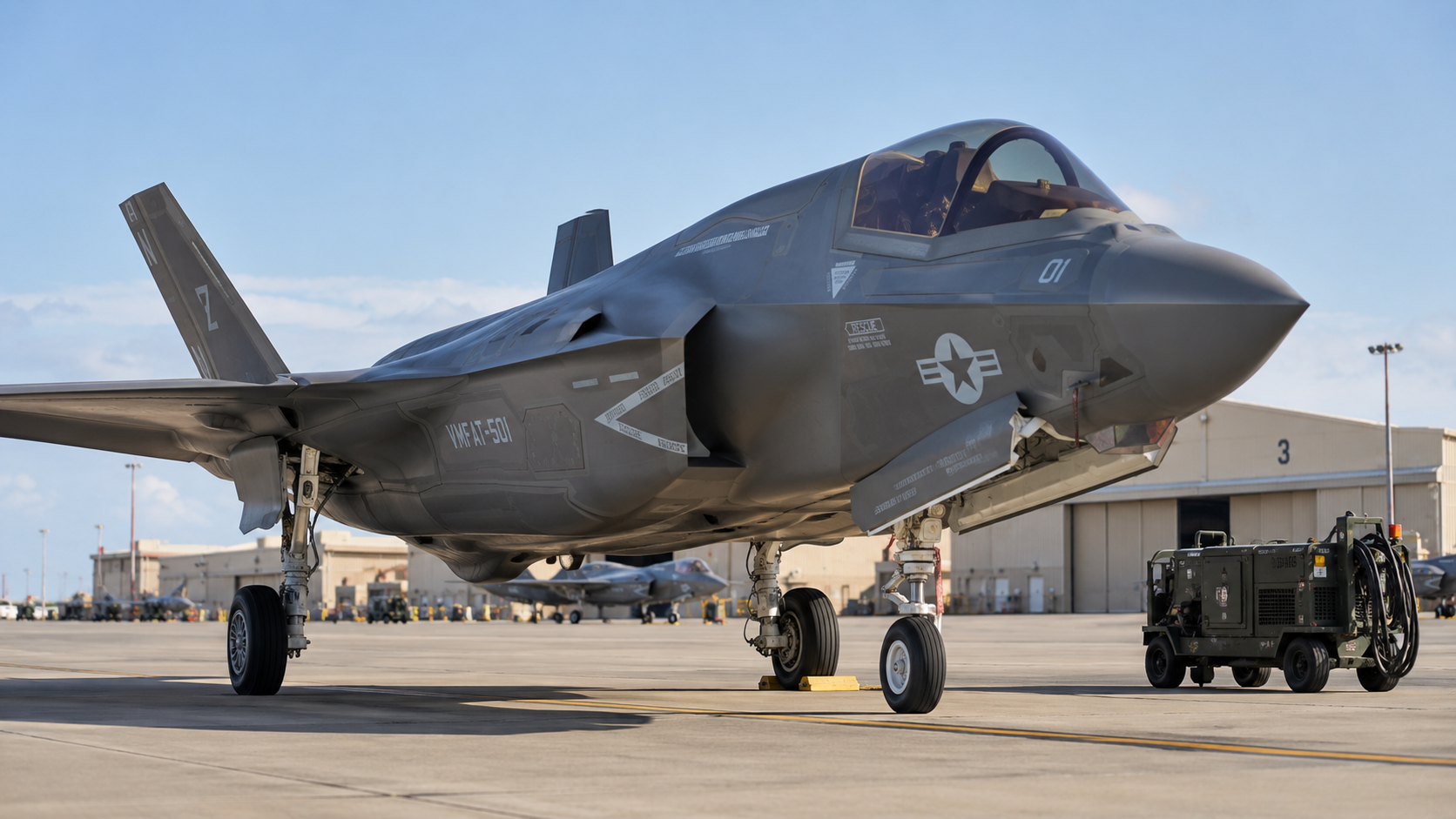
The F-35 Joint Strike Fighter.
Early on December 12, Trump posted a message on Twitter criticizing the aircraft's enormous price tag.
“The F-35 program and cost is out of control. Billions of dollars can and will be saved on military (and other) purchases after January 20th.”
The reaction was immediate.
Shares of Lockheed Martin, the F-35's prime contractor, plunged.
A Fighter Jet With a Troubled History
Trump had chosen an easy target for anyone looking to criticize Pentagon spending.
The F-35 program was enormously ambitious.
The idea was to develop a family of advanced stealth fighters capable of serving the Air Force, Navy and Marine Corps while also supplying aircraft to American allies.
Three major variants would share much of the same underlying design.
The Air Force's F-35A would operate from conventional runways.
The Marine Corps' F-35B could perform short takeoffs and vertical landings.
The Navy's F-35C would operate from aircraft carriers.
In theory, sharing technology and components among the services could reduce costs.
In practice, developing such a complicated family of aircraft proved enormously expensive.
By the time Trump won the presidency, the F-35 had already endured years of delays, technical problems and criticism over its cost.
But it was also moving into operational service and had become deeply embedded in American and allied defense planning.
Canceling or dramatically restructuring it would therefore be far more complicated than criticizing it on Twitter.
Wall Street Reacts
Investors nevertheless took Trump's message seriously.
Lockheed Martin shares fell sharply after the tweet, at one point dropping roughly 5 percent.
Billions of dollars in market value temporarily disappeared.
It was the second time in less than a week that Trump had publicly targeted one of America's largest aerospace companies.
On December 6, he had attacked Boeing over the projected cost of replacing the presidential Air Force One aircraft.
Now Lockheed Martin was in the spotlight.
A pattern was emerging.
Instead of waiting until taking office and conducting a formal procurement review, Trump was using his public platform to put pressure on major government contractors before his administration had even begun.
Lockheed Martin Responds
Lockheed Martin didn't deny that affordability was a major concern.
Company officials emphasized that the cost of producing the aircraft had already been falling as production increased.
F-35 program manager Jeff Babione said the company understood concerns about affordability and had been working to reduce both production and operating costs.
That distinction would become important.
The F-35 program was extraordinarily expensive overall, but the price of individual aircraft was already moving downward as manufacturing expanded.
Determining how much additional savings could be attributed to presidential pressure would therefore eventually require separating Trump's actions from reductions that were already expected.
“Billions” Becomes a Testable Promise
Trump's tweet contained something unusually useful for evaluating a president's record later:
A measurable claim.
Billions of dollars can and will be saved.
Once Trump became president, his administration would have the opportunity to negotiate with Lockheed Martin and influence future F-35 contracts.
That means the December 12 statement doesn't have to remain merely political rhetoric.
It can eventually be tested.
Did F-35 prices decline?
How much did the government actually save?
How much of those reductions had already been planned?
Did the overall cost of the F-35 program decline — or did other expenses continue rising?
And how did Trump's claimed savings compare with the program's total cost over the following years?
Those answers would take time.
The Beginning of a Much Longer F-35 Story
For now, Trump had put America's largest defense contractor on notice.
He had identified a weapons program with a genuine and well-documented history of cost problems and promised that his administration would force those costs downward.
Lockheed Martin's stock market reaction demonstrated that investors believed the incoming president might actually change the economics of major Pentagon contracts.
Whether he ultimately delivered the billions of dollars in savings he promised was another question.
And unlike many political promises, this one would eventually leave behind a long trail of contracts, budgets and government spending reports that could be examined.