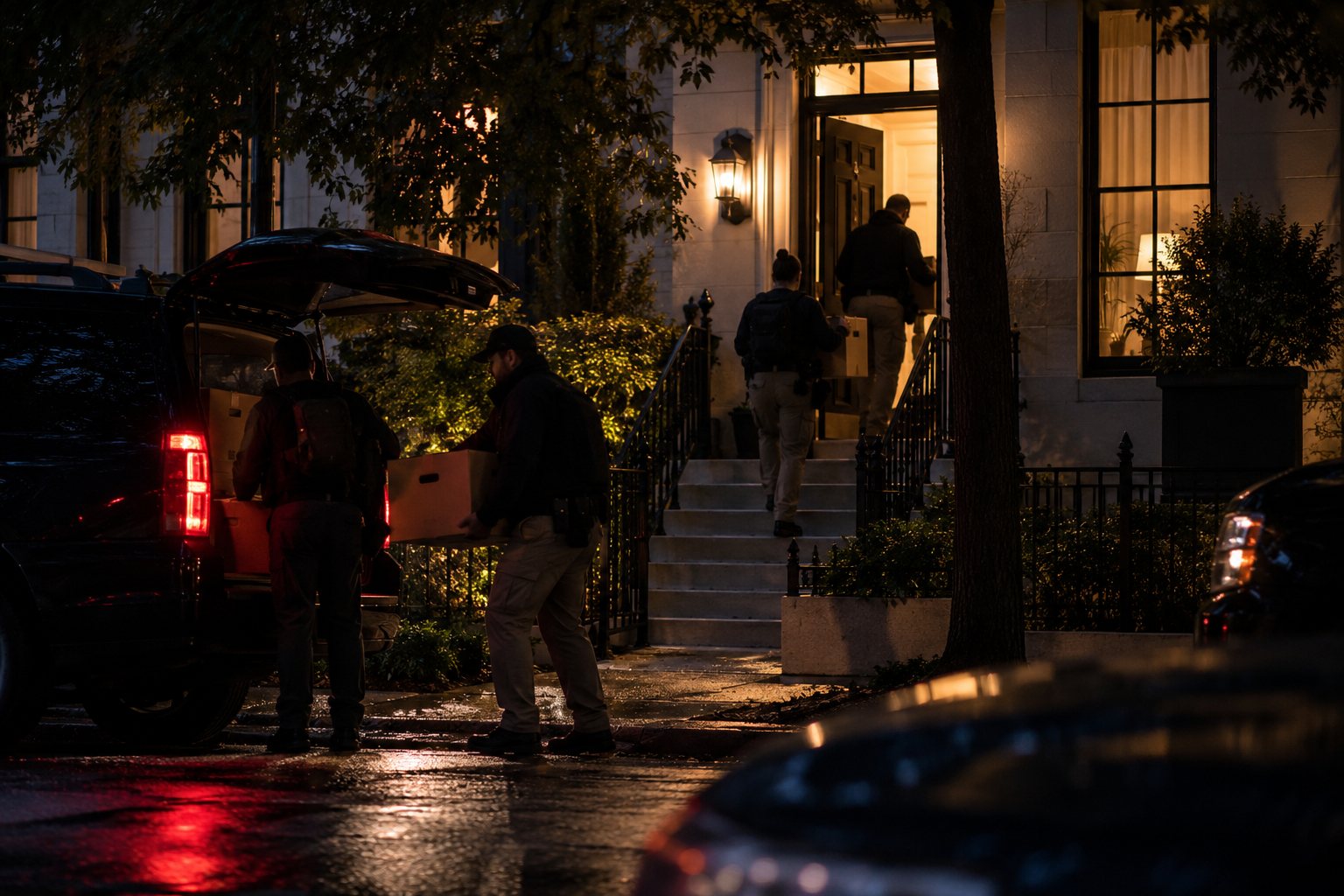
Federal agents raided Democratic Representative Ilhan Omar's Washington, D.C., home Monday as part of an investigation into immigration paperwork completed when she was a child. But the extraordinary action raises an uncomfortable question for President Donald Trump: Why has his administration pursued allegations involving Omar while documented questions about the immigration histories of Elon Musk and First Lady Melania Trump have attracted no comparable public enforcement action?**
On October 12, Homeland Security Investigations agents executed a judicially authorized search warrant at Omar's residence, just three weeks before the midterm elections.
According to Reuters, the investigation concerns possible irregularities in immigration documents completed by Omar's late father when she was a child.
Federal officials have not publicly established that Omar committed immigration fraud, and she has repeatedly denied allegations surrounding her immigration history.
Yet the investigation has already produced a highly visible federal raid against one of Trump's most outspoken political opponents.
Meanwhile, two prominent figures in Trump's own orbit have faced serious, extensively reported questions about their immigration histories.
Elon Musk's Immigration History
In October 2024, The Washington Post published an investigation concluding that billionaire Elon Musk worked in the United States without proper authorization while establishing the company that became Zip2 in the mid-1990s.
Musk had been accepted into a graduate program at Stanford University but never enrolled. Instead, he began building his technology business.
Former associates and investors told the newspaper that Musk's immigration status became a concern because he lacked the necessary authorization to work.
The investigation also uncovered a 2005 email in which Musk acknowledged that he had lacked a legal right to remain in the country when he was establishing his business.
Investors reportedly pushed Musk and his brother to resolve their immigration status before the company proceeded with additional financing.
Musk has denied working illegally, maintaining that he possessed valid immigration authorization, including a J-1 visa that later transitioned to an H-1B visa.
The precise details of his immigration record have not been publicly established.
Nevertheless, the reporting raises legitimate questions about whether Musk complied with the same immigration rules he has since publicly demanded be strictly enforced against others.
Melania Trump Worked Before Receiving Authorization
The immigration history of First Lady Melania Trump presents another documented controversy.
In November 2016, an Associated Press investigation uncovered modeling agency records showing that Melania Trump received payment for 10 modeling assignments in the United States before obtaining authorization to work.
The assignments took place between September 10 and October 15, 1996.
According to the AP, she earned $20,056 during that period.
Her attorney previously stated that she entered the United States on a visitor visa in August 1996 and received an H-1B work visa on October 18.
Visitor visas generally do not authorize paid employment in the United States.
The documents therefore indicated that Melania Trump performed paid work before receiving the authorization required for those assignments.
Melania Trump has maintained that she followed immigration law and entered the country legally.
Questions were also raised about her subsequent green card, which she received in 2001 through an employment-based category reserved for individuals demonstrating extraordinary ability.
Immigration attorneys questioned how her modeling career satisfied the program's demanding criteria.
However, questions about eligibility are not proof that her application contained false information, and no public finding has established that she fraudulently obtained permanent residency.
One Standard for Political Enemies, Another for Allies?
The contrast with Omar's situation is difficult to ignore.
Omar arrived in the United States as a child and became a naturalized citizen in 2000.
The current investigation reportedly concerns information submitted by her father decades ago.
No public evidence has established that Omar knowingly submitted false information.
Yet federal investigators have searched her home, and senior Trump administration officials have publicly discussed the possibility of deportation.
Musk and Melania Trump, by contrast, were adults when the conduct examined in the Washington Post and Associated Press investigations occurred.
Their cases are not legally identical. Working without authorization, misrepresenting information on an immigration application, and obtaining citizenship through fraud are distinct issues with different legal requirements and consequences.
But that distinction makes the administration's approach worth examining rather than dismissing.
If the government considers decades-old immigration irregularities serious enough to justify an investigation of a sitting member of Congress, the public is entitled to ask whether the same scrutiny is applied consistently to influential presidential allies.
A Raid Just Weeks Before an Election
The timing adds another troubling dimension.
Omar is seeking reelection on November 3, and the raid occurred only 22 days before voters head to the polls.
Justice Department policy prohibits investigative actions designed to influence elections. Although the existence of a search warrant means a judge authorized the search, that authorization does not establish the truth of every allegation under investigation.
Nor does the timing alone prove political interference.
But Trump has repeatedly attacked Omar personally, and senior administration officials publicly discussed investigating her immigration history before the raid occurred.
Omar has described the investigation as political intimidation.
The administration maintains that the search is part of a legitimate federal criminal investigation.
The Question the White House Should Answer
Immigration law should apply consistently, regardless of wealth, political connections, or party affiliation.
The documented questions surrounding Musk's employment authorization and Melania Trump's early modeling work deserve accurate examination, just as any credible evidence concerning Omar's immigration paperwork deserves fair consideration.
But allegations must be distinguished from proven violations, and investigative powers must not be used selectively against political opponents.
For an administration that has made strict immigration enforcement a defining priority, the contrast is particularly striking.
If decades-old immigration paperwork is grounds for federal scrutiny, why should that scrutiny stop at the president's political allies?