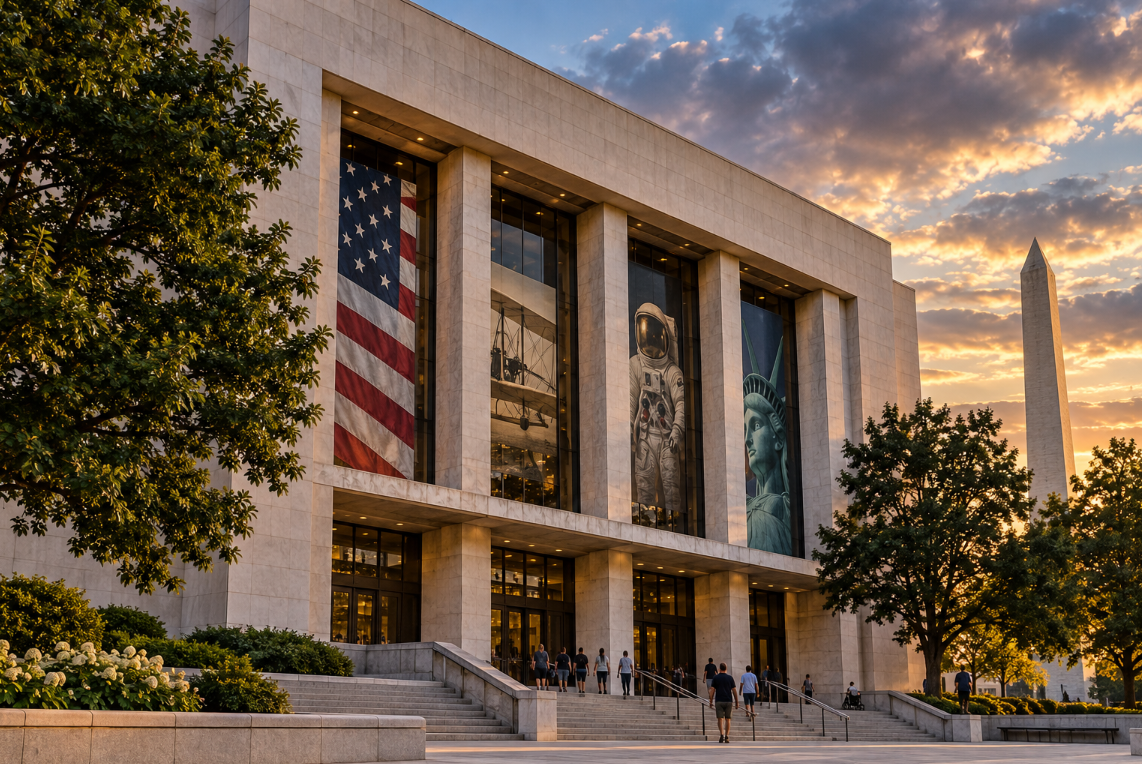
President Donald Trump has opened another front in his administration's campaign to reshape American cultural institutions, this time targeting one of the country's most recognizable centers of history, education, art and scientific research: the Smithsonian Institution.
On July 24, Trump signed Executive Order 14416, titled "Restoring Trust in the Smithsonian Institution." Despite its reassuring title, the order represents an extraordinary attempt by a presidential administration to use the power of the federal government to influence how one of America's most important cultural institutions presents the nation's history.
The order followed a months-long review conducted by Trump's Domestic Policy Council. The resulting White House report accused Smithsonian leadership of using American history to promote social justice and what the administration described as the "radical transformation" of society.
Trump's response went considerably further than simply criticizing museum exhibits.
His order directs the Interior Department, Office of Management and Budget, General Services Administration and White House Domestic Policy Council to identify and use available government authority to pressure the Smithsonian to address the administration's complaints.
Even more remarkably, Trump ordered the National Park Service to place temporary signs along the sidewalks and walkways leading to the National Museum of American History.
Those signs are intended to warn visitors about what the administration calls the museum's "ideological capture" and tell them that exhibits should be changed.
In effect, the federal government is being instructed to place its own competing interpretation of American history outside a national museum because the White House objects to what visitors may encounter inside.
The order also directs the government to install temporary displays outside the museum to counter information the administration considers inaccurate, specifically criticizing the museum for what Trump says is an inadequate commemoration of the 56 signers of the Declaration of Independence during America's 250th anniversary.
THE SMITHSONIAN IS MORE THAN A MUSEUM
The confrontation is significant because the Smithsonian is far larger than the National Museum of American History.
For generations, the Smithsonian Institution has served as one of America's great repositories of knowledge. Its museums preserve everything from the original Star-Spangled Banner and the Wright brothers' airplane to works of art, fossils, scientific specimens and artifacts documenting some of the most difficult chapters in American history.
The institution also conducts scientific research and operates educational programs and research centers.
That makes the administration's campaign against the Smithsonian part of a larger question: how much control should a president have over the institutions responsible for preserving and interpreting America's history, culture, art and scientific knowledge?
Trump's answer increasingly appears to be that the federal government should play a much more aggressive role.
A CAMPAIGN THAT BEGAN IN 2025
The July order did not appear out of nowhere.
In March 2025, Trump signed another executive order titled "Restoring Truth and Sanity to American History."
That order directed Vice President JD Vance, a member of the Smithsonian's Board of Regents, to work to eliminate what the administration described as "improper, divisive, or anti-American ideology" from Smithsonian museums, education and research centers and the National Zoo.
The administration also sought to influence future congressional funding for Smithsonian programs and exhibits.
The message was unmistakable: federal support could increasingly become connected to whether cultural institutions presented American history in a manner acceptable to the administration.
WHO DECIDES WHAT HISTORY AMERICANS SEE?
Trump and his supporters argue that American museums have become overly focused on racism, oppression, inequality and the country's historical failures while giving insufficient attention to American achievements.
That is a legitimate subject for public debate.
But there is an enormous difference between criticizing a museum and using presidential authority, federal agencies and potentially federal funding to pressure that museum into presenting history differently.
Museums exist precisely because history is complicated.
American history includes the Declaration of Independence and slavery.
It includes the Constitution and segregation.
It includes extraordinary scientific achievements and episodes in which scientific institutions failed the public.
It includes military victories, political accomplishments, civil-rights struggles, economic innovation and profound injustice.
Preserving that entire story is not the same thing as attacking America.
THE PRESSURE CONTINUES
The July executive order represents another stage in a confrontation that has been building since Trump returned to office.
The administration is no longer merely complaining about paintings, exhibits or historical interpretations it dislikes. It is attempting to use the machinery of the federal government to influence what Americans encounter when they walk into institutions entrusted with preserving the country's cultural and intellectual heritage.
That should make the Smithsonian dispute about something much larger than a museum exhibit.
Presidents come and go.
The nation's history, art, scientific collections and cultural institutions are supposed to outlast them.
The question raised by Trump's campaign against the Smithsonian is whether those institutions will remain places where Americans can confront the country's complicated history and explore knowledge freely — or whether the federal government will increasingly decide which parts of the American story are acceptable to display.