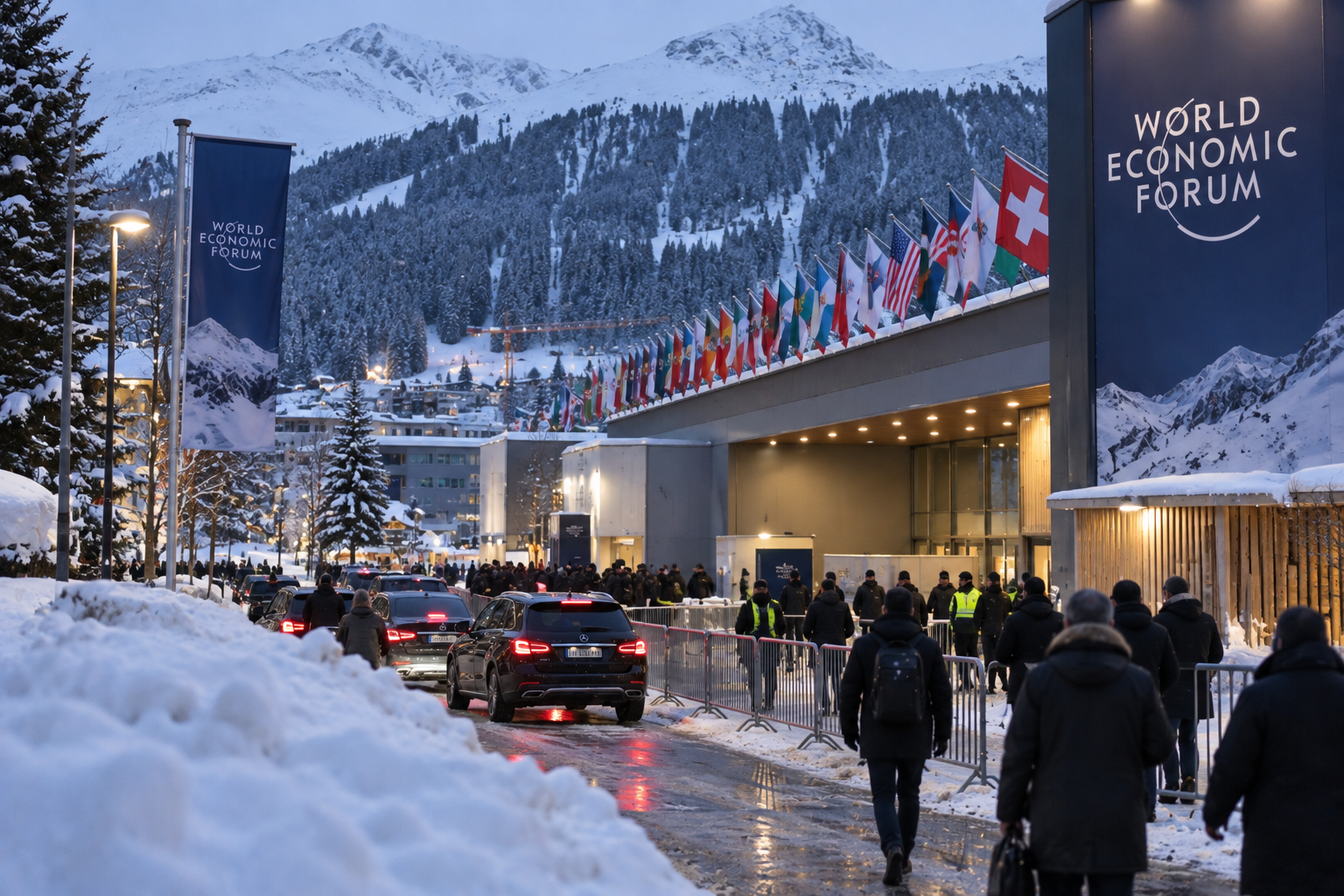
Donald Trump arrived in Davos, Switzerland, carrying a message that seemed almost designed to clash with the institution hosting him.
“America First.”
The World Economic Forum was built around international cooperation, global commerce and relationships among political and business leaders. Trump had risen to the presidency attacking many of the assumptions associated with that global economic order.
Yet standing before the world's political and business elite on January 26, Trump attempted to present “America First” not as American withdrawal from the world, but as an invitation to invest in the United States.
“As President of the United States, I will always put America first,” Trump told the gathering.
Then came the qualification:
“But America first does not mean America alone.”
Trump Goes to Davos
Trump's appearance itself was significant.
Bill Clinton had become the first sitting American president to attend the World Economic Forum in Davos in 2000. Neither George W. Bush nor Barack Obama attended the annual gathering while president.
Eighteen years later, Trump became the second sitting U.S. president to make the trip.
It was an unusual setting for a politician whose campaign had been built partly around opposition to globalization and criticism of international trade agreements.
But Trump did not travel to Switzerland to abandon that message.
He went there to sell it.
“Come to America”
Much of Trump's address sounded like a sales pitch for the United States.
He highlighted corporate tax reductions, deregulation and economic growth while urging international businesses to invest and manufacture in America.
“America is the place to do business,” Trump said, before inviting companies to come to the United States to “innovate, create and build.”
Trump argued that American economic growth benefited other countries as well.
“When the United States grows, so does the world,” he said.
It was a more conciliatory formulation of the nationalism that had defined his campaign.
But when Trump turned to trade, the harder edge of “America First” quickly returned.
Fair and Reciprocal Trade
Trump told the audience that the United States supported free trade — but only under conditions he considered fair.
“We support free trade, but it needs to be fair and it needs to be reciprocal,” Trump said.
He accused countries of exploiting the international trading system through practices including intellectual-property theft, industrial subsidies and state-directed economic policies.
“The United States will no longer turn a blind eye to unfair economic practices,” Trump declared.
The message was particularly significant because Trump had just demonstrated his willingness to use tariffs.
Only days earlier, he had approved safeguard tariffs on imported washing machines and solar products.
The administration was moving from criticism of existing trade arrangements toward direct intervention in international commerce.
America First Meets Globalization
Davos represented almost everything Trump's political movement had criticized.
The annual meeting brought together political leaders, corporate executives, financiers and other influential figures from around the world.
Trump nevertheless told that audience that nationalism and international commerce did not necessarily have to conflict.
His argument was that every national leader should pursue the interests of his or her own country — just as he intended to pursue America's.
Trump also indicated that the United States remained interested in negotiating trade agreements, including potentially with countries participating in the Trans-Pacific Partnership, the agreement he had withdrawn the United States from shortly after taking office.
The distinction Trump attempted to draw was between globalization on terms he believed disadvantaged the United States and international commerce conducted on terms he considered reciprocal.
A Preview of the Trade Battles Ahead
Trump's Davos appearance came at an important moment.
His administration had spent its first year withdrawing from the Trans-Pacific Partnership, renegotiating NAFTA and criticizing China's trade practices.
Now tariffs were beginning.
Within weeks, Trump would announce tariffs on imported steel and aluminum.
Soon afterward, the administration's confrontation with China would escalate dramatically, with the United States and China eventually imposing tariffs on hundreds of billions of dollars of each other's goods.
Against that backdrop, Trump's carefully worded Davos message takes on additional significance.
“America First does not mean America alone” suggested cooperation.
But the rest of his message contained a warning.
The United States would participate in the global economy.
It would welcome foreign investment.
It would negotiate with other countries.
But under Trump, the United States was also prepared to challenge the rules and relationships that had governed international trade for decades.
Standing before the world's economic establishment in Davos, Trump wasn't abandoning “America First.”
He was taking it directly to them.