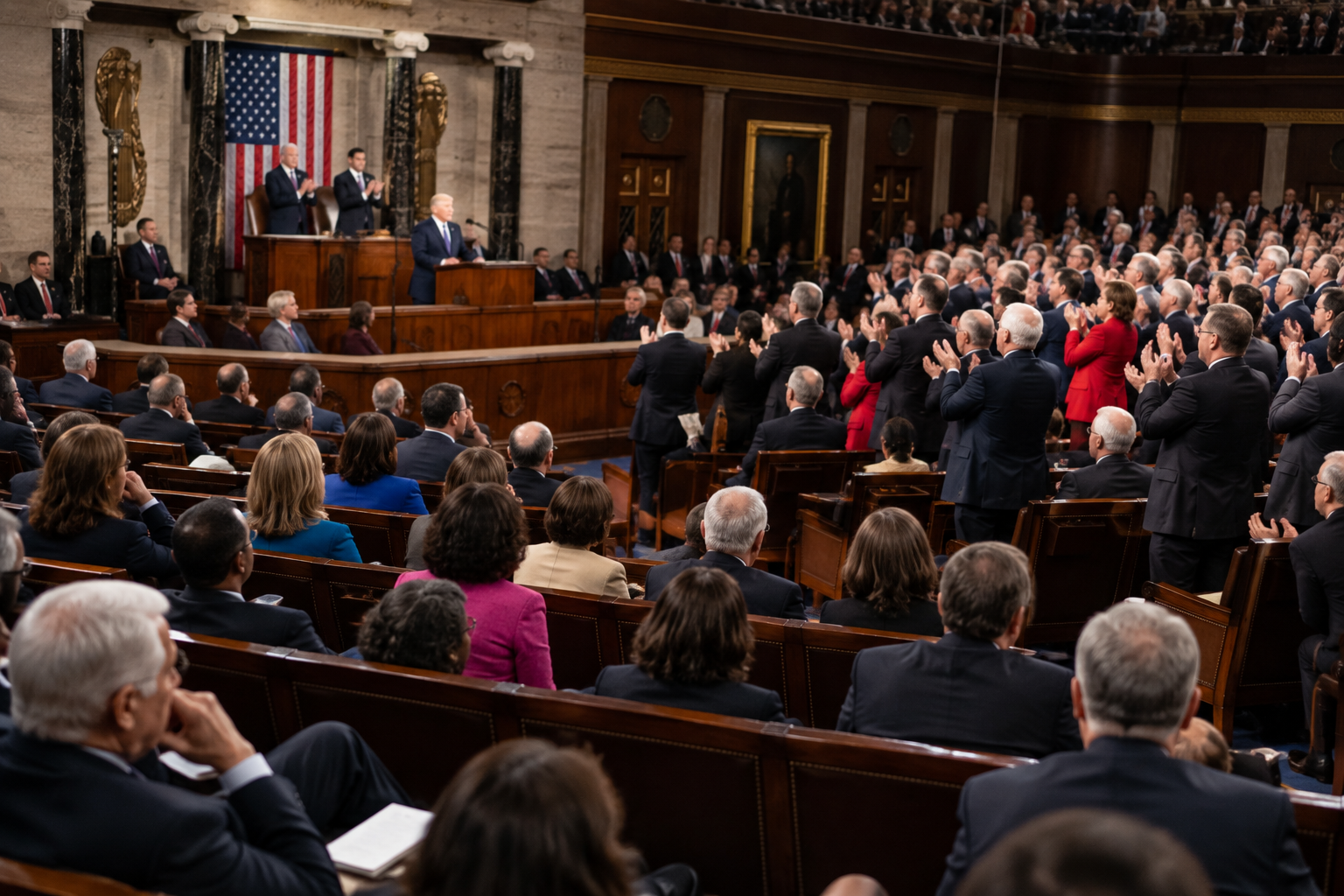
Five days after delivering his first State of the Union address, President Donald Trump stood before an audience in Ohio and complained about something that had bothered him during the speech.
Democrats hadn't applauded enough.
Trump had watched Democratic lawmakers remain seated during portions of his address while Republicans repeatedly stood and cheered.
At an event in Blue Ash, Ohio, Trump returned to the subject.
“They were like death,” Trump said of the Democrats.
Then the president of the United States used a considerably more serious word.
“Somebody said ‘treasonous,’” Trump told the crowd.
“I mean, yeah, I guess, why not?”
Trump then described the Democrats' behavior as “un-American.”
It was an extraordinary escalation of what was, fundamentally, an ordinary Washington ritual:
The opposition party refusing to applaud the president.
Democrats Sit Through Trump's Speech
Trump delivered his State of the Union address on January 30, 2018.
Like virtually every modern State of the Union, the speech produced sharply partisan reactions inside the House chamber.
Republicans frequently rose to applaud.
Many Democrats remained seated.
Trump particularly objected to Democrats remaining seated during portions of the speech in which he discussed positive economic statistics.
Speaking in Ohio on February 5, Trump portrayed their reaction as something more sinister than partisan disagreement.
“They would rather see Trump do badly, okay, than our country do well,” he said.
He then described their behavior as “very selfish.”
“But they were like death and un-American,” Trump continued.
“Un-American. Somebody said ‘treasonous.’ I mean, yeah, I guess, why not?”
The crowd responded with laughter and applause.
Treason Isn't Just Another Political Insult
The significance of Trump's remark wasn't simply that it was inflammatory.
“Treason” has an actual meaning under the Constitution.
Article III defines treason against the United States narrowly as levying war against the country or adhering to its enemies by giving them “Aid and Comfort.”
The Constitution deliberately sets an extraordinarily high standard for proving it.
The Founders had seen governments use accusations of treason against political enemies and designed the American definition to prevent the charge from being casually expanded.
Not applauding a president doesn't remotely approach that constitutional standard.
Neither does opposing his policies.
Neither does belonging to the opposing political party.
And neither does sitting silently during a State of the Union address.
Whatever Trump intended by the remark, the behavior he described was not treason.
The White House Says Trump Was Joking
The White House quickly attempted to soften the president's remarks.
Press secretary Sarah Huckabee Sanders said Trump had been joking.
“He was clearly joking with his comments,” Sanders told reporters the following day.
She said Democrats had chosen to “sit on their hands” rather than celebrate accomplishments that Trump believed benefited Americans.
The White House therefore characterized the treason comment as political humor rather than an accusation that Democratic lawmakers had literally committed a crime against the United States.
But the episode still mattered.
Presidents possess an enormous platform.
And words such as “treason” carry considerably different implications when spoken by the nation's chief executive than when shouted by someone at a political rally.
Democrats Push Back
Democrats condemned Trump's comments.
Sen. Tammy Duckworth of Illinois, an Iraq War veteran who lost both legs after the helicopter she was piloting was struck by a rocket-propelled grenade, responded particularly forcefully.
“We don't live in a dictatorship or a monarchy,” Duckworth said.
She argued that criticizing or refusing to applaud the president was not un-American.
Other Democrats similarly pointed out that members of the opposition party routinely decline to applaud presidents from the other party.
Republicans had done it during Barack Obama's presidency.
Democrats had done it during George W. Bush's presidency.
Partisan reactions during presidential addresses were nothing new.
Calling those reactions “treasonous” was something different.
Presidents Have Always Faced Hostile Audiences
State of the Union addresses are political theater as much as constitutional ceremony.
The president's party stands.
The opposition often sits.
One side cheers.
The other side sometimes stares silently.
Occasionally lawmakers groan, laugh or visibly object.
Presidents have endured this behavior for generations.
During Barack Obama's presidency, Republican lawmakers frequently remained seated during portions of his addresses.
During George W. Bush's presidency, Democrats did the same.
That behavior was partisan.
Sometimes it was petty.
Sometimes it was performative.
But it was also part of American democracy.
The opposition is not obligated to applaud the president.
Loyalty to the Country Versus Loyalty to the President
Trump's comments raised a larger question that would repeatedly surface during his presidency:
Where does disagreement with Donald Trump end and disloyalty to America begin?
In the American constitutional system, those are supposed to be entirely different things.
A president is not the country.
Supporting the United States does not require supporting the person occupying the White House.
Members of Congress swear an oath to the Constitution, not to a president.
They are free to oppose a president's agenda.
They are free to criticize him.
They are free to vote against his legislation.
And they are certainly free to remain seated while he gives a speech.
That distinction is fundamental to representative government.
An Early Example of a Recurring Trump Theme
Viewed by itself, Trump's February 5 comment could be dismissed as another provocative remark at a political event.
The White House essentially did exactly that by describing it as a joke.
But viewed as part of Trump's broader political rhetoric, the moment is more significant.
Trump repeatedly portrayed political opponents not simply as people with different ideas, but as people acting against the interests of the country.
Opposition became obstruction.
Criticism became hostility.
Investigations became conspiracies.
And, on this occasion, refusing to applaud became something that could jokingly—or perhaps not entirely jokingly—be described as treason.
That rhetorical distinction matters.
Democracy assumes political opponents are legitimate participants in the system.
They can be wrong.
They can be partisan.
They can be hypocritical.
They can even be irresponsible.
But disagreement with the president does not make them enemies of the United States.
February 5, 2018
Nothing happened legally as a result of Trump's remark.
No Democrats were investigated for treason because they remained seated.
No prosecutor treated Trump's statement as an actual allegation.
The White House said the president was joking.
But the moment deserves a place in the record because of the language Trump chose.
Five days after Democrats declined to applaud portions of his State of the Union address, the president publicly entertained the idea that their behavior was “treasonous.”
Not because they aided an enemy.
Not because they took up arms against the United States.
Not because they betrayed classified information.
They didn't clap.
And in Donald Trump's Washington, even that could become a question of patriotism.