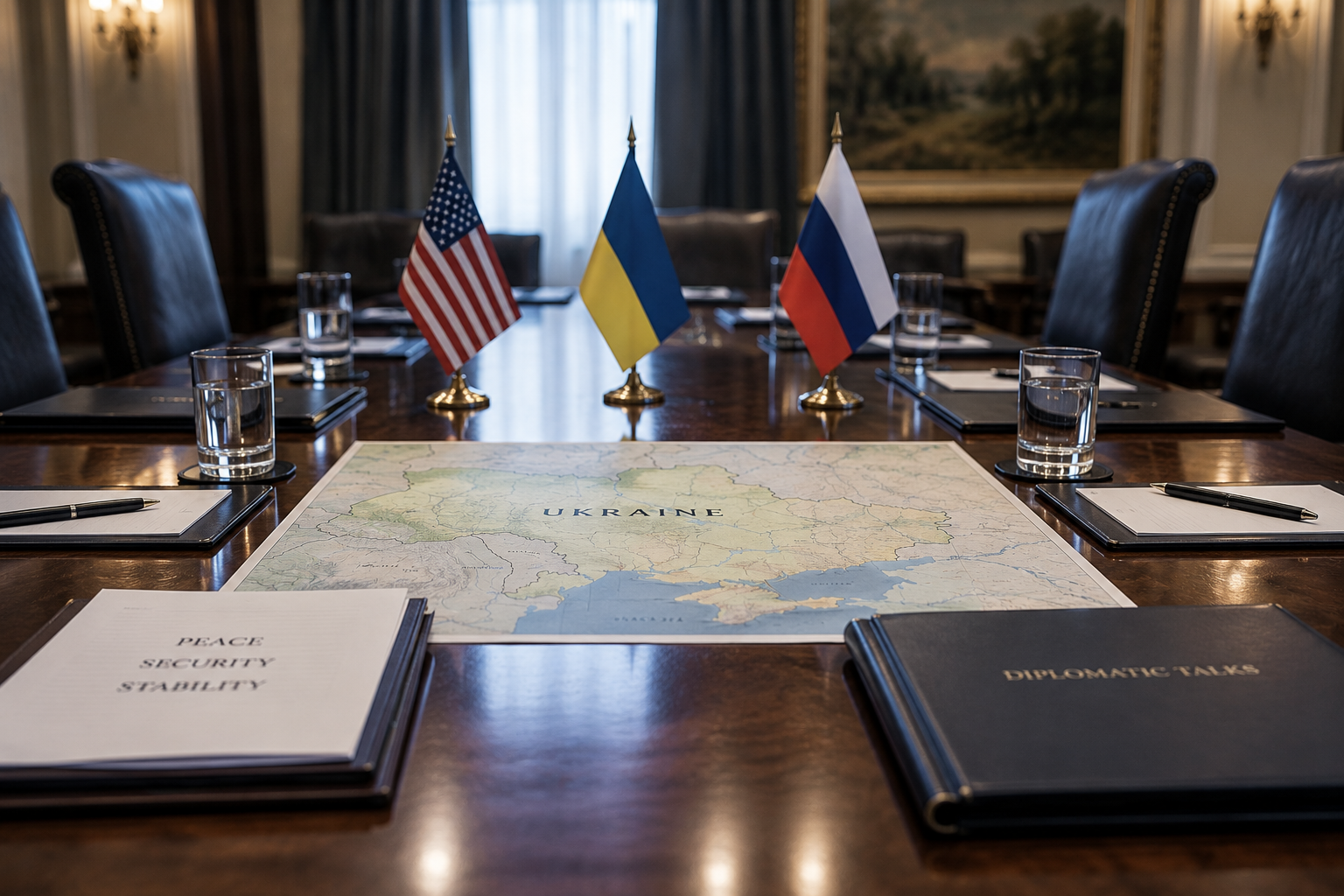
President Donald Trump promised he could bring Russia's war against Ukraine to an end. To accomplish one of the most complicated diplomatic missions in the world, he has repeatedly turned to two men with extraordinarily unconventional résumés for the assignment: his son-in-law Jared Kushner and real-estate billionaire Steve Witkoff.**
Neither man is a career diplomat.
Neither built his career negotiating arms-control agreements, military ceasefires or European security arrangements.
Both made their names in real estate.
Yet they have become central players in the Trump administration's attempts to negotiate with Russian President Vladimir Putin and Ukrainian President Volodymyr Zelenskyy.
And after repeated meetings, trips to Moscow and months of diplomacy, the fundamental dispute that has prevented a peace agreement remains unresolved.
Russia and Ukraine are still at war.
Trump's Unconventional Diplomatic Team
Steve Witkoff entered government after building a multibillion-dollar real-estate business.
He was also a longtime friend and golfing partner of Trump.
Trump initially appointed Witkoff as his special envoy to the Middle East, but his responsibilities expanded dramatically. He became involved not only in Middle Eastern diplomacy but also negotiations concerning Russia and Ukraine.
Jared Kushner presents another unusual choice.
Kushner is Trump's son-in-law and previously served as a senior White House adviser during Trump's first administration.
Like Witkoff, Kushner came from the real-estate business rather than the diplomatic corps.
During Trump's first term, Kushner was involved in negotiating the Abraham Accords between Israel and several Arab countries — experience the administration has pointed to as evidence of his ability to negotiate international agreements.
But negotiating the Russia-Ukraine war presents an entirely different challenge.
The conflict involves occupied territory, NATO, European security, nuclear powers, sanctions, military guarantees, hundreds of thousands of troops and fundamentally incompatible demands from Moscow and Kyiv.
Repeated Trips. No Peace Agreement.
Witkoff has made repeated trips to Moscow.
His September meeting with Putin was reportedly his eighth visit to the Russian capital as Trump's special envoy.
Kushner has increasingly joined him in the negotiations.
Earlier this month, the two traveled to Moscow for another lengthy meeting with Putin before traveling to Kyiv for discussions with Zelenskyy.
It was their first official visit to Ukraine as envoys.
The Moscow meeting lasted more than three hours.
Russian officials described the discussions as constructive.
Then the Americans traveled to Kyiv.
Again, the talks were described positively.
Again, there was no breakthrough.
The Associated Press reported that the meetings produced no significant progress toward ending Russia's full-scale invasion.
The reason is not particularly mysterious.
The central demands of Russia and Ukraine remain fundamentally incompatible.
Putin Hasn't Fundamentally Changed His Position
This is where criticism of Trump's negotiating strategy becomes particularly significant.
The International Institute for Strategic Studies recently examined the latest Witkoff-Kushner diplomatic mission and reached a harsh assessment.
Its analysis described the Moscow portion of their trip as essentially a repeat of previous unsuccessful negotiations.
Russia offered warmth and hospitality while continuing to insist upon its longstanding demands.
The institute concluded that Witkoff and Kushner still appeared not to understand the fundamental nature of the conflict or what would be necessary to produce a settlement acceptable to both sides.
That criticism gets to the central problem facing Trump's envoys.
A real-estate transaction generally assumes that both parties ultimately want a deal.
International conflicts do not necessarily work that way.
Sometimes one side believes continuing the war will produce a better result than compromising.
Russia continues to occupy Ukrainian territory and continues military operations while simultaneously negotiating with Washington.
The existence of negotiations does not itself mean that Moscow is prepared to accept the type of settlement Ukraine would consider viable.
The 'Win-Win' Problem
Kushner provided an illuminating description of the administration's philosophy during the latest trip.
Asked whether Washington would increase pressure on Russia if negotiations continued to produce no breakthrough, Kushner said the United States was looking for a "win-win" solution.
That language would be completely ordinary in a commercial negotiation.
It is considerably more complicated when applied to a war launched by one country invading another.
Ukraine's concerns include sovereignty, territory, military security and whether any peace agreement would prevent another Russian attack.
Russia has its own demands regarding Ukrainian territory, military alignment and the future security architecture of Eastern Europe.
Finding mutually beneficial economic projects is not the same thing as reconciling those positions.
Even after repeated American diplomatic missions, the basic disagreement remains.
Eight Trips to Moscow
Witkoff's repeated engagement with Putin has attracted particular scrutiny.
By September, he had reportedly traveled to Moscow eight times as Trump's special envoy.
Until this month, however, neither Witkoff nor Kushner had made an official visit to Ukraine in their capacity as Trump's peace envoys.
That imbalance generated frustration in Kyiv.
The latest trip finally changed that.
After meeting Putin in Moscow on September 5, Witkoff and Kushner traveled to Kyiv the following day and held three rounds of discussions with Zelenskyy.
Representatives from Britain, France and Germany eventually participated as well.
That was a significant expansion of the diplomatic process and acknowledged something European governments and Ukraine have repeatedly emphasized:
A settlement concerning Ukraine cannot realistically be negotiated solely between Washington and Moscow.
Trump's Promise Meets Diplomatic Reality
Trump spent years presenting himself as uniquely capable of ending the Ukraine war.
Actual diplomacy has proven considerably harder.
His administration has now spent an extended period attempting to broker an agreement.
Witkoff has repeatedly met Putin.
Kushner has joined the negotiations.
Russian and Ukrainian officials have met with American representatives.
Plans have been discussed.
Proposals have circulated.
Meetings have been described as productive, constructive, meaningful and encouraging.
Yet Russia and Ukraine remain divided over the issues that matter most.
Territory.
Security guarantees.
Ukraine's military.
Russia's occupation of Ukrainian land.
And what happens after the shooting stops.
Diplomacy Is More Than Making a Deal
There is nothing inherently wrong with using unconventional negotiators.
Career diplomats do not possess a monopoly on successful dip