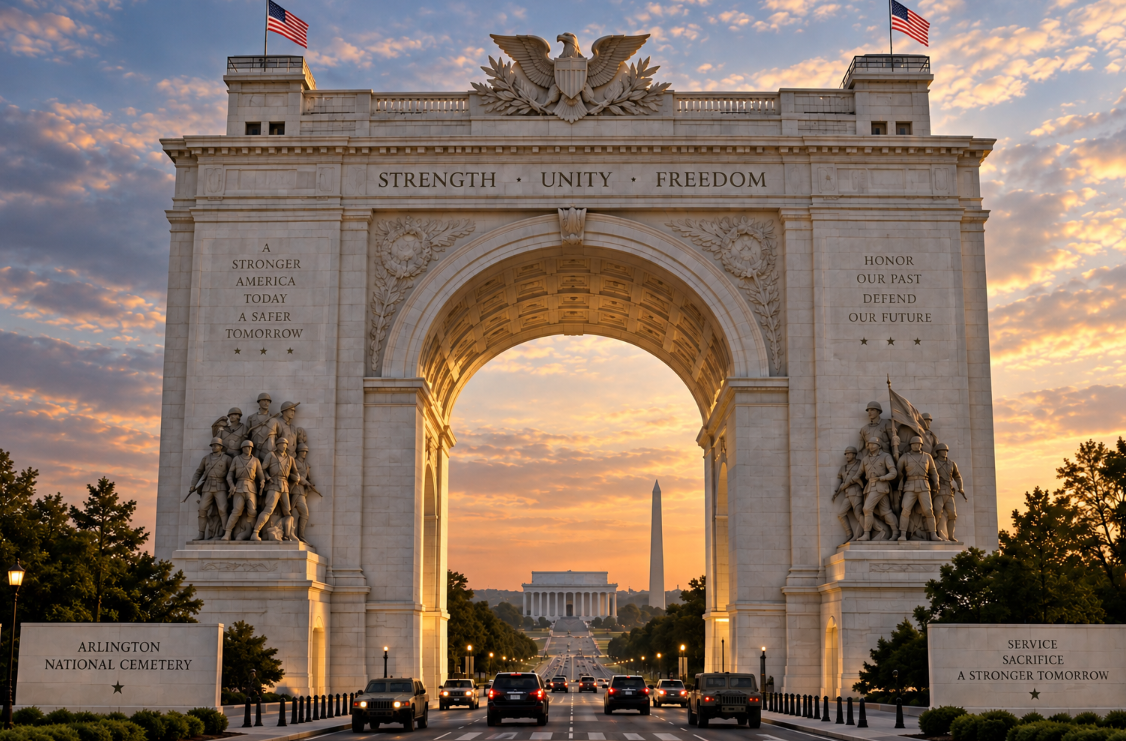
President Donald Trump says his proposed 250-foot triumphal arch near Arlington National Cemetery will serve another purpose beyond becoming a new monumental landmark in Washington: it will also function as a military complex equipped to house drones, snipers and ammunition.
Trump announced the change on September 20, saying it came at the request of the U.S. military and was necessary for national security.
According to Trump, the proposed facility would be capable of storing and rapidly deploying large numbers of drones, while also providing positions for snipers on the roof and plaza areas. He also said the facility would contain stores of sniper ammunition.
The announcement adds a significant new dimension to a project that was originally presented primarily as a monumental arch commemorating the United States' 250th anniversary.
From Monument to Military Facility
The arch is planned for Memorial Circle near Arlington National Cemetery, across the Potomac River from the Lincoln Memorial.
Modeled in concept after monumental arches such as the Arc de Triomphe in Paris, Trump's proposed structure would stand approximately 250 feet tall.
That would make it considerably more than a decorative entrance to Washington.
Trump now says the structure would combine its ceremonial role with military functions.
What remains unclear is precisely what security requirement led to that decision.
Trump said the change came at the "strong request" of the military, but he did not identify a specific threat that would require drones, snipers and ammunition to be stationed at the site.
Reuters reported that a U.S. military official had nothing further to add beyond the president's statement.
Questions About the Military Rationale
The proposed location also raises questions about why another military installation would be required there.
Memorial Circle is approximately one mile from Joint Base Myer-Henderson Hall and roughly two miles from the Pentagon.
Mark Cancian, a retired Marine colonel and defense analyst quoted by Reuters, questioned the military rationale for the proposal.
While additional security infrastructure around the White House could have an obvious protective purpose, Cancian said the justification for converting the arch into a military facility was more difficult to understand.
That distinction matters because the military component is being introduced while the arch itself faces legal and preservation challenges.
The Arch Was Already Controversial
The proposed monument had attracted opposition before Trump announced its potential military role.
Veterans and preservation advocates have challenged the project, arguing in part that such a massive structure could alter the historic visual connection between the Lincoln Memorial and Arlington National Cemetery.
A federal judge has ordered the administration to provide 48 hours' notice before undertaking most activity at the proposed construction site.
There have also been aviation concerns.
The site is approximately 3,000 feet from Reagan Washington National Airport and sits near heavily traveled flight paths.
On September 18, the Federal Aviation Administration determined that the proposed 250-foot structure would not constitute a hazard to aircraft if certain visibility requirements were met. Those requirements include lighting and an illuminated feature at the top of the arch.
Part of a Larger Transformation of Washington
The triumphal arch is not an isolated project.
Trump has pursued several major changes to prominent sites around Washington, including construction associated with a new White House ballroom, work involving the Lincoln Memorial Reflecting Pool, changes at the Kennedy Center and redevelopment proposals elsewhere in the capital.
The administration has also increasingly described some of these construction projects in national-security terms.
Trump has similarly argued that the new White House ballroom complex serves national-security purposes, with plans involving protective and military infrastructure.
The proposed arch now follows that same pattern.
What Remains Unanswered
Trump's announcement establishes what he says the arch will contain, but several important details remain unresolved.
It is not yet clear which branch or military organization would operate the proposed facility, how many personnel would be assigned there, what types of drones would be stored at the site, what operational role those drones would perform, or why the existing military installations nearby would be insufficient.
It is also unclear how incorporating military facilities could affect the ongoing legal, historic-preservation and construction reviews surrounding the project.
Those questions may ultimately become as important as the architecture itself.
What began as a proposal for a massive commemorative arch at one of America's most symbolically important locations is now being described by the president as both monument and military installation — combining ceremonial architecture with operational security functions in the heart of the nation's capital.