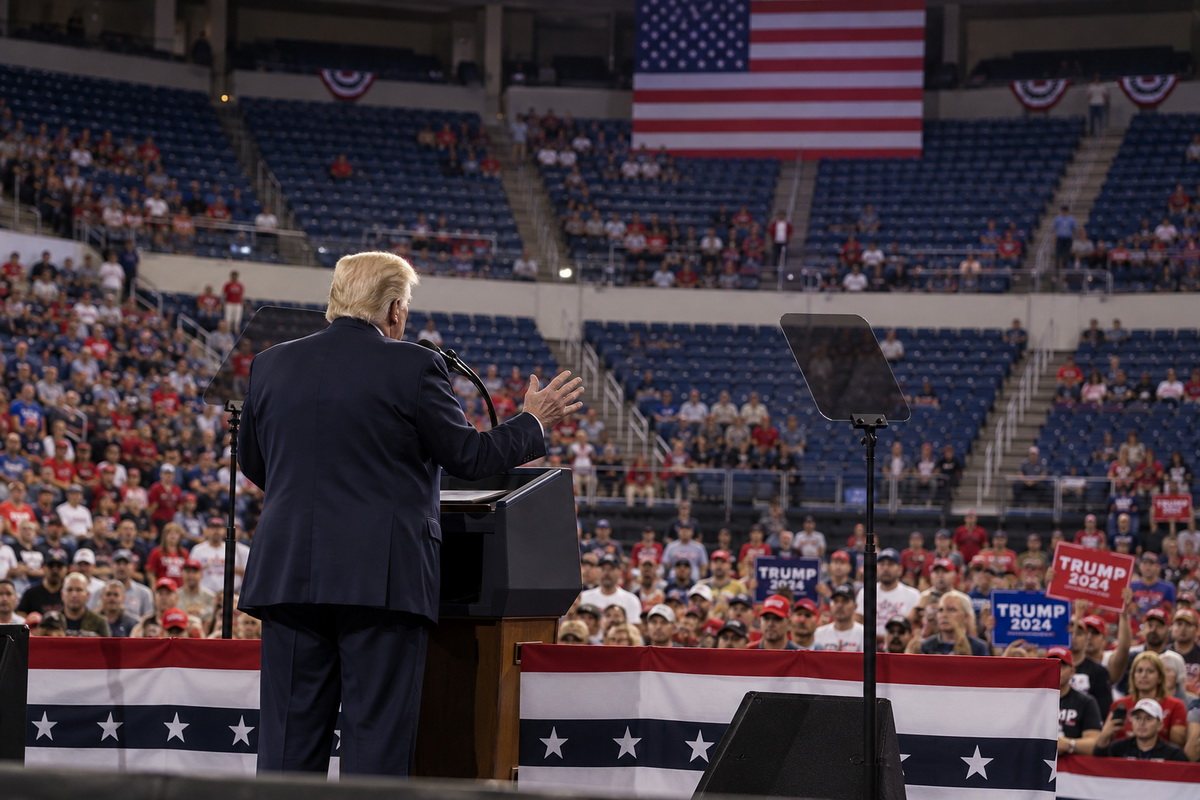
President Donald Trump has spent years insisting that he understands subjects ranging from economics and military strategy to medicine better than the people who have spent their careers studying them.
This weekend, he dispensed with individual subjects altogether.
According to Trump, he knows more about essentially everything than everyone.
Speaking at a rally in Ohio, Trump was discussing inflation when he made an extraordinary declaration about the breadth of his own knowledge.
“I know more about inflation, I know more about everything than anybody in this room,” Trump said.
Then he expanded the claim considerably.
“Anybody anywhere in the world.”
Trump briefly appeared to acknowledge that someone else might know more than he did.
Pointing toward a woman in the audience, Trump described her as a housewife who possessed a “natural instinct for business” and suggested she might know more than him.
Then he reconsidered.
“But I actually don't think so,” Trump said.
The comments quickly spread online, where critics again raised questions about Trump's behavior and some called for the 25th Amendment to be invoked.
The President Who Says He Knows Better
The statement was striking, but the underlying theme is hardly new.
Trump has repeatedly presented his own judgment as superior to that of specialists, advisers and established institutions.
During his presidency, that tendency has extended into areas where inaccurate information can have real consequences — including medicine.
During a September 2025 White House event addressing autism, Trump personally urged pregnant women not to take Tylenol.
“Don't take Tylenol,” Trump said repeatedly, at one point telling women to “fight like hell” not to take it.
Trump himself acknowledged that his recommendation went further than what government officials and researchers were prepared to say.
“This is a very strong recommendation, maybe stronger for me than from the group because they're waiting for certain studies,” Trump said.
Major medical organizations disputed the administration's conclusions, saying the available evidence did not establish that acetaminophen causes autism.
The episode illustrated a recurring feature of Trump's public rhetoric: confidence frequently arrives before scientific certainty.
Now Trump has taken that confidence to its logical extreme.
He doesn't merely know more than the experts on a particular issue.
According to Trump, he knows more about “everything” than anybody anywhere in the world.
Critics Again Mention the 25th Amendment
The remarks prompted another round of online calls for Trump's removal under the 25th Amendment.
Journalist Mehdi Hasan shared video of Trump's comments accompanied simply by the words “25th Amendment.”
Other critics used harsher language, describing Trump's declaration as evidence of narcissism or questioning his cognitive fitness.
Those reactions should not be confused with medical diagnoses.
No diagnosis of a mental disorder can responsibly be established from a political speech or social-media clips, and people commenting online are not conducting medical examinations.
Likewise, there is currently no announced effort by Vice President JD Vance and Trump's Cabinet to invoke the 25th Amendment.
The amendment establishes a process for transferring presidential authority when a president is “unable to discharge the powers and duties of his office.”
Under Section 4, the vice president and a majority of the principal officers of the executive departments can formally declare the president unable to perform those duties.
Political critics demanding that it happen does not mean the constitutional process has begun.
It hasn't.
Questions About Trump's Health Aren't New
Trump's health has nevertheless received increasing scrutiny as he has aged.
The president is now 80 years old.
The White House has maintained that Trump is healthy and capable of performing the duties of the presidency. His physician has previously described him as being in excellent health and has reported strong cardiovascular, pulmonary, neurological and physical performance.
Some outside physicians and mental-health professionals have publicly questioned those assessments or argued that Trump's public behavior deserves greater scrutiny.
Psychologist John Gartner, one of Trump's most outspoken mental-health critics, has gone substantially further, publicly arguing that Trump displays symptoms of cognitive decline and calling for his removal.
Gartner has not personally examined Trump, however, and his conclusions remain disputed professional opinions rather than an established diagnosis.
That distinction matters.
There is no need to diagnose Donald Trump from afar to examine what Donald Trump actually says.
“I Alone Can Fix It”
The Ohio remarks also fit a much older pattern in Trump's political identity.
At the 2016 Republican National Convention, Trump famously declared:
“I alone can fix it.”
That message — that institutions, experts and conventional political leadership have failed while Trump possesses the ability to solve problems others cannot — became central to his political appeal.
Ten years later, the language has become even broader.
Trump isn't merely saying he understands politics better than politicians.
Or business better than economists.
Or negotiations better than diplomats.
Or government better than bureaucrats.
He told a crowd that he knows more about everything than anybody in the room.
Then he expanded the comparison to everybody on Earth.
Whether that statement reflects exaggeration, political showmanship, Trump's familiar style of self-promotion or something else isn't something that can be determined from a rally speech.
But the statement itself requires no interpretation.
The president of the United States stood before an audience and declared that he knows more about everything than anyone anywhere in the world.
Those were his words.