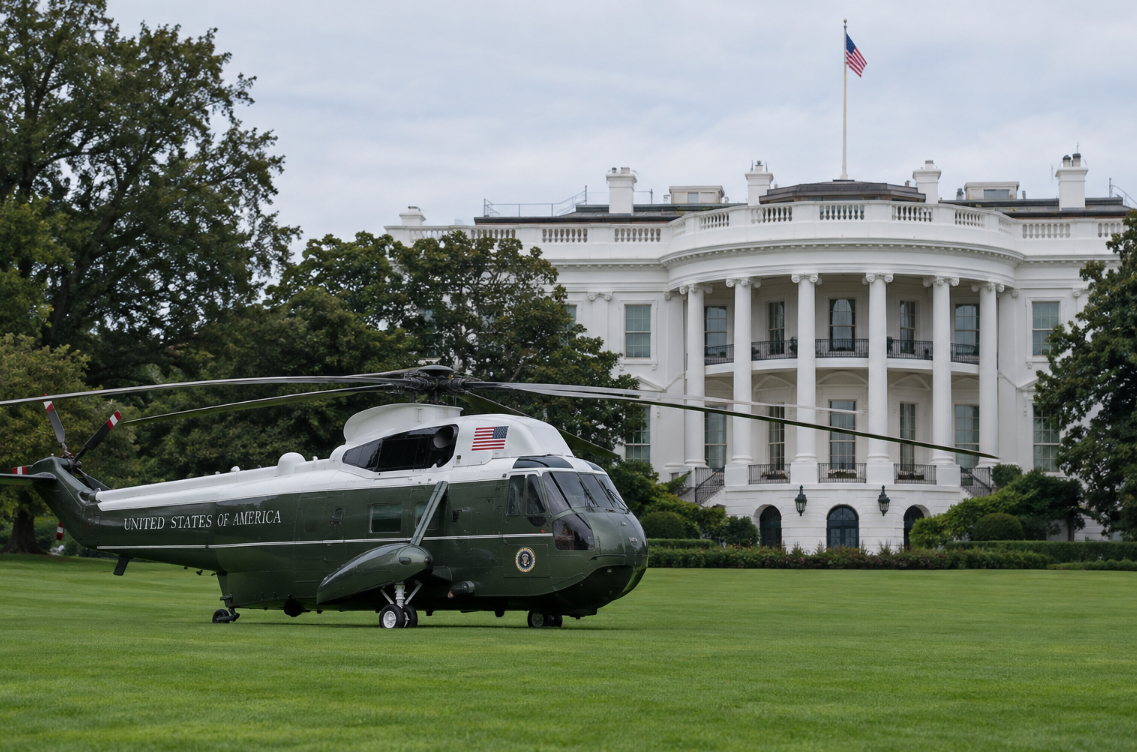
President Donald Trump gathered on the White House South Lawn Monday to cut the ribbon on his new granite helicopter landing pad.
There was a ribbon.
There were oversized gold scissors.
There was Marine One waiting nearby.
There was just one rather important problem:
Much of the country couldn't hear what the president was saying.
The unusual scene unfolded amid Trump's escalating confrontation with the White House press corps, after his administration barred CNN, MS NOW and Politico from White House grounds.
CNN had been scheduled to provide television pool coverage of the president Monday.
Instead of replacing CNN, the other major television networks stood together.
ABC, CBS, NBC and Fox News declined to provide substitute pool coverage.
The White House was left largely relying on its own video feed.
And during Trump's ribbon-cutting ceremony, the consequences became immediately apparent.
You Could See the President. Hearing Him Was Another Matter.
Trump appeared on the South Lawn in a light drizzle to inaugurate the new helipad before departing aboard Marine One for New York and the United Nations General Assembly.
Construction workers and officials gathered around as Trump used oversized gold scissors to cut a red, white and blue ribbon.
But the president's waiting helicopter created an enormous amount of background noise.
Without the normal television-pool equipment positioned to capture his remarks clearly, Trump's comments during the ceremony were largely drowned out.
Even Newsmax noticed the problem.
While showing footage from the event, the network explained that there was no pool microphone capturing the president and suggested the dispute with the press was “backfiring just a little bit.”
It was an unusually direct demonstration of something normally invisible to viewers:
The White House press pool doesn't simply provide reporters.
It provides the cameras, microphones, technicians and infrastructure that allow presidential events to be seen and heard across the country.
Why the Television Cameras Were Missing
CNN is one of five major television organizations that participate in the primary White House television pool, alongside ABC, CBS, Fox News and NBC.
The networks rotate responsibility for covering the president and distribute that footage more broadly to other news organizations.
CNN was scheduled to handle Monday's assignment.
But Trump had barred CNN, MS NOW and Politico from White House grounds after repeatedly attacking their coverage.
Trump defended the restrictions Monday, saying his administration was targeting what he calls “fake news” rather than the free press.
The affected news organizations see it very differently.
CNN, MS NOW and Politico filed a federal lawsuit Monday arguing that the White House restrictions violate constitutional protections for freedom of speech and freedom of the press.
The administration has disputed that characterization.
When CNN was prevented from performing its scheduled pool duties, the other four major networks declined to step in and replace it.
That meant there was no normal television pool covering Trump's event.
Then Came the Helicopter
Under ordinary circumstances, the absence of a television pool might have been mostly invisible to viewers.
Marine One made sure it wasn't.
The helicopter's engines overwhelmed much of the available audio as Trump spoke near the newly completed landing pad.
The White House could provide pictures.
It could provide its own livestream.
What it could not easily reproduce was the professional audio coverage normally supplied by the television pool.
The result was an awkward moment in which the president was holding an event intended for public consumption while much of what he said could not be clearly heard.
Trump did not stop to answer reporters' shouted questions before boarding Marine One.
Instead, he later celebrated the occasion on social media, describing the departure as the maiden voyage from the newly constructed heliport.
A Fight With the Press Becomes a Fight Over Access
The dispute is larger than one poorly heard ribbon-cutting ceremony.
Presidents have clashed with reporters throughout American history.
Trump's administration, however, has repeatedly challenged the access of individual news organizations whose reporting he considers unfair.
During Trump's first term, his White House attempted to revoke CNN correspondent Jim Acosta's press credentials. A federal judge ordered the administration to restore them.
Trump's second administration has continued battling news organizations over access, credentials and coverage.
Now CNN, MS NOW and Politico are asking a federal court to intervene again.
Their lawsuit argues that allowing the government to exclude news organizations because officials dislike their reporting would give the White House unconstitutional power over which journalists can directly cover the president.
The White House maintains that the dispute is about access rather than press freedom and argues that the affected organizations remain capable of reporting from outside the grounds.
That disagreement will now play out in federal court.
An Immediate Consequence
Whatever the courts ultimately decide, Monday produced an unusually visible example of why the White House television pool exists.
The system isn't simply a perk for television networks.
Because it is impractical for every television organization in the country to place its own camera crew beside the president, a rotating group records events and distributes the material.
That allows Americans watching different networks to see essentially the same presidential event.
On Monday, that system broke down.
And it happened because the White House barred the network scheduled to operate it, while the other participating networks declined to replace CNN.
The resulting footage provided an immediate illustration of the consequences.
Trump had restricted the access of several news organizations whose coverage he dislikes.
Then he walked outside to hold a presidential event.
The cameras were different.
The usual microphones weren't there.
Marine One started roaring.
And suddenly, the president himself was much harder to hear.