Trump’s U.N. Speech Draws Silence and Walkouts as He Threatens Iran and Cuba
President Donald Trump arrived at the United Nations on Tuesday with a message that the United States was stronger than ever.
Parts of the room responded with something considerably less enthusiastic: silence.
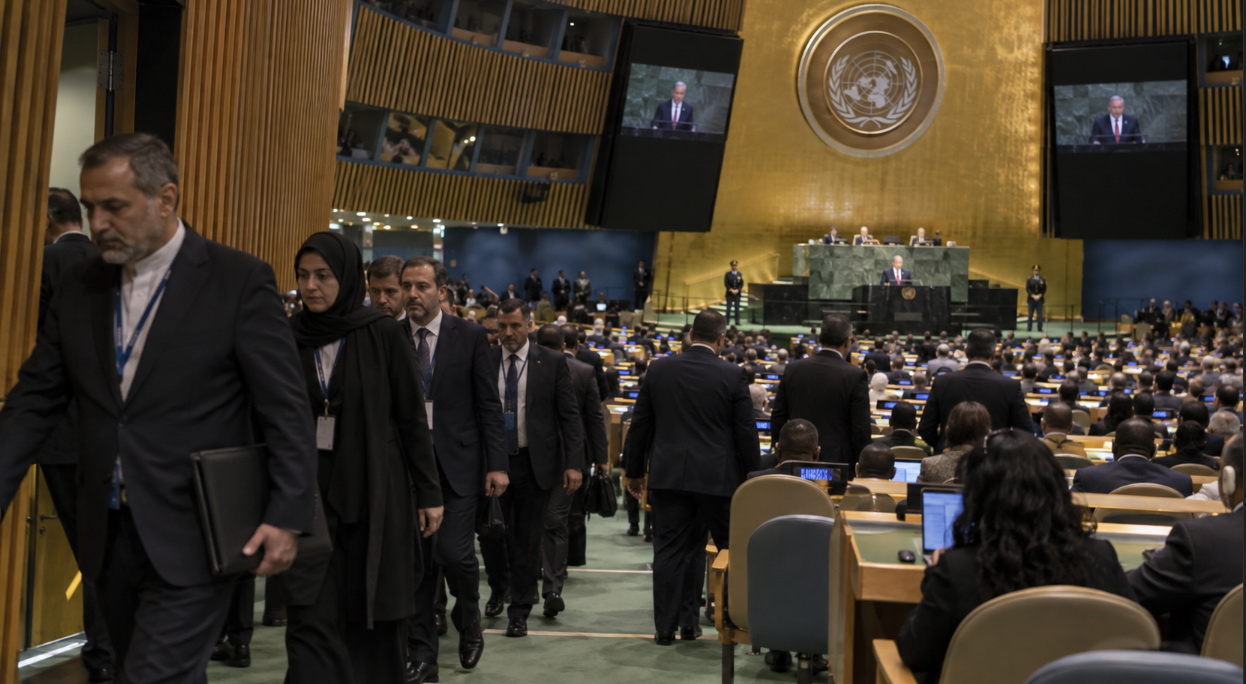
And before the speech was finished, some delegates were heading for the exits.
Trump used his address to the 81st United Nations General Assembly to deliver an expansive defense of his administration’s foreign policy, including the war with Iran, while issuing extraordinary threats against Tehran and Cuba and attacking international institutions that could constrain American power.
Early in the address, Trump declared that America was “stronger today than ever before.”
He then paused.
According to accounts from inside the General Assembly, the declaration was met without the applause that might normally follow such a line in a political speech.
It would not be the only uncomfortable moment.
IRAN GETS AN ULTIMATUM
Trump devoted a significant portion of his 37-minute address to Iran and defended the U.S.-Israeli military campaign against the country.
He called on other nations to economically isolate Tehran and presented Iran with a stark choice: reach an agreement with the United States or face potentially overwhelming military action.
Trump said he faced what he called a “big decision” over whether an agreement could be reached that would allow Iran to rebuild.
The alternative, he said, was to “annihilate the Islamic Republic.”
Members of the Iranian delegation walked out during portions of the address.
The threat came more than six months into a conflict that Trump has so far been unable to bring to a negotiated conclusion.
Trump nevertheless predicted that an agreement could be reached after the November midterm elections.
CUBA WALKS OUT
Iran was not the only country targeted.
Trump turned his attention to Cuba, calling the communist-controlled country a failed state and predicting that its government would eventually fall.
He said his administration was seeking what he described as a fundamental change in Cuba and declared that “freedom will be coming to Cuba.”
Members of the Cuban delegation responded by getting up and leaving the General Assembly hall.
The walkout provided one of the most striking visual moments of the speech: representatives of another nation physically leaving the chamber while the American president discussed the future of their government.
ATTACKING INTERNATIONAL INSTITUTIONS
Trump also took aim at the International Criminal Court, urging countries associated with the institution to withdraw and making clear that his administration would reject attempts to subject American military personnel to its authority.
The remarks came as international scrutiny of American military operations has intensified.
Trump portrayed such oversight as illegitimate interference with American sovereignty and promised that U.S. service members would not face what he described as politically motivated international prosecutions.
He also criticized the United Nations bureaucracy itself while simultaneously arguing that the organization still has enormous potential.
FROM AI TO “SUPER INTELLIGENCE”
The speech occasionally veered far beyond traditional foreign-policy subjects.
Trump announced that his administration would begin referring to artificial intelligence as “super intelligence,” arguing that warnings about the dangers of AI have been exaggerated.
He compared some concerns about artificial intelligence to what he characterized as previous political hoaxes and said the United States would not allow regulation to prevent development of a technology he predicted could become larger than the Industrial Revolution.
Trump also claimed the United States was substantially ahead of China in the technology race.
A DIFFERENT RECEPTION
Presidents routinely use appearances before the General Assembly to promote American policy, defend controversial decisions and challenge adversaries.
Trump did all three.
But the reaction inside the chamber became part of the story.
The silence following some of his declarations contrasted with the applause Trump routinely receives at domestic political events, while the departures of Iranian and Cuban representatives offered a visible reminder that an address to the United Nations is not a campaign rally.
Trump presented his administration as restoring American strength and argued that military power had produced results where diplomacy had failed.
His critics see the same record very differently, pointing to an unresolved war with Iran, deteriorating relationships with international institutions and increasingly confrontational rhetoric toward foreign governments.
At the United Nations on Tuesday, those competing views were on display in the same room.
Trump spoke about an America more powerful than ever.
Some delegates listened.
Some remained silent.
And some simply walked out.