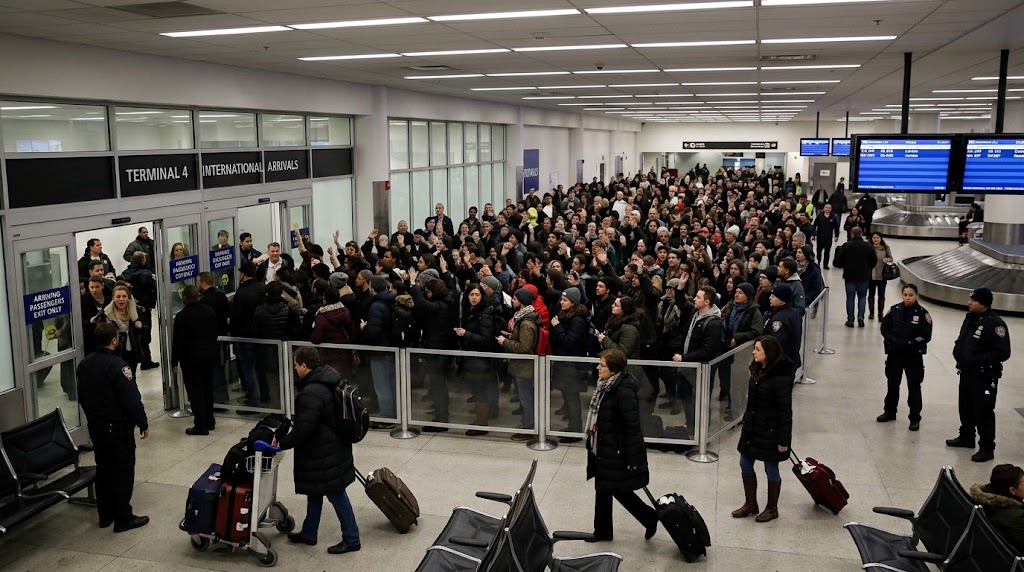
One week after taking office, President Donald Trump signed an executive order that immediately transformed immigration policy — and created confusion at airports across the United States.
Executive Order 13769, titled “Protecting the Nation from Foreign Terrorist Entry into the United States,” temporarily restricted entry into the country for nationals of seven predominantly Muslim countries.
The order also suspended the U.S. refugee admissions program.
Because the restrictions took effect immediately, travelers who had already boarded airplanes — some carrying valid visas and others previously approved to enter the United States — arrived to discover that the rules had changed while they were traveling.
Detentions followed.
So did protests, lawsuits and emergency court hearings.
Seven Countries Affected
The order temporarily suspended entry into the United States for many nationals of seven countries:
Iran, Iraq, Libya, Somalia, Sudan, Syria and Yemen.
The restriction was initially set for 90 days while the administration reviewed screening and vetting procedures.
The order also suspended the entire U.S. Refugee Admissions Program for 120 days.
Syrian refugee admissions were suspended indefinitely.
Trump had campaigned on imposing stricter immigration controls and what he described as “extreme vetting.”
Now those promises were becoming federal policy.
Confusion at the Airports
Implementation was immediate.
That created an unusual problem.
People affected by the order were already traveling to the United States.
Some had received visas before Trump became president. Others had gone through lengthy refugee screening procedures.
When they arrived at American airports, some were detained by Customs and Border Protection.
One of the most prominent cases involved Hameed Khalid Darweesh, an Iraqi who had worked with the U.S. government and had been granted a Special Immigrant Visa.
He was detained after arriving at John F. Kennedy International Airport in New York.
His detention quickly became part of the first major legal challenge to Trump's order.
Protesters Head to the Airports
As reports of detained travelers spread, demonstrations formed at airports around the country.
Lawyers also began arriving.
At airports including JFK, attorneys volunteered to assist detained travelers and their families while protesters gathered outside demanding their release.
The immigration order had been signed only hours earlier.
Already, its implementation was becoming a national political and legal confrontation.
The First Lawsuit Arrives
On January 28, attorneys representing detained travelers filed Darweesh v. Trump in federal court in New York.
The lawsuit challenged the detention of people who had arrived with authorization to enter the United States but were prevented from doing so after the executive order took effect.
That evening, U.S. District Judge Ann Donnelly issued an emergency order temporarily preventing the government from removing certain affected travelers from the United States.
It was the beginning of a much larger court battle.
Other lawsuits and judicial orders soon followed in different parts of the country.
The Administration Defends the Order
The Trump administration argued that the restrictions were necessary to protect national security while the government reviewed its immigration screening procedures.
The executive order itself said the United States needed to ensure that people admitted into the country did not pose a security threat.
Critics challenged both the policy and its implementation.
Civil-rights and immigration organizations argued that the order unlawfully discriminated against Muslims and violated protections afforded to people who had already been authorized to travel to the United States.
The administration disputed the characterization that the policy constituted a “Muslim ban,” noting that the restrictions applied to specific countries rather than Muslims worldwide.
That disagreement would become central to the political and legal battle surrounding the policy.
A Policy Written in Washington Reaches the Airport Terminal
The significance of January 27 wasn't co