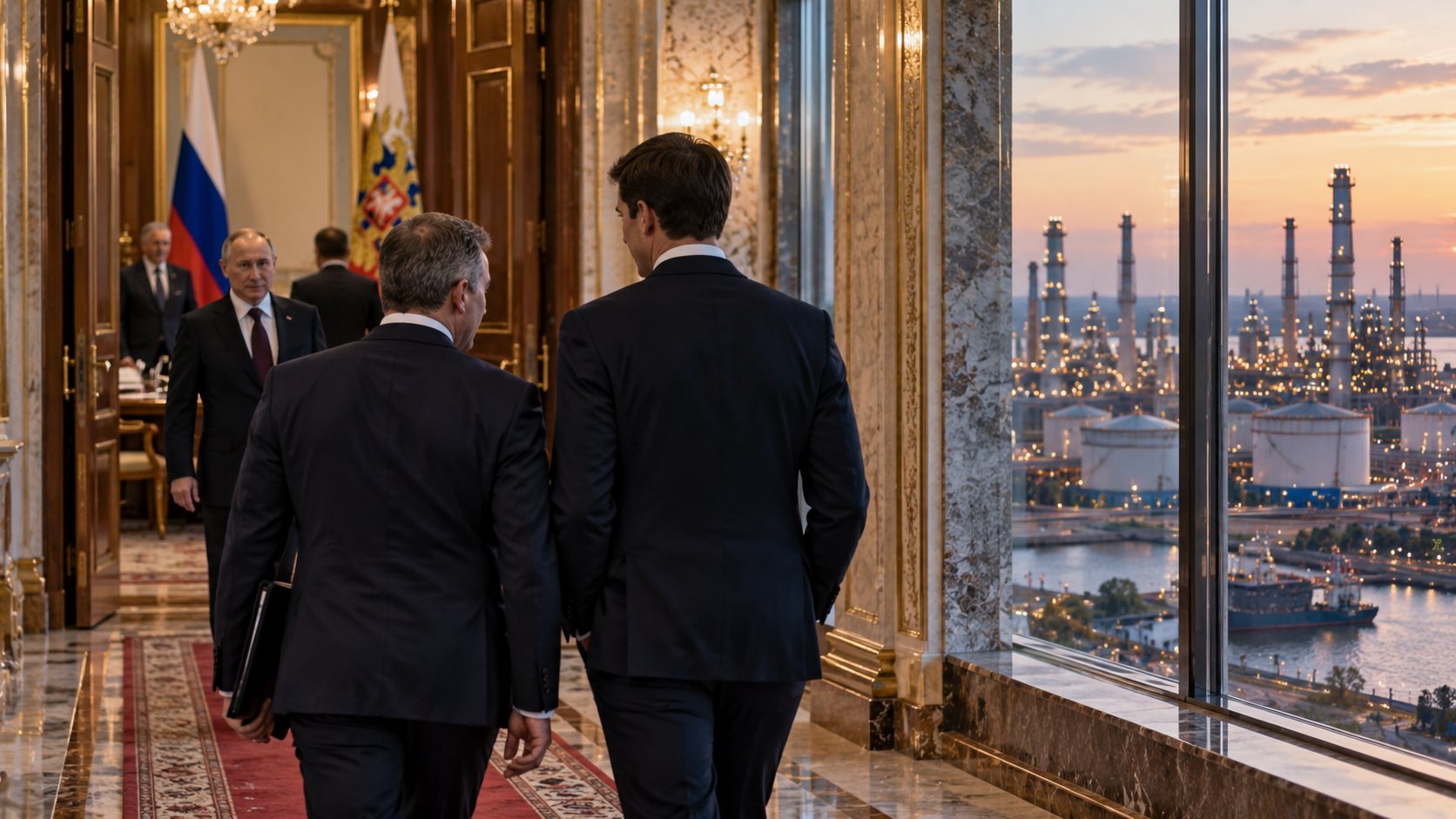
What exactly is the Trump administration negotiating with Vladimir Putin?
An end to Russia's war in Ukraine?
Or business deals?
Increasingly, the answer appears to be both.
The Trump administration's negotiations with Russia have expanded to include a multibillion-dollar deal involving international assets belonging to sanctioned Russian oil giant Lukoil, according to reporting by The New York Times subsequently confirmed in part by Reuters and other news organizations.
That alone would be extraordinary.
But the potential buyers reportedly include business interests with financial connections to the families and businesses surrounding two of President Donald Trump's principal negotiators with Moscow: Jared Kushner and Steve Witkoff.
The proposed transaction also includes billionaire Todd Boehly, who has donated millions of dollars to Trump-aligned political causes.
And the deal would require approval from both the United States and Russia.
In other words, American officials involved in negotiating with Vladimir Putin are simultaneously working on a gigantic commercial transaction involving people with business relationships inside Trump's orbit.
There is currently no evidence that Kushner or Witkoff themselves would personally receive money from the Lukoil transaction.
That distinction matters.
But it doesn't make the conflict-of-interest questions disappear.
It makes them questions Americans deserve answers to.
Putin Introduced the Deal
The proposal reportedly emerged directly from Vladimir Putin.
During a September 5 meeting at the Kremlin, Putin raised the possibility of selling Lukoil's international assets while meeting with Kushner and Witkoff.
The assets are enormous.
They include oil fields.
Refineries.
Gas stations.
Energy infrastructure spread around the world.
Lukoil is one of Russia's largest energy companies, and its international holdings have been caught up in Western sanctions imposed against Russia.
Putin reportedly presented the proposed sale as evidence that Russia and the United States could resume doing business together.
Kushner and Witkoff apparently viewed economic cooperation as something that could improve relations with Moscow and potentially help move peace negotiations forward.
There is a logic to that strategy.
Countries with significant economic relationships have incentives to avoid conflict.
Trump has repeatedly argued that business deals can create diplomatic leverage where traditional diplomacy has failed.
But there is an enormous difference between using commerce as diplomacy and conducting diplomacy that financially benefits people connected to the diplomats.
That's where this becomes uncomfortable.
Who Would Benefit?
The group pursuing Lukoil's international assets reportedly includes billionaire investor Todd Boehly.
Boehly has donated approximately $2 million to Trump-aligned political causes.
Political donations do not automatically make a business transaction improper.
But he isn't the only connection.
Two Middle Eastern investment groups involved in the proposed acquisition have existing business relationships with Kushner or members of Witkoff's family.
Qatari businessmen Moutaz and Ramez Al-Khayyat reportedly would hold a major stake in the transaction.
Their conglomerate is already working with Kushner and Ivanka Trump on a multibillion-dollar luxury resort project in Albania.
Another potential investor is associated with Sheikh Tahnoon bin Zayed Al Nahyan of the United Arab Emirates.
Tahnoon has financial connections to Kushner's private-equity operation.
He also has financial ties to World Liberty Financial, the cryptocurrency venture associated with the Trump family.
Those relationships don't establish that anyone committed a crime.
But imagine this arrangement without the names.
Two people representing the president in negotiations with a foreign government are discussing a multibillion-dollar commercial transaction.
Some of the people positioned to benefit from that transaction already do business with the negotiators' families or businesses.
The U.S. government must approve the transaction.
The foreign government must approve the transaction.
And the foreign leader himself introduced the idea during diplomatic negotiations.
That deserves scrutiny regardless of which political party controls the White House.
Sanctions Could Turn Into Profits
There's another unusual feature of the deal.
Lukoil's international assets are currently constrained by American sanctions.
That depresses their value and complicates their sale.
But if Washington approves the transaction and releases the assets from those restrictions, their value could increase significantly.
That means the United States government isn't merely watching a private transaction occur.
Government decisions could materially affect how valuable the assets become.
According to reporting on the negotiations, Kushner and Witkoff have participated in negotiating financial terms intended to produce a substantial upfront payment and a profit interest for the United States.
The administration can argue that this is precisely why they should be involved: if American approval is necessary, American taxpayers should receive something in return.
That's a defensible position.
But it makes transparency even more important.
Who benefits?
Who invested?
What did they pay?
What did the assets become worth after sanctions relief?
And what existing financial relationships do those investors have with people inside the administration?
Those shouldn't be partisan questions.
They should be basic requirements for evaluating the deal.
Is This Illegal?
That question is more complicated than it should be.
Federal law contains criminal conflict-of-interest restrictions for government officials.
But presidents occupy an unusual position under those laws, and the main federal criminal conflict-of-interest statute does not apply to the president or vice president.
The status of informal presidential advisers and special envoys can also complicate the application of traditional ethics requirements.
That does not mean anything a president or presidential adviser does for financial benefit is automatically legal.
Bribery laws still exist.
Federal disclosure requirements still exist.
Sanctions laws still exist.
Other criminal statutes still exist.
The Constitution also contains provisions intended to prevent presidents from receiving prohibited benefits from foreign governments.
But enforcement mechanisms surrounding presidential conflicts have repeatedly proved weak.
That is why ethics organizations across the political spectrum have argued for stronger rules requiring presidents to divest business holdings or place assets into genuinely independent blind trusts.
Trump has never taken that approach.
Instead, his family businesses have continued operating while he occupies the White House.
Governing While the Family Does Business
This latest controversy does not exist in isolation.
Trump's second presidency has repeatedly blurred the traditional separation between public power and private business.
Trump's most recent financial disclosures showed extraordinary income from private enterprises while he was president.
Cryptocurrency has become an especially significant source of wealth for Trump and his family.
Foreign investors have participated in ventures connected to the Trump family.
Kushner's private-equity operation has attracted enormous investments from Middle Eastern governments and sovereign wealth funds.
Trump-family real-estate ventures continue overseas.
World Liberty Financial has established financial relationships involving foreign investors.
Ethics experts have repeatedly warned that these arrangements create circumstances in which the American public may have difficulty determining whether a government decision is being made exclusively for the national interest.
That doesn't mean every government decision involving someone who has done business with the Trump family is corrupt.
It means the conflicts are so extensive that separating public policy from private financial interests becomes increasingly difficult.
Kushner's Dual Role
Jared Kushner illustrates the problem particularly well.
He is not simply a businessman.
He is representing the president of the United States in some of the most consequential diplomatic negotiations in the world.
He has negotiated with Russia.
He has negotiated with Ukraine.
He has participated in Middle Eastern diplomacy.
At the same time, Kushner remains connected to a private investment business with extensive financial relationships in many of the same regions.
His company has received billions of dollars in investments from Middle Eastern sovereign wealth funds and other investors.
Now companies associated with people who already have business relationships with Kushner are positioned to participate in a gigantic Russian energy transaction emerging from diplomatic negotiations in which Kushner himself is involved.
Again:
That does not prove Kushner is personally profiting from this particular deal.
The New York Times specifically reported that there is no indication he or Witkoff personally stands to make money from the Lukoil transaction.
But conflict-of-interest rules exist precisely because proving a direct quid pro quo shouldn't be the only standard.
Government officials are supposed to avoid circumstances that create reasonable questions about whether private financial interests are influencing public decisions.
Peace Should Not Be a Business Opportunity
There is nothing inherently wrong with including economics in peace negotiations.
In fact, economic incentives have been part of diplomacy for centuries.
Sanctions are economic tools.
Trade agreements are economic tools.
Reconstruction assistance is an economic tool.
Foreign investment can encourage countries to maintain peaceful relationships.
But there should be a bright line between:
Economic agreements intended to advance American interests
and
economic agreements that enrich people financially connected to the Americans negotiating them.
If those categories begin overlapping, transparency becomes essential.
The public should know every investor.
Every ownership stake.
Every existing financial relationship.
Every government approval.
And every financial benefit produced by the lifting of American sanctions.
Putin Understands Business
Vladimir Putin certainly understands the leverage involved.
Russia has spent years attempting to escape the economic isolation imposed following its invasion of Ukraine.
Restoring commercial relationships with American companies would be enormously valuable to Moscow.
Putin's decision to personally introduce the Lukoil proposal during a meeting with Trump's negotiators therefore deserves attention.
The deal could accomplish several Russian objectives simultaneously.
It could unload sanctioned international assets.
It could establish new financial relationships with powerful American and Middle Eastern investors.
It could demonstrate that Russia is returning to international commerce.
And it could create a constituency of wealthy business interests that benefits financially from improving relations between Washington and Moscow.
That may be clever diplomacy.
It may also be precisely why American negotiators need to maintain unmistakable independence from anyone positioned to profit from it.
The Trump Administration's Conflict Problem
The fundamental problem is larger than one oil deal.
The Trump presidency has normalized financial relationships that previous administrations generally tried to avoid.
Presidents traditionally placed investments into blind trusts or divested assets.
They did so not necessarily because every conflict was explicitly prohibited by criminal law, but because Americans needed confidence that presidential decisions weren't influenced by personal wealth.
Trump rejected that model during his first presidency.
His second administration has pushed the boundary even further.
Trump-family businesses remain active.
Foreign investors continue doing business with them.
People conducting diplomacy for the United States maintain private business networks.
And now peace negotiations over a war that has killed and wounded hundreds of thousands of people are intersecting with a multibillion-dollar oil transaction involving people financially connected to Trump's negotiators.
Maybe every decision being made is entirely in America's interest.
If so, transparency should make that easy to demonstrate.
Show Us the Deal
The administration should release the relevant information.
Who owns each company participating in the Lukoil transaction?
How much is each investor contributing?
What business relationships do those investors have with Trump, Kushner, Witkoff or their families?
What role did Kushner and Witkoff play in selecting or approving potential buyers?
What sanctions would Washington remove?
How much would those sanctions changes increase the assets' value?
What financial interest would the United States government receive?
And what safeguards are being used to ensure that America's diplomatic decisions aren't enriching people connected to the people making those decisions?
Those are not unreasonable demands.
They're the minimum Americans should expect when diplomacy and billions of dollars collide.
America's Foreign Policy Is Not a Family Business
Ending the war in Ukraine would be an extraordinary accomplishment.
If Trump, Kushner and Witkoff can negotiate a genuine and durable peace acceptable to Ukraine, that achievement should be judged on its merits.
But peace negotiations cannot become an investment conference for politically connected billionaires.
American sanctions cannot become a mechanism for creating discounted investment opportunities for people connected to government negotiators.
And access to the president of the United States cannot become another financial asset.
The administration says Witkoff has no financial stake in the Lukoil transaction.
There is currently no evidence that Kushner personally stands to profit from it either.
Those facts belong in the story.
So do the conflicts surrounding them.
The American government is negotiating simultaneously over war, peace, sanctions and billions of dollars in private assets.
Some of the people positioned to benefit financially already have business relationships with the families and businesses surrounding America's negotiators.
That doesn't automatically make the deal illegal.
It does make full transparency absolutely necessary.
Because the White House belongs to the American people.
American foreign policy belongs to the American people.
And neither should ever become an opportunity for the president, his family, his friends or their business partners to get richer.
Source: The New York Times, Reuters, Mediaite and contemporary reporting concerning U.S.-Russia negotiations and the proposed acquisition of Lukoil's international assets.