Donald Trump had been president for approximately one day when his new administration became consumed by an unexpected controversy:
How many people had attended his inauguration?
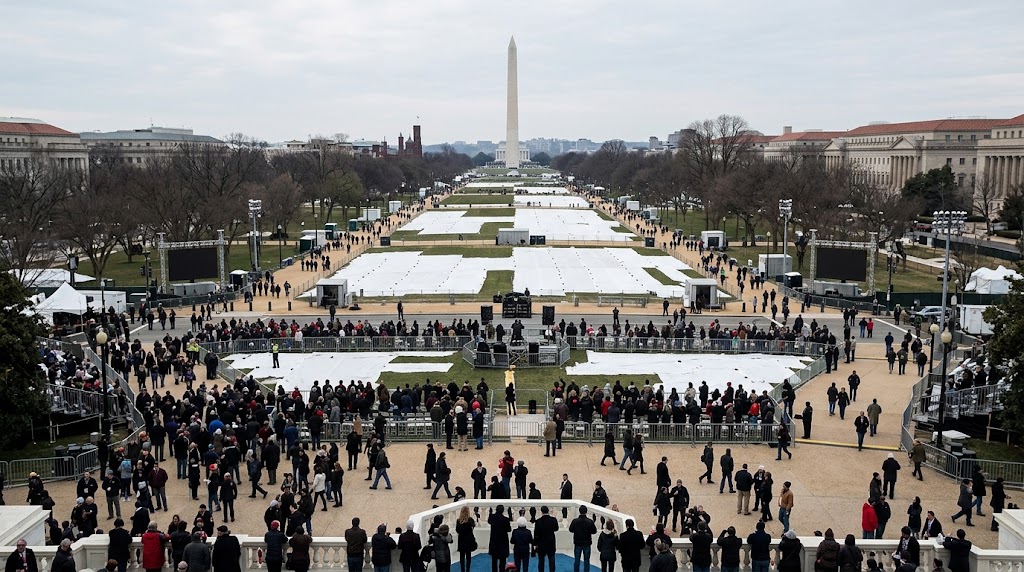
Photographs from the National Mall showed considerably more empty space than had been visible during Barack Obama's first inauguration eight years earlier.
Trump disputed the coverage.
Then his White House press secretary, Sean Spicer, stepped behind the briefing-room podium and turned the disagreement into one of the defining controversies of the administration's opening weekend.
“This was the largest audience to ever witness an inauguration — period — both in person and around the globe.”
The available evidence did not support that claim.
It Started at CIA Headquarters
Trump spent part of his first full day as president visiting CIA headquarters in Langley, Virginia.
It was an important appearance.
During the presidential transition, Trump had repeatedly questioned intelligence assessments concerning Russian interference in the 2016 election.
The CIA visit offered the new president an opportunity to repair that relationship.
Trump told agency employees that he strongly supported them.
But during the appearance, he also turned to another subject:
His inauguration crowd.
Trump complained about news reports and photographs suggesting attendance had been smaller than at Obama's inauguration.
He told the audience that when he looked toward the National Mall, the crowd appeared to contain perhaps a million to a million and a half people.
He also complained that television coverage had shown areas that appeared empty.
The dispute quickly followed him back to the White House.
Then Sean Spicer Walked Into the Briefing Room
Later that afternoon, newly appointed White House Press Secretary Sean Spicer appeared before reporters.
It was his first formal appearance from the White House briefing-room podium.
Instead of announcing a major policy initiative, Spicer delivered a prepared statement challenging news coverage of the inauguration.
He accused the media of using photographs that minimized the crowd.
Spicer then offered estimates for how many people could fit into different sections of the National Mall and said those areas had been filled.
He also cited Washington Metro ridership as evidence.
Then came the declaration that would dominate coverage:
“This was the largest audience to ever witness an inauguration — period — both in person and around the globe.”
Spicer left without taking questions.
The Numbers Didn't Support the Claim
Determining the exact number of people attending an event on the National Mall is difficult.
The National Park Service no longer produces official crowd estimates for such events.
But several independent measurements allowed comparisons between Trump's inauguration and previous inaugurations.
Photographs taken from similar locations showed significantly more empty space on the National Mall during Trump's inauguration than during Obama's first inauguration in 2009.
Public transportation numbers told a similar story.
Washington's Metro system recorded approximately 570,000 passenger trips on Trump's inauguration day.
Obama's first inauguration in 2009 generated approximately 1.1 million Metro trips.
Obama's second inauguration in 2013 generated approximately 782,000.
There was another problem with Spicer's presentation.
He cited approximately 420,000 Metro riders for Trump's inauguration while comparing that figure with approximately 317,000 for Obama's 2013 inauguration.
But those numbers weren't measuring the same thing.
The Trump figure represented ridership over a longer portion of the day, while the Obama number represented ridership only through 11 a.m.
Comparable measurements showed Trump's inauguration generating fewer Metro trips.
Then Came “Alternative Facts”
The controversy could have ended there.
Instead, it produced another phrase that would become closely associated with the early Trump presidency.
The following morning, January 22, presidential counselor Kellyanne Conway appeared on NBC's Meet the Press.
Host Chuck Todd challenged her over Spicer's statements.
Conway defended the press secretary.
“You're saying it's a falsehood,” she told Todd, “and Sean Spicer, our press secretary, gave alternative facts to that.”
Todd immediately responded:
“Alternative facts are not facts. They're falsehoods.”
Two words — alternative facts — instantly entered the American political vocabulary.
Why the Crowd Fight Mattered
Inauguration attendance had little effect on Trump's ability to govern.
Crowd size didn't change the election results.
It didn't change the powers of the presidency.
And it didn't determine whether Trump's administration would succeed or fail.
But the controversy became significant because of what it revealed about the relationship developing between the new administration, the press and publicly verifiable information.
Trump disputed news coverage.
His press secretary repeated claims that available evidence contradicted.
And when challenged the following day, one of Trump's most prominent advisers described the administration's assertions as “alternative facts.”
It all happened during the president's first full weekend in office.
Donald Trump had promised to bring a dramatically different style of leadership to Washington.
Within 48 hours of taking the oath of office, Americans were already seeing just how different the relationship between the White House and the press was going to be.