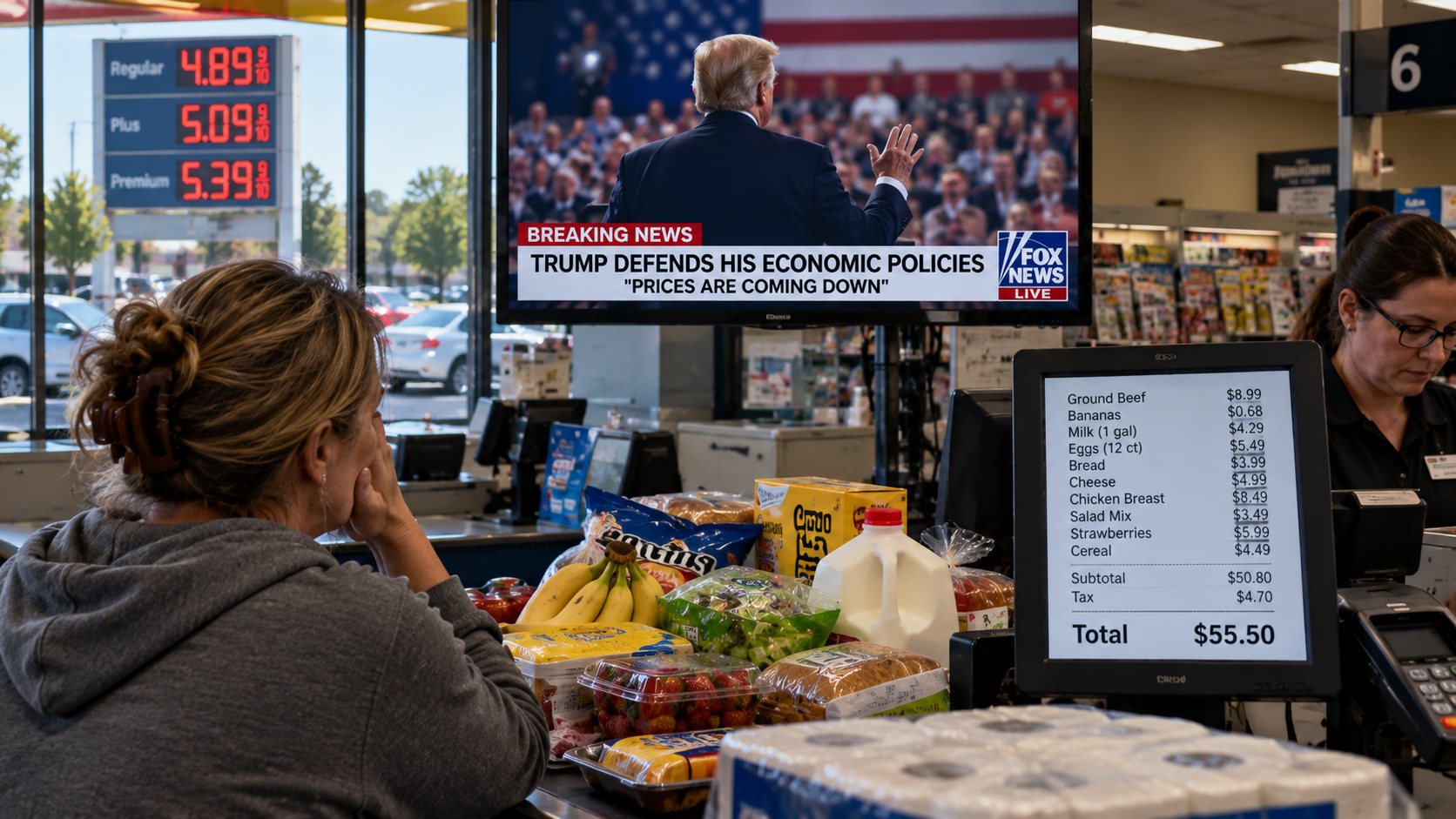
Donald Trump returned to the White House promising Americans he would bring prices down.
Nearly two years later, voters increasingly aren't buying it.
A new Associated Press-NORC poll paints an extraordinarily bleak picture for the president just weeks before the 2026 midterm elections.
Only 31% of American adults approve of Trump's overall job performance, while 69% disapprove.
But Trump's numbers on the issue that helped return him to the White House are even worse.
Only 26% approve of Trump's handling of the economy.
And when Americans are asked specifically about the cost of living?
Just 17% approve.
That means more than eight in ten Americans do not approve of Trump's handling of one of the most important issues facing American families.
For a president who spent much of the 2024 campaign promising to make life more affordable, the numbers represent a remarkable political reversal.
Americans Are Blaming Trump
Presidents frequently receive too much credit when the economy is good and too much blame when it is bad.
Trump could reasonably argue that presidents don't personally control every grocery price, gasoline price or interest rate.
But the new poll contains a particularly troubling finding for the White House.
Americans aren't simply unhappy about prices.
They increasingly believe Trump's own policies are responsible for them.
According to AP-NORC, 65% of U.S. adults say Trump's policies are more responsible for persistently high prices than factors outside his control.
That distinction matters.
Americans aren't merely telling pollsters:
Things are expensive.
They're saying:
We think the president's policies helped make them expensive.
Only 17% Approve on Cost of Living
The cost-of-living number may be the most politically damaging result in the entire survey.
Just 17% approve of Trump's performance on the issue.
About seven in ten Americans say Trump's handling of the cost of living has been worse than they expected.
And dissatisfaction is no longer confined to Democrats and independents.
Roughly six in ten Republicans disapprove of Trump's handling of the cost of living, according to the poll.
That Republican dissatisfaction has increased since April, when roughly half disapproved.
The problem isn't difficult to understand.
Americans experience the economy differently from economists.
They don't necessarily judge it by GDP reports.
They don't live inside stock-market charts.
They experience it at the grocery store.
At the gas station.
When the electric bill arrives.
When they pay their insurance premium.
When they fill a shopping cart and realize that the same amount of money buys less than they expected.
About half of American adults now say they are extremely or very concerned about being able to afford gasoline.
In July, that number was 39%.
About half are similarly concerned about affording food.
Those are everyday economic pressures.
And they're landing directly on Trump's presidency.
The Economy Was Supposed to Be Trump's Strength
That's what makes these numbers particularly significant.
Trump's economic record was historically one of his strongest political assets.
During his first presidency, even voters who disliked Trump personally sometimes gave him relatively strong marks on the economy.
Trump leaned heavily on that reputation during the 2024 campaign.
He relentlessly attacked President Joe Biden over inflation.
He attacked Vice President Kamala Harris over grocery prices.
He promised cheaper energy.
Cheaper gasoline.
Lower inflation.
Lower interest rates.
Greater prosperity.
Trump told Americans that putting him back in the White House would restore the economic conditions they remembered from before the pandemic.
The AP-NORC poll suggests a large portion of the country believes that promise hasn't been fulfilled.
Trump's economic approval has fallen 14 percentage points since March 2025.
Trump Is Approaching Biden's Worst Economic Numbers
There is another uncomfortable comparison for Trump.
Joe Biden.
Trump spent years using Biden's poor economic polling as evidence that Democratic economic policies had failed.
Now Trump's economic approval has fallen to roughly the same territory.
In June 2022, during the inflation surge following the COVID-19 pandemic, Biden's economic approval fell to 28%.
Trump is now at 26%.
But there is an important difference.
When Americans were asked about high prices before the 2022 midterms, they were less likely to directly blame Biden.
In October 2022, 44% said Biden's policies were responsible for high prices, while 55% blamed circumstances outside his control.
Today, 65% say Trump's policies bear more responsibility for high prices.
Trump therefore isn't merely confronting Biden-level economic dissatisfaction.
He's confronting a public that is more inclined to blame the president directly.
Tariffs Are Becoming a Liability
Trump's aggressive tariff policies aren't helping.
Trump has long argued that tariffs protect American workers, encourage domestic manufacturing and force foreign countries to negotiate better trade agreements.
His administration continues to defend them.
But Americans increasingly appear skeptical.
Only about three in ten adults approve of Trump's handling of international trade negotiations.
And 64% say Trump has gone too far in imposing tariffs on other countries.
That's up from 58% in January.
Tariffs are ultimately taxes imposed on imported goods.
Although Trump frequently describes them as money paid by foreign countries, importers pay the tariffs to the U.S. government, and economists generally find that at least part of those costs can be passed along to American businesses and consumers.
When voters are already angry about prices, that becomes politically dangerous.
Then There's Iran
The war with Iran has created another serious problem.
Energy prices.
Trump campaigned as a president who would keep America out of new wars.
The continuing conflict with Iran has instead become another source of economic and political dissatisfaction.
According to AP-NORC, 69% of Americans say the war has not been worth fighting.
Only 28% approve of Trump's handling of Iran.
The opposition has increased since July, when 64% said the war wasn't worth fighting.
The connection between foreign policy and household economics is becoming increasingly difficult for the White House to escape.
War in the Middle East threatens oil supplies.
Disruption in the Strait of Hormuz affects global energy markets.
Higher oil prices affect gasoline.
Higher diesel prices increase transportation costs.
Transportation costs eventually affect almost everything Americans buy.
A war thousands of miles away eventually arrives at the grocery store.
Even Some Trump Voters Are Losing Patience
Perhaps the most politically significant part of the AP reporting isn't a percentage.
It's who is complaining.
The Associated Press interviewed several Americans who previously supported Trump or generally vote Republican.
Their frustration is unmistakable.
A retired Pennsylvania factory worker who identifies as Republican told AP he had expected Trump to improve the country but hadn't seen the economic improvement he expected.
An Iowa farmer who has voted for Trump three times said grocery prices seemed increasingly out of control.
A Mississippi Republican criticized the administration for focusing on symbolic issues while families struggle to afford necessities.
These aren't Democratic activists.
They're voters Trump needs.
That doesn't necessarily mean they'll vote Democratic in November.
Some may stay home.
Some may continue voting Republican despite their dissatisfaction.
Some may blame Congress rather than Trump.
And some Republicans in the poll still attribute inflation primarily to circumstances beyond Trump's control.
But dissatisfaction inside your own political coalition is dangerous heading into a midterm election.
Border Security Remains Trump's Bright Spot
The poll isn't universally terrible for Trump.
One issue remains substantially stronger:
Border security.
About half of Americans approve of Trump's handling of the border.
That makes immigration and border enforcement one of the few major policy areas where Trump's approval approaches or reaches the halfway mark.
The White House can legitimately point to that as evidence that substantial numbers of Americans support at least part of Trump's agenda.
But there's a political problem.
The economy and cost of living are affecting virtually everyone.
And Americans increasingly rank affordability among their most immediate concerns.
A president can have strong border numbers and still suffer politically if voters believe they can't afford groceries.
Are These Numbers an Outlier?
One poll should never be treated as a prediction.
Polls are snapshots.
Different pollsters use different methodologies, different samples and slightly different questions.
And Trump's support has historically been difficult for some polling organizations to measure accurately.
But AP-NORC isn't the only survey showing Trump underwater.
Other recent national polling has also found substantially more Americans disapproving than approving of Trump's performance.
A CBS News poll released Sunday, for example, measured Trump at 39% approval and 61% disapproval.
The exact numbers vary.
The direction does not.
Trump is currently underwater nationally, and economic dissatisfaction is a major reason.
Midterms Are One Month Away
The timing couldn't be much worse for Republicans.
Election Day is November 3.
Trump isn't personally on the ballot.
But he has explicitly encouraged voters to behave as though he is.
Republicans are trying to defend control of Congress while the Republican president carries deeply negative approval numbers.
That creates a difficult equation.
Republican candidates need Trump's supporters to turn out.
But some also need independents and swing voters who currently disapprove of Trump.
The president is now embarking on an aggressive rally schedule intended to energize Republican voters.
Whether those appearances help Republican candidates or force them to answer for Trump's unpopular policies will vary from race to race.
But Republicans cannot simply ignore the numbers.
Trump Promised to Fix Prices
Ultimately, this is about expectations.
Trump didn't inherit the presidency promising Americans that lowering prices would be difficult.
He didn't tell voters inflation was complicated.
He didn't campaign on patience.
He told Americans he could fix it.
During the 2024 campaign, Trump repeatedly blamed Biden and Harris for inflation and presented himself as the solution.
Americans listened.
They returned him to the White House.
Now they're judging the result.
And according to AP-NORC, the verdict from many Americans is increasingly negative:
69% disapprove of Trump's overall job performance.
74% do not approve of his handling of the economy.
83% do not approve of his handling of the cost of living.
65% primarily blame Trump's policies for persistently high prices.
69% say the Iran war hasn't been worth fighting.
64% believe Trump has gone too far with tariffs.
Those aren't numbers produced by Democratic politicians.
They're answers given by Americans to a national survey.
Trump spent years telling voters that presidents should be held accountable when Americans can't afford the cost of living.
Now he's president.
And increasingly, Americans appear to be holding him to his own standard.
Source: Associated Press-NORC Center for Public Affairs Research and contemporary national polling.