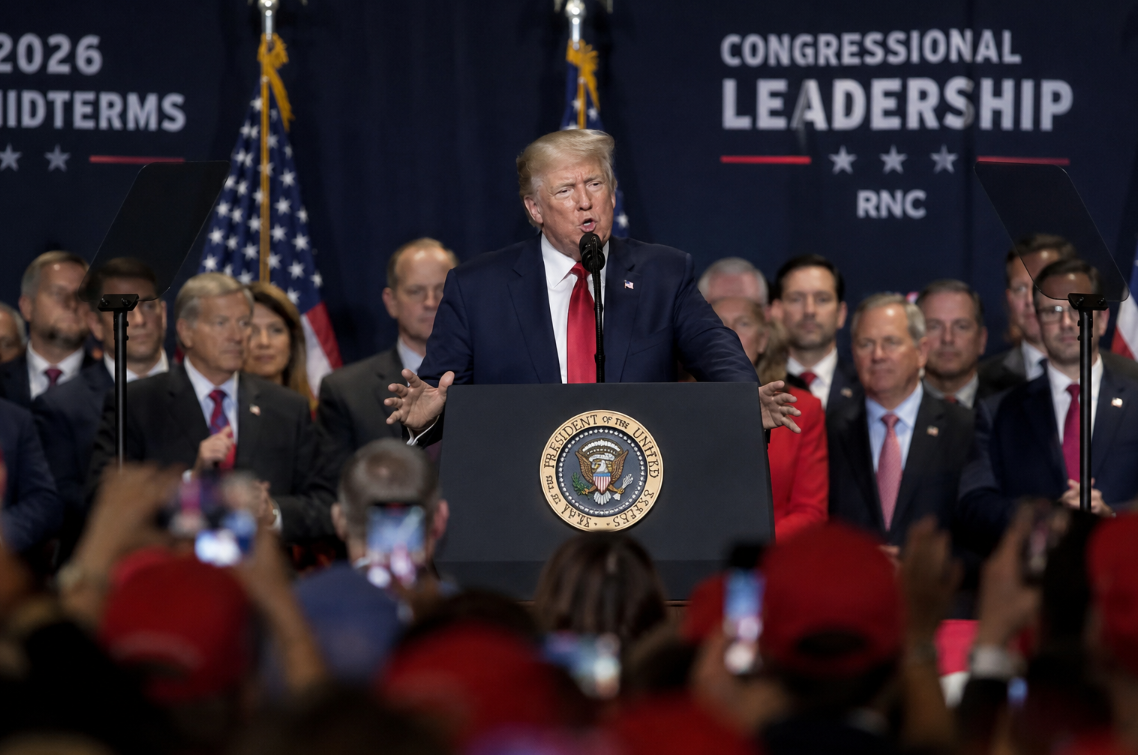
With the 2026 midterm elections approaching, Republicans are confronting an increasingly difficult political environment — and President Donald Trump is at the center of it.
Recent national polling shows Democrats with a substantial advantage on the congressional ballot, while Trump’s approval ratings remain deeply underwater. The numbers do not guarantee a Democratic wave, much less the Republican “bloodbath” some critics predict. Congressional districts, turnout, redistricting and individual candidates will ultimately determine what happens on Election Day.
But there is growing evidence that Trump himself — and several of the major policies pursued during his second term — have become significant liabilities for Republican candidates.
And that presents Republicans with a fundamental problem: They are running for Congress, but many voters appear to be voting on Donald Trump.
Trump Is Effectively on the Ballot
Midterm elections frequently become referendums on the sitting president, and 2026 appears to be following that pattern.
A July Pew Research Center survey found that 42 percent of registered voters viewed their congressional vote as a vote against Trump, compared with 22 percent who viewed their vote as a vote for Trump.
The situation has deteriorated further for Republicans as Election Day approaches.
A September New York Times/Siena poll found likely voters favoring Democratic congressional candidates by roughly eight percentage points. Trump’s approval rating in that survey stood at just 38 percent, while independent voters — often critical in competitive districts — approved of Trump by only 27 percent.
Other surveys tell a similar story. A September Reuters/Ipsos poll put Democrats ahead 44 percent to 37 percent on the generic congressional ballot.
Those numbers do not tell us what the final seat count will be. But they demonstrate why Republican candidates have reason to worry.
The Iran War Has Become a Political Liability
Perhaps no Trump policy illustrates the problem more clearly than the continuing war with Iran.
Trump campaigned for years as a president who would keep the United States out of prolonged foreign wars. Now, months into the Iran conflict, public support has fallen considerably.
Silver Bulletin's September polling average found approximately 34 percent of Americans supporting the war and 58 percent opposing it. The latest Times/Siena survey included in that average found 64 percent saying Trump's decision to go to war with Iran was the wrong decision.
The political consequences extend beyond foreign policy.
The conflict has contributed to disruptions in global energy supplies and sharply higher gasoline prices. AP reported this week that the nationwide average had reached roughly $4.48 per gallon, putting additional pressure on household budgets immediately before the midterms.
That creates an especially damaging combination for the party in power: an unpopular overseas conflict coupled with an economic consequence voters encounter every time they fill their gas tanks.
Trump retains substantial support among Republican voters, including on Iran, and many Republicans continue to support military action aimed at preventing Iran from obtaining nuclear weapons. But even within the Republican coalition, AP-NORC polling has documented growing concern about gasoline prices and the possibility of a prolonged conflict.
Then There Is Canada
At a time when voters consistently identify affordability as one of their greatest concerns, Trump's escalating trade confrontation with Canada has created another problem for Republicans.
An Ipsos survey released in September found that 57 percent of Americans opposed additional tariffs on Canada while only 20 percent supported them. Sixty-eight percent said the United States should be willing to compromise with Canada rather than insist on getting most of what it wants.
The political danger is particularly visible in states economically connected to Canada.
A Washington Post/Schar School poll found that more than 60 percent of likely Michigan voters opposed Trump's 50 percent tariffs on Canadian products. Among independents, opposition reached 68 percent.
Reuters has reported that Republican candidates in states including Michigan and Maine are being forced to navigate the political fallout from the dispute, with some distancing themselves from aspects of Trump's tariff policy.
Whatever the administration's long-term strategic argument for the tariffs, Republicans must contend with their immediate political reality: voters worried about prices are being asked to accept another policy that many believe could increase their costs.
Greenland Added Another Controversy
Trump's continuing fixation on gaining greater American control over Greenland has produced yet another foreign-policy controversy.
The administration has argued that Greenland is strategically important to American national security, particularly because of Arctic security, shipping routes and competition with Russia and China.
But the idea of the United States taking control of Greenland has never attracted broad public support.
A Pew Research Center survey conducted in January found 58 percent of Americans opposed a U.S. takeover of Greenland, while just 21 percent supported it. Even Republicans were divided: 41 percent favored the proposal while 33 percent opposed it.
Greenland may not determine many congressional votes by itself. But politically, it adds to a broader problem for the administration: Trump has repeatedly devoted attention to dramatic international disputes while Americans continue telling pollsters that their immediate concern is the cost of everyday life.
Affordability May Be the Biggest Problem of All
Ultimately, Iran, Canada and other controversies feed into a much simpler political issue:
How much does it cost to live in America?
A Reuters/Ipsos survey found 47 percent of registered voters naming the cost of living as the single most important factor in deciding their midterm vote. In the same survey, 71 percent of Americans disapproved of Trump's handling of the cost of living, compared with just 22 percent who approved.
Marquette Law School's September poll produced similarly difficult numbers for the administration. Trump's approval was below 30 percent on the economy, the Iran war, gasoline prices, and inflation and the cost of living.
That matters because the economy was supposed to be one of Trump's greatest political strengths.
Instead, the Times/Siena poll found voters trusting Democrats more than Republicans on both the economy and the cost of living — issues that helped Trump return to the White House in 2024.
Republicans Have to Run With Trump's Record
Republican congressional candidates now face a difficult balancing act.
Trump remains enormously influential within the Republican Party, and openly breaking with him can carry substantial political risk among Republican voters.
But general elections require winning independents and less-partisan voters as well.
Those are precisely the voters among whom Trump has encountered serious difficulties.
In competitive House districts rated Toss Up, Lean Republican or Lean Democratic by the Cook Political Report, a bipartisan September poll found Democratic candidates ahead 49 percent to 47 percent — even though Trump had carried those districts collectively by an average of five points in 2024.
The national environment is even more striking. Silver Bulletin's generic-ballot polling average had Democrats ahead by approximately 7.5 points as of September 18.
Republicans need only look at history to understand the danger. The president's party frequently loses congressional seats during midterm elections, particularly when the president is unpopular.
But history is not destiny, and Republicans still have advantages. Only a fraction of House districts are genuinely competitive, redistricting has protected incumbents in many states, and the Senate map presents Democrats with difficult terrain. Reuters estimates roughly 50 of the 435 House races are genuinely competitive.
So predictions of an inevitable Republican electoral collapse should be treated cautiously.
What can be said with considerably more confidence is that Republicans are entering the final weeks of the campaign facing a political environment dominated by an unpopular president, widespread anxiety about affordability, an unpopular war with Iran, rising gasoline prices, a deeply unpopular trade confrontation with Canada and other controversial foreign-policy initiatives.
Donald Trump may not literally be listed on the congressional ballot in November.
Politically, however, he is very much part of the election.
And for Republican candidates trying to hold Congress, the central question of the 2026 midterms may be whether voters ultimately decide to hold them responsible for the policies of the president who leads their party.