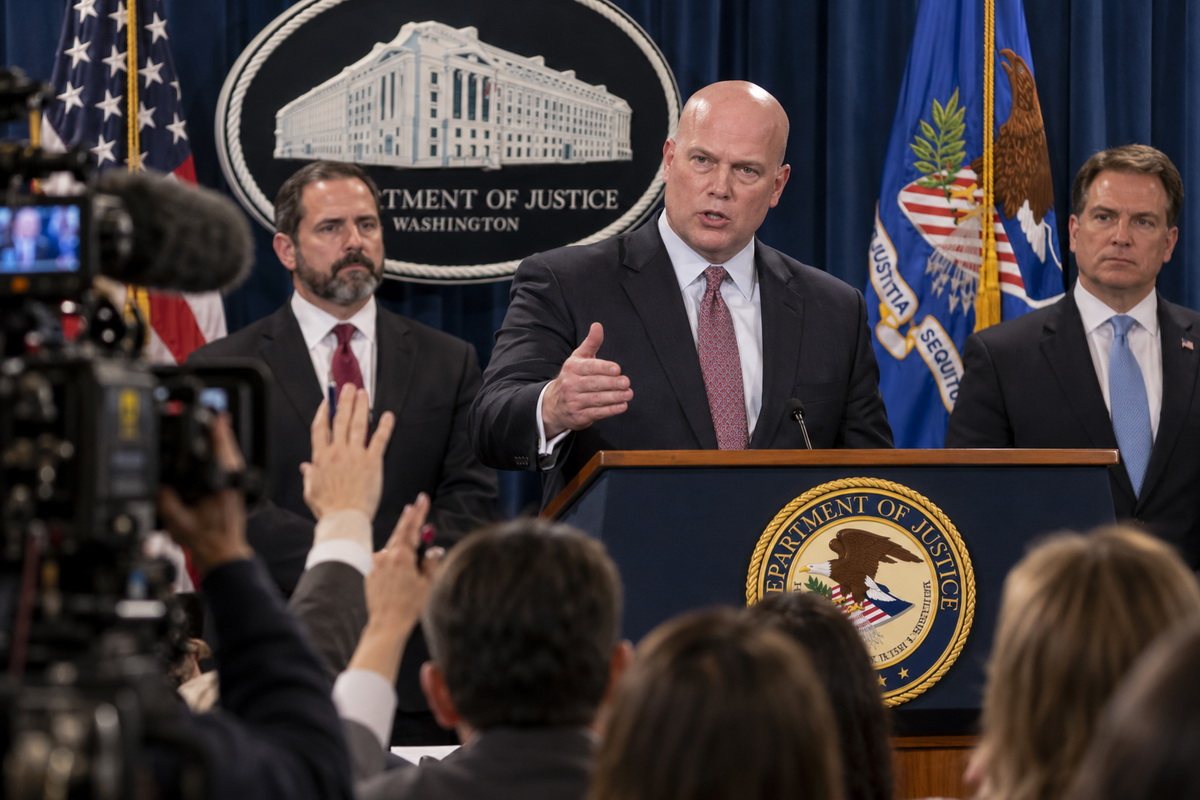
President Donald Trump's decision to remove Attorney General Jeff Sessions and replace him with a vocal critic of the Russia investigation is raising serious concerns about the independence of the Justice Department and the future of Special Counsel Robert Mueller's investigation.
Matthew Whitaker, previously Sessions' chief of staff, assumed control of the Justice Department Wednesday after Trump forced Sessions to resign.
Whitaker now oversees Mueller's investigation into Russian interference in the 2016 presidential election and possible connections between Russian officials and members of Trump's campaign.
The appointment is drawing immediate scrutiny because Whitaker has publicly discussed ways to restrict the investigation he is now responsible for supervising.
Whitaker Previously Suggested Cutting Mueller's Funding
In a July 2017 CNN appearance, Whitaker described how a replacement attorney general could undermine Mueller without formally firing him.
Whitaker suggested that a new attorney general could reduce the investigation's budget so severely that its work would nearly stop.
The remarks are receiving renewed attention because Whitaker now possesses significant authority over Mueller's investigation.
He has also criticized the investigation's scope, arguing that examining Trump's personal finances could exceed the special counsel's authorized responsibilities.
In a 2017 opinion article, Whitaker warned that such an inquiry could transform the investigation into what he described as a political fishing expedition.
Those statements have prompted questions about whether Whitaker can impartially oversee an investigation he has repeatedly criticized.
Trump Removes an Attorney General He Frequently Attacked
Sessions' departure follows months of public criticism from Trump, who repeatedly expressed anger over Sessions' decision to recuse himself from the Russia investigation.
Sessions stepped aside in March 2017 because of his involvement in Trump's presidential campaign and contacts with Russian officials.
That recusal placed Deputy Attorney General Rod Rosenstein in charge of supervising Mueller.
Trump frequently complained that Sessions' decision had deprived him of an attorney general willing to defend his interests.
Now, with Sessions gone, Rosenstein has lost his supervisory authority over the special counsel.
That responsibility belongs to Whitaker.
Eighteen State Attorneys General Demand Recusal
On Thursday, a coalition of 18 state attorneys general sent Whitaker a letter urging him to remove himself from oversight of Mueller's investigation.
The officials argued that Whitaker's previous statements raised legitimate concerns about his impartiality.
They warned that public confidence in the Justice Department depends on ensuring that the investigation proceeds without improper political interference.
Meanwhile, reports indicate Whitaker does not intend to recuse himself.
His appointment also raises questions about whether he would approve efforts to compel testimony from Trump.
Concerns Over Presidential Influence
The Brennan Center for Justice warned Thursday that Whitaker's appointment threatens established principles of Justice Department independence.
Critics argue that placing an outspoken opponent of the investigation in charge creates a potential conflict between the department's law enforcement responsibilities and the president's political interests.
Trump has repeatedly characterized Mueller's investigation as a witch hunt and denied wrongdoing.
Whitaker, meanwhile, has pledged to lead a fair Justice Department with high ethical standards.
There is currently no public evidence that Whitaker has taken action to restrict Mueller's investigation since assuming office.
Nevertheless, his previous statements have intensified demands for congressional oversight.
An Investigation at a Critical Moment
Mueller's investigation has already produced criminal charges and guilty pleas involving several former Trump associates.
With Democrats preparing to take control of the House of Representatives in January, congressional scrutiny of the administration is expected to increase.
The central question is whether Whitaker will allow the special counsel to continue operating independently or use his authority to limit the investigation.
For now, Trump's decision has placed one of the president's public defenders in charge of overseeing an investigation involving his own campaign.
That arrangement is already generating significant concern about the Justice Department's independence.