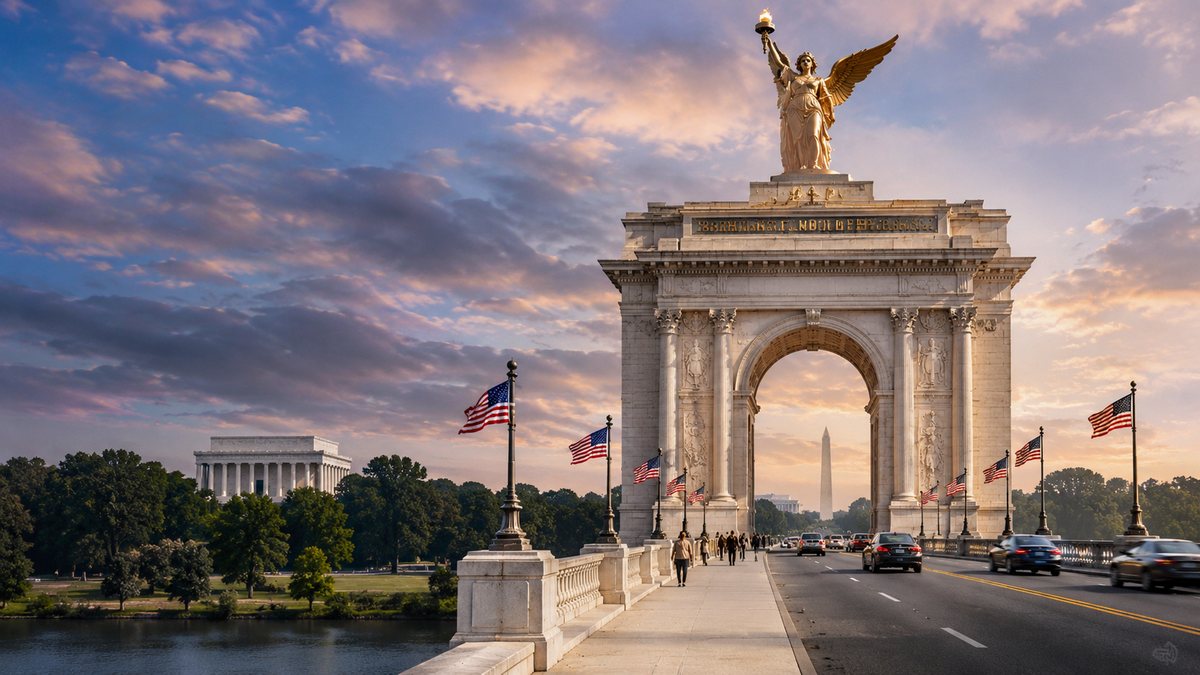
Donald Trump's plans to dramatically reshape the nation's capital are facing another legal challenge, this time from the governments of Virginia and Washington, D.C., which have filed a federal lawsuit seeking to block construction of his proposed 250-foot triumphal arch near Arlington National Cemetery.
The massive monument, inspired by Paris's Arc de Triomphe, would tower over the entrance to Arlington Memorial Bridge, fundamentally changing one of Washington's most historically significant landscapes.
Trump says the arch would commemorate America's 250th anniversary and honor the nation's military veterans. But opponents argue that the president is attempting to push through an enormous construction project without the congressional authorization, environmental reviews, and historic preservation protections required by law.
And the legal opposition is growing.
On October 31, D.C. Attorney General Brian Schwalb and Virginia Attorney General Jay Jones filed suit, warning that construction would cause serious and potentially irreversible damage to the surrounding communities.
Their lawsuit describes a project that could disrupt traffic for approximately three years, interfere with emergency services, increase pollution, and threaten the historic character of the area surrounding Arlington National Cemetery.
The lawsuit also challenges whether the administration has legal authority to construct the monument without congressional approval.
The proposed arch would stand approximately 100 feet taller than the Statue of Liberty itself, excluding its pedestal.
Its design includes an enormous winged figure of Lady Liberty carrying a torch, observation areas, offices, elevators, and other interior facilities.
Administration officials have also suggested the structure could serve national security purposes, raising additional questions about its intended function.
Veterans Are Among Those Fighting the Project
The latest lawsuit is not the first challenge.
Three Vietnam War veterans and a historic preservationist have already sued to stop construction, arguing that the monument would damage the historic relationship between the Lincoln Memorial and Arlington National Cemetery.
Arlington County has filed a separate lawsuit raising environmental, aviation, and public safety concerns.
For critics, the location is especially sensitive.
Arlington National Cemetery is the final resting place of hundreds of thousands of American service members and veterans. Opponents argue that inserting a towering monument into the surrounding landscape would alter the solemn character of a place dedicated to military sacrifice.
Federal Judge Tanya Chutkan held a hearing on October 30 and questioned why the administration needed to move forward so quickly.
The administration hopes to obtain final approval from the National Capital Planning Commission on November 5 and potentially begin construction immediately afterward.
Chutkan indicated she would consider the request to halt construction promptly.
A Monument to America or Another Trump Legacy Project?
The White House has defended the arch, arguing that it would become an internationally recognized landmark and a tribute to American military service.
Administration officials also maintain that they have complied with applicable legal requirements.
But the lawsuits raise a fundamental question: Can a president permanently transform federally protected historic landscapes without the ordinary approval and review processes?
Critics see the project as part of Trump's broader effort to leave his personal architectural mark on Washington, including his controversial White House ballroom project.
Supporters see an opportunity to create a new national landmark.
For now, the proposed monument remains unbuilt, with multiple lawsuits challenging its legality and federal courts weighing whether construction should be stopped.
The dispute is no longer simply about architecture.
It is about presidential authority, historic preservation, and who gets to decide how America's most important public spaces are transformed.