The Pentagon's bill has reached $43.6 billion. But Americans are paying for the Iran war somewhere else, too—in gasoline, energy costs, higher interest rates and an economy absorbing the consequences of a conflict now approaching seven months.
Donald Trump's war with Iran is becoming increasingly expensive.
Not just for the Pentagon.
For American families.
A new analysis from Moody's Analytics estimates that the economic consequences of the conflict have imposed costs equivalent to approximately $1,760 per U.S. household since the war began in February.
That doesn't mean Washington has mailed every family a $1,760 invoice.
The cost is being felt differently.
According to Moody's Analytics chief economist Mark Zandi, approximately $930 of the estimated household burden comes from higher energy costs.
Another $425 comes from higher interest rates since the conflict began.
And approximately $405 represents households' share of increased military spending—money ultimately financed through government borrowing or taxes.
Add it together:
$1,760 per household.
And the war isn't over.
The Pentagon Bill: $43.6 Billion
The newest U.S. military estimate puts the direct cost of the Iran conflict at $43.6 billion through September 3.
That is already substantially higher than an earlier Congressional Budget Office estimate of $38 billion through August 1.
The largest expense is ammunition.
According to U.S. Central Command's accounting, approximately $28.1 billion will be needed to replace missiles, bombs and other munitions expended during the fighting.
Another $11.2 billion represents operating expenses.
Approximately $4.3 billion accounts for equipment that has been lost or damaged.
And even that doesn't represent the entire bill.
The $43.6 billion estimate does not include all the damage Iran has inflicted on American military installations throughout the Middle East.
Iranian ballistic missiles and drones have damaged or destroyed hundreds of structures at U.S. bases across the region.
Repairing them will cost additional billions.
And It Keeps Growing
The Congressional Budget Office estimates that continuing military operations could cost approximately $2 billion to $3 billion every month.
That means even if the conflict remains at roughly its current intensity, taxpayers could watch billions more accumulate before the fighting ends.
But Pentagon spending represents only one part of the economic consequences.
The war disrupted one of the most important energy-producing regions on Earth.
Oil shipments were disrupted.
Energy markets reacted.
Gasoline and diesel prices climbed.
Transportation became more expensive.
And those costs began moving through the American economy.
Americans Pay at the Pump
For most families, the Pentagon's accounting is abstract.
Gas prices aren't.
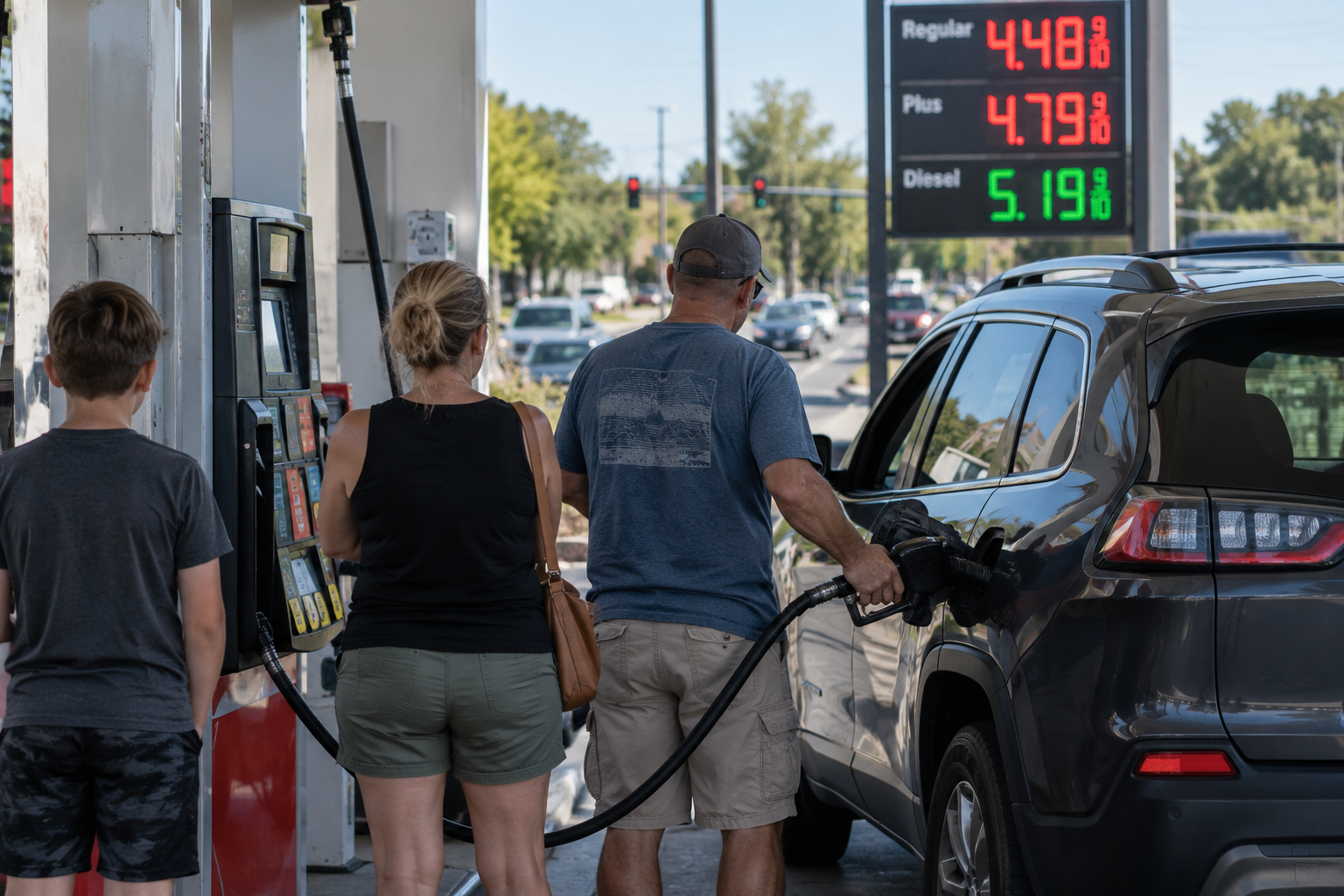
The national average for gasoline recently reached approximately $4.48 per gallon, while diesel prices climbed even higher.
That affects considerably more than the cost of filling a car.
Almost everything Americans buy has to be transported somewhere.
Food travels by truck.
Packages travel by truck.
Construction materials travel by truck.
Farm equipment runs on diesel.
Airlines buy enormous quantities of fuel.
When energy becomes more expensive, those costs spread throughout the economy.
That is why Moody's estimates energy alone has imposed approximately $930 in additional costs on the average American household since the war began.
It is also why the economic consequences don't stop at the gas station.
They show up in groceries.
Airfare.
Shipping.
Manufacturing.
Home improvement.
And countless other goods and services.
Inflation Is Back in the Conversation
The Congressional Budget Office has also warned that the war's energy shock could push inflation higher than it otherwise would have been.
CBO estimates inflation during the first quarter of 2027 could be approximately half a percentage point higher than projected before the war.
That matters because Americans had already spent years dealing with elevated prices.
A family doesn't experience inflation as an economic statistic.
It experiences it when the grocery bill is higher.
When filling the car costs more.
When financing a vehicle becomes more expensive.
When a mortgage payment becomes harder to afford.
When a business raises prices because transportation and electricity cost more.
And unlike the Pentagon's war expenditures, those expenses don't appear in a congressional appropriations bill labeled “Iran.”
They simply appear in household budgets.
Trump Once Warned Obama About This Exact War
There is another remarkable piece of history surrounding the conflict.
In 2011, Donald Trump repeatedly predicted that President Barack Obama would start a war with Iran.
Trump claimed Obama would do it because he was incapable of negotiating successfully.
“Our president will start a war with Iran because he has absolutely no ability to negotiate,” Trump said at the time.
Obama never started that war.
Instead, his administration joined other world powers in negotiating the 2015 nuclear agreement designed to restrict Iran's nuclear program.
Trump later withdrew the United States from that agreement during his first presidency.
Fifteen years after Trump predicted Obama would launch a war with Iran, it was President Trump who ultimately entered one.
And Americans are now paying for it.
Trump Calls the Higher Prices an ‘Inexpensive Price to Pay’
Trump has acknowledged that the conflict has increased energy costs.
But he has argued that Americans should accept those costs because of what he says the war is accomplishing.
Speaking about higher gasoline prices this month, Trump characterized them as an “inexpensive price to pay.”
For families struggling with their household budgets, the calculation may look different.
An estimated $930 in additional energy costs isn't theoretical.
Neither are higher borrowing costs.
Neither is inflation.
Neither are the billions of dollars being spent replacing missiles and military equipment.
And neither is the national debt that eventually absorbs federal spending not covered by current revenues.
$1,760—and Counting
The Moody's estimate deserves an important qualification.
No American family receives an itemized Iran-war bill for $1,760.
Some households will experience greater costs.
Others will experience less.
Energy consumption varies.
Borrowing varies.
Income varies.
The figure is an economic estimate designed to illustrate the scale of the conflict's broader impact.
But it exposes something that discussions of war spending often obscure.
Wars aren't paid for only at the Pentagon.
Americans pay at gas stations.
They pay through higher prices.
They pay through interest rates.
They pay through federal borrowing.
And eventually, they pay through taxes or reduced government spending elsewhere.
The Pentagon says Trump's Iran war has already accumulated at least $43.6 billion in military costs.
Moody's estimates the broader economic burden has reached approximately $1,760 per American household.
And the Congressional Budget Office says another $2 billion to $3 billion in military costs could be added every month the conflict continues.
There is no final price tag yet.
Because the meter is still running.