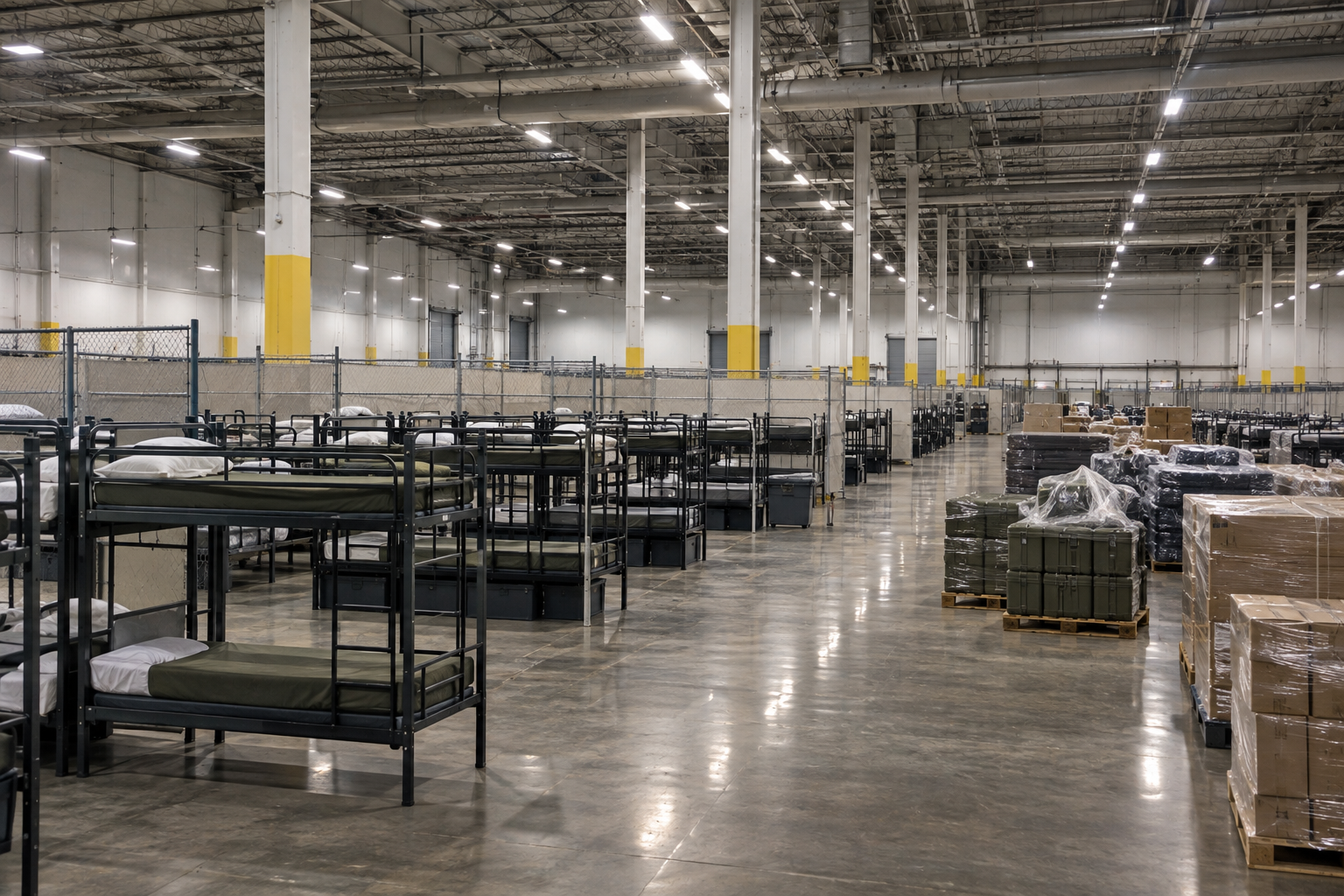
ICE spent billions expanding immigration detention capacity, bought more than $1 billion worth of warehouses and poured millions into facilities that were barely used. A federal watchdog says the agency did it without first developing a comprehensive plan.
The Trump administration wanted immigration detention space.
A lot of it.
As President Donald Trump pushed ahead with his mass-deportation program, Immigration and Customs Enforcement began an enormous effort to increase the number of immigrants the federal government could detain.
Congress provided unprecedented amounts of money to make it happen.
ICE began spending.
There was just one problem.
According to the federal government's own watchdog, the agency didn't have a comprehensive strategic plan for what it was building.
The result has already cost taxpayers tens of millions of dollars in waste—and potentially much more.
A new report from the nonpartisan Government Accountability Office found that ICE invested billions of dollars across six new detention initiatives since January 2025 without conducting sufficient analysis and planning.
GAO's conclusion was straightforward:
The rush resulted in waste.
$1.07 Billion Worth of Warehouses
One of the administration's biggest ideas was converting industrial warehouses into enormous immigration detention centers.
ICE purchased 11 warehouses at a reported cost of approximately $1.07 billion.
Communities across the country pushed back against several of the proposed facilities.
Then the administration changed course.
By June 2026, ICE officials told GAO that the government planned to sell seven of the 11 warehouses it had purchased.
But taxpayers don't simply get all their money back.
ICE had already spent millions preparing and maintaining properties it no longer intends to use.
Approximately $7.7 million went toward expenses including zoning assessments and title insurance.
Another approximately $12.8 million had been spent on utilities, security and other services at warehouses the government now plans to sell.
That is more than $20 million in nonrecoverable costs.
And ICE is still paying expenses associated with some of those properties while it attempts to unload them.
$2.85 Million for Tents Nobody Used
Then there was Guantánamo Bay.
The Trump administration announced plans to use the U.S. naval base in Cuba to hold large numbers of immigration detainees.
At one point, Trump talked about creating capacity for as many as 30,000 people there.
The reality looked considerably different.
The Department of Defense spent approximately $2.85 million assembling tents at Guantánamo that were never used.
The government's own analysis ultimately concluded that housing anything approaching 30,000 detainees there wasn't practical, in part because constructing facilities meeting ICE detention standards would be prohibitively expensive.
Meanwhile, ICE continued spending money on detention operations at the base.
From the beginning of fiscal year 2025 through June 30, 2026, ICE obligated approximately $43 million for operations there.
During fiscal year 2026, Guantánamo held an average of just 16 immigration detainees per day.
Sixteen.
Millions of dollars were being spent maintaining an immigration detention operation whose average daily population could fit inside a small passenger van.
Then There Was Camp East Montana
Another expensive experiment appeared at Fort Bliss in El Paso, Texas.
Camp East Montana was constructed as a massive temporary detention facility.
Again, the government's watchdog found serious problems.
ICE entered into arrangements requiring the government to pay for meals and operational services based on capacity considerably greater than the actual number of detainees housed there.
At one point, the government was paying for services for 5,000 people while the facility held only about 1,600 detainees.
GAO previously concluded that more than $11 million in taxpayer money was wasted operating the facility.
That included paying for meals when detainees hadn't even arrived.
Even after those problems were identified, investigators found that cost-saving measures still had not been incorporated into a subsequent contract as of August 2026.
The government continued paying for services it didn't need.
‘Alligator Alcatraz’
Florida's controversial immigration detention facility in the Everglades also appears in the GAO investigation.
The temporary facility became nationally known as “Alligator Alcatraz.”
The facility has since closed.
But the financial questions surrounding it haven't disappeared.
Despite the absence of an agreement obligating ICE to reimburse Florida, DHS used Federal Emergency Management Agency funding to award the state approximately $608.4 million connected to the facility.
The enormous expense illustrates the scale of the government's effort to rapidly create detention capacity outside ICE's traditional network.
It also demonstrates why planning matters.
ICE Doesn't Know What This Will Cost Long Term
Perhaps the most concerning finding isn't about a particular warehouse, tent or detention camp.
It's about what happens next.
GAO found that ICE hasn't adequately determined the long-term cost of operating its expanded detention system.
The agency has not projected facility costs beyond the first three years of operation.
That is particularly important because much of the extraordinary funding currently financing the expansion is available only through fiscal year 2029.
Eventually that money runs out.
The detention centers don't necessarily disappear with it.
That means future taxpayers could inherit enormous operating expenses without the government having adequately calculated what those expenses will be.
GAO warned that ICE lacks important information about the long-term affordability of its investments.
The Plan Comes Later
GAO made what seems like an extraordinarily basic recommendation:
Develop a comprehensive strategic plan.
The plan should establish ICE's goals, activities and resource requirements for expanding immigration detention.
The Department of Homeland Security agreed.
There is another problem.
ICE says it doesn't expect to finish that plan until August 31, 2027.
In other words, the administration began spending billions of dollars expanding the nation's immigration detention infrastructure in 2025.
The strategic plan explaining how that expansion should actually work isn't expected until more than two years later.
GAO suggested that perhaps ICE should move faster.
Given the unprecedented amount of taxpayer money involved and the continuing potential for waste, investigators wrote, “more timely completion may be warranted.”
That's government-watchdog language for something fairly obvious:
Maybe develop the plan before spending billions of dollars.
This Isn't About Whether Immigration Laws Should Be Enforced
There is a legitimate political debate over immigration enforcement.
Americans disagree about deportations, detention, border security and what should happen to undocumented immigrants already living in the United States.
But none of those disagreements require the government to waste taxpayer money.
Someone can support Trump's immigration policies and still expect the administration to determine whether a billion-dollar detention project makes financial sense before purchasing the buildings.
Someone can support increased detention capacity and still question why taxpayers spent $2.85 million erecting tents that were never used.
Or why millions were spent providing services for detainees who weren't there.
Or why the government purchased 11 warehouses before deciding it wanted to sell seven of them.
Those aren't ideological questions.
They're basic questions about competence and stewardship of public money.
Billions First. Plan Later.
Trump's immigration crackdown has been sold to Americans as an enormous federal undertaking requiring unprecedented resources.
Congress provided them.
ICE received billions to dramatically expand detention capacity.
The agency bought warehouses.
It erected tents.
It built enormous temporary detention facilities.
It expanded operations at Guantánamo Bay.
And only afterward did the federal government's watchdog conclude that ICE lacked the comprehensive strategic plan necessary to determine what capacity it actually needed, which facilities made financial sense and what all of this would eventually cost taxpayers.
More than $20 million has already been lost on warehouses the government now wants to sell.
Millions more went toward tents that were never used.
Millions were spent providing services that weren't needed.
And billions of dollars in additional facilities remain in the system.
ICE has now agreed to develop the strategic plan GAO says it should have had from the beginning.
It should be ready in 2027.
By then, taxpayers will have been paying for the experiment for nearly three years.