Donald Trump went to Hanoi promising that his personal relationship with Kim Jong Un could accomplish what traditional diplomacy had not.
He left without a deal.
No denuclearization agreement.
No timetable for eliminating North Korea's nuclear weapons.
No agreement detailing what nuclear facilities North Korea would dismantle.
No sanctions agreement.
No peace declaration.
The planned signing ceremony was canceled.
The working lunch disappeared from the schedule.
And the second summit between the president of the United States and the dictator of North Korea ended early.
For all the spectacle surrounding Trump's personal diplomacy with Kim, Hanoi produced no signed agreement at all.
Trump Bet on Personal Diplomacy
Trump had invested enormous political capital in his relationship with Kim.
After their first summit in Singapore in June 2018, Trump repeatedly emphasized the personal connection he believed he had established with the North Korean leader.
The two men exchanged letters.
Trump praised Kim publicly.
And Trump increasingly portrayed his unconventional leader-to-leader diplomacy as something capable of breaking through decades of hostility between Washington and Pyongyang.
The second summit was supposed to demonstrate that the relationship could produce concrete results.
Trump arrived in Vietnam talking optimistically about North Korea's economic future.
He repeatedly told Kim that North Korea could become an economic powerhouse if it abandoned its nuclear weapons.
The administration's objective remained extraordinarily ambitious: the final, fully verified denuclearization of North Korea.
By February 28, it was apparent that Trump and Kim remained far apart on what that actually required.
The Deal Falls Apart
The fundamental disagreement involved sanctions and denuclearization.
North Korea offered steps involving its Yongbyon nuclear complex in exchange for substantial sanctions relief.
The Trump administration concluded that what Kim was offering wasn't sufficient.
Trump later said North Korea wanted sanctions lifted while refusing to dismantle enough of its nuclear program.
“They wanted the sanctions lifted in their entirety,” Trump told reporters. “And we couldn't do that.”
North Korean officials subsequently disputed Trump's characterization.
Foreign Minister Ri Yong Ho said Pyongyang had sought only the removal of sanctions that directly affected the civilian economy and people's livelihoods, not every sanction imposed on North Korea.
Whatever the disagreement over how extensive North Korea's sanctions demand actually was, the fundamental problem was unmistakable.
Washington wanted substantially more denuclearization.
Pyongyang wanted substantially more sanctions relief.
Neither side would move far enough.
And the summit collapsed.
The Signing Ceremony That Never Happened
The failure was especially conspicuous because the White House had prepared for a dramatically different ending.
Trump's schedule included a joint signing ceremony.
The two leaders were expected to have lunch.
Instead, the schedule suddenly changed.
The lunch was canceled.
The signing ceremony was canceled.
Trump left the summit and appeared before reporters earlier than expected.
He acknowledged that documents had actually been prepared for the leaders to sign.
“We actually had papers ready to be signed,” Trump said.
But there would be no signatures.
Trump attempted to portray walking away as evidence that he was unwilling to accept a bad agreement.
Sometimes, he argued, a negotiator simply had to walk away.
That explanation addressed why Trump declined Kim's proposal.
It did not change what the summit produced.
Nothing was signed.
The Limits of Trump's Personal Relationship
Hanoi also exposed a fundamental weakness in Trump's approach to North Korea.
Personal chemistry could not resolve the enormous substantive differences separating the two governments.
Trump repeatedly emphasized how well he and Kim got along.
He described their relationship positively even after negotiations collapsed.
But nuclear diplomacy ultimately required considerably more than two leaders liking one another.
The United States and North Korea still disagreed over what denuclearization meant, what facilities had to be dismantled, how those steps would be verified, when sanctions should be removed and what each side would receive in return.
Those were precisely the issues professional negotiators normally attempted to resolve before leaders arrived to sign an agreement.
In Hanoi, the leaders themselves were left confronting fundamental disagreements.
The personal relationship wasn't enough.
No Denuclearization Breakthrough
Most importantly, the summit produced no concrete breakthrough toward eliminating North Korea's nuclear arsenal.
Trump had entered office threatening North Korea with “fire and fury.”
He later transformed that confrontation into unprecedented face-to-face diplomacy with Kim.
That change dramatically reduced the public hostility between the two leaders.
But reduced hostility was not the same thing as denuclearization.
After two summits, North Korea still possessed its nuclear weapons.
There was still no mutually agreed definition or roadmap for complete denuclearization.
There was still no comprehensive declaration of North Korea's nuclear arsenal and facilities.
There was still no timetable for dismantling that arsenal.
And Hanoi produced no agreement that would create one.
The Summit Ends With Empty Tables
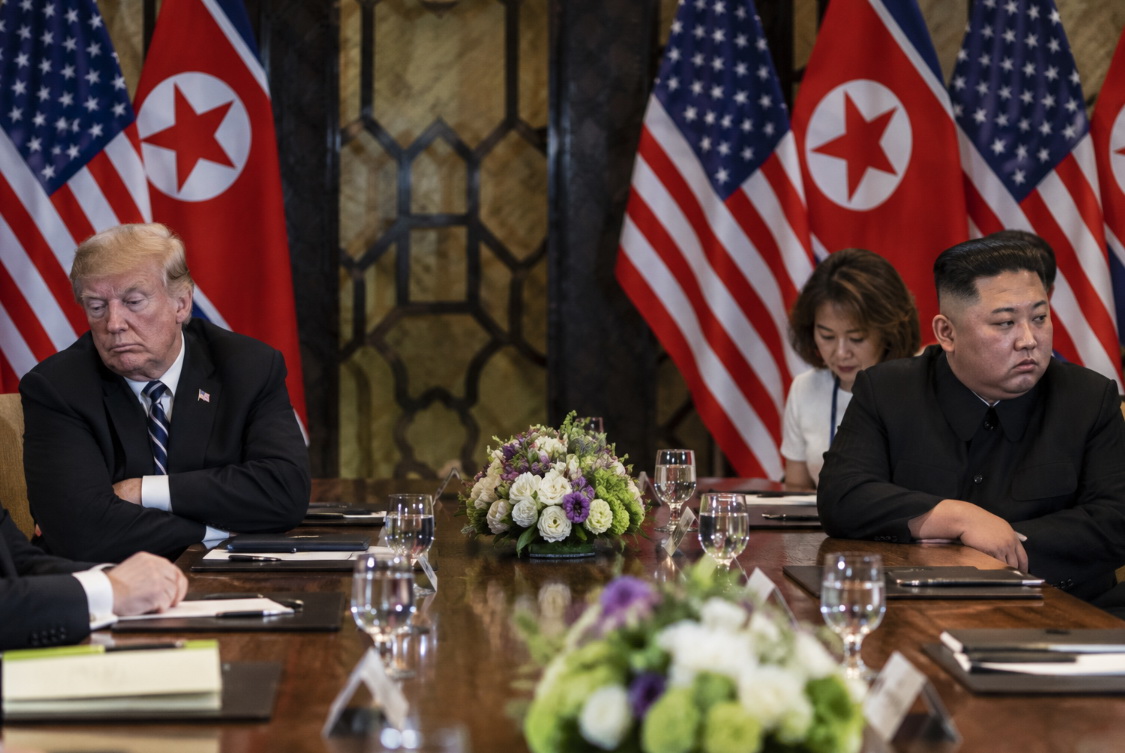
The images from Hanoi had been carefully designed to convey historic diplomacy.
American flags stood beside North Korean flags.
Trump and Kim shook hands before the cameras.
The two leaders sat together and spoke warmly about their relationship.
Trump talked about North Korea's “tremendous” economic potential.
Then the summit ended.
The ceremonial tables prepared for an agreement went unused.
The planned lunch wasn't held.
The signing ceremony never happened.
Trump flew home without the agreement he had traveled halfway around the world to negotiate.
His administration insisted that useful discussions had taken place and that the two sides had exchanged detailed positions.
That was true.
But it was also far short of what the summit was intended to accomplish.
The second Trump-Kim summit had been designed as the next major step toward resolving one of the world's most dangerous nuclear confrontations.
Instead, it demonstrated just how far apart the United States and North Korea remained.
Trump had gambled that his personal relationship with Kim could bridge that divide.
In Hanoi, it couldn't.