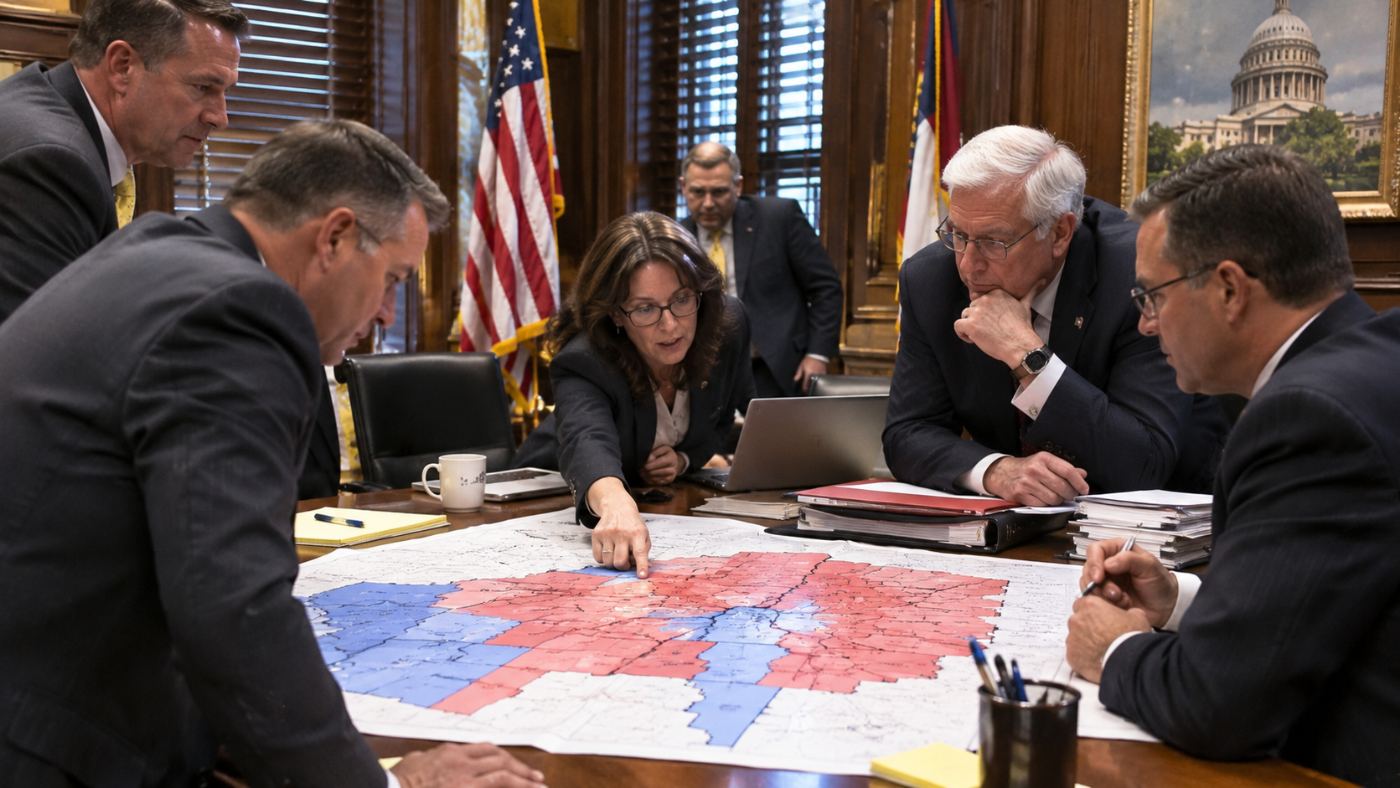
President Donald Trump spent much of 2025 pressuring Republican-controlled states to redraw congressional districts, hoping to strengthen the GOP's hold on the House of Representatives.
Instead, the 2026 midterm elections produced an unexpected outcome: Democrats won many of the districts Republicans had specifically redesigned to favor their own candidates.
According to a November 16 CNN analysis, Republicans won just two of the 15 congressional districts they attempted to make more favorable to their party. Another contest in Louisiana remains headed for a runoff.
The results illustrate the limits of manipulating congressional boundaries when voters shift dramatically against the party drawing them.
Trump Wanted Five More Seats in Texas
The redistricting campaign began in Texas, where Trump publicly demanded five additional Republican congressional seats.
Republican lawmakers responded by redrawing district boundaries in an effort to improve their party's prospects.
But the election results did not match expectations.
Democrats won four of the five districts Republicans had targeted for gains.
They also flipped two additional Republican-held seats in Texas.
The outcome was particularly striking because the new boundaries were designed using previous voting patterns to favor Republican candidates.
North Carolina Becomes a Warning
North Carolina produced an even more dramatic result.
Republican lawmakers attempted to expand their congressional advantage by redistributing Republican voters across additional districts.
The strategy created more potentially competitive Republican seats but reduced the party's margins of safety.
When Democratic candidates substantially outperformed expectations, those narrower margins became a liability.
Democrats were positioned to flip six or seven Republican-held seats.
Political analysts call this phenomenon a "dummymander," when an attempted partisan gerrymander inadvertently benefits the opposing party.
Democrats Respond With Their Own Maps
Trump's redistricting campaign also prompted Democratic-controlled states to consider similar tactics.
In California, voters approved a new congressional map intended to counter Republican redistricting elsewhere.
Democrats were positioned to gain five seats under the revised boundaries.
Ohio also produced unexpected Republican losses, with Democrats flipping three seats despite changes intended to improve Republican prospects.
Across states involved in the redistricting fight, CNN estimated Democrats could gain a net 16 seats if outstanding results held.
Not every gain resulted directly from redistricting. The national political environment also played a substantial role.
Some Republicans Refused Trump's Demands
In Indiana, Republican state legislators resisted pressure from Trump to redraw congressional districts.
Their refusal angered the president, who supported primary challenges against several lawmakers.
Subsequent election analysis suggested the proposed maps might have endangered additional Republican seats.
A similar concern emerged in South Carolina, where another proposed Republican redraw could have exposed an incumbent to defeat.
The lawmakers who resisted Trump's pressure may have avoided additional electoral losses.
The Fight Is Not Over
Despite the disappointing results for Republicans, the new congressional maps could still provide advantages in future elections.
Districts designed to favor Republican candidates may become more competitive for the party when national voting patterns change.
Democrats are also considering additional redistricting efforts in states including Maryland, Virginia, and New York.
The continuing struggle raises broader concerns about politicians choosing their voters rather than voters choosing their representatives.
A Strategy That Failed Its First Test
Trump's objective was to create additional Republican seats and protect his party's congressional majority.
The 2026 election produced the opposite immediate result.
Republicans lost control of the House