For years, Republicans had promised to repeal and replace the Affordable Care Act.
By March 2017, they finally had the political power to try.
Donald Trump was in the White House.
Republicans controlled the House of Representatives.
Republicans controlled the Senate.
And House Republicans had introduced legislation designed to dismantle major portions of Barack Obama's signature domestic achievement.
Then, on March 24, the effort collapsed before the House could even vote.
Unable to secure enough Republican support for the American Health Care Act, House Speaker Paul Ryan withdrew the legislation from consideration.
Trump had spent days personally lobbying lawmakers and pushing Republicans to approve the bill.
It wasn't enough.
The new administration had suffered its first major legislative setback.
Seven Years of Promises Meet Governing Reality
Republicans had campaigned against the Affordable Care Act almost from the moment Obama signed it into law in 2010.
The House voted repeatedly during the Obama years to repeal all or portions of the law, knowing that Obama could veto legislation that reached his desk.
The 2016 election changed everything.
For the first time since the Affordable Care Act became law, Republicans controlled both Congress and the presidency.
Repealing Obamacare was no longer primarily a political statement.
Republicans now had to agree on what would replace it.
That proved considerably harder.
The American Health Care Act
House Republicans introduced the American Health Care Act in March.
The legislation would have eliminated the Affordable Care Act's individual mandate penalties, changed the law's insurance subsidies and made major changes to Medicaid.
Supporters argued that Obamacare had increased government involvement in health care, imposed costly mandates and left some consumers facing high premiums and limited insurance choices.
The AHCA, they argued, would move health-care policy in a more market-oriented direction and reduce federal spending.
But the Congressional Budget Office's analysis demonstrated how significant the consequences could be.
CBO initially estimated that approximately 14 million more people would be uninsured in 2018 under the proposal than under existing law.
By 2026, CBO projected that the number of uninsured Americans would be 24 million higher than under existing law.
The legislation was therefore not simply a symbolic repeal of Obamacare.
It represented a substantial restructuring of the American health-insurance system.
Republicans Couldn't Agree
The central political problem was inside the Republican Party itself.
Conservative members of the House Freedom Caucus argued that the legislation did not go far enough in dismantling Obamacare.
Other Republicans worried about moving too far in the opposite direction.
Some represented districts where constituents had benefited from the Affordable Care Act or its Medicaid expansion.
Others were concerned about the potential political consequences of supporting legislation projected to leave millions more Americans without insurance.
Trump and congressional leaders attempted to bridge those differences.
Negotiations continued.
Changes were offered.
Meetings were held.
Trump personally pressured Republican lawmakers to support the legislation.
Still, the votes weren't there.
The Vote That Never Happened
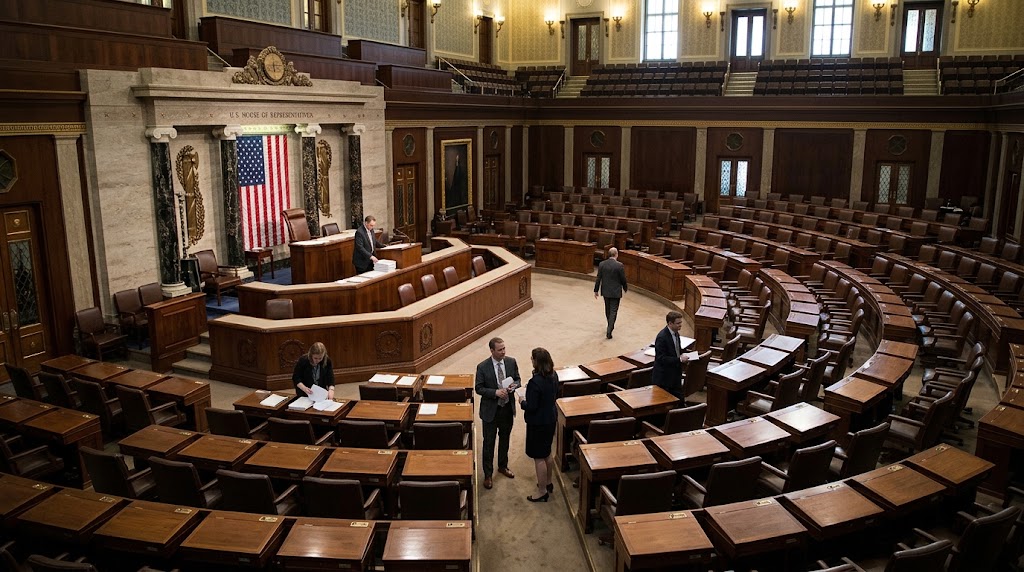
The House was expected to vote on the American Health Care Act on March 24.
Instead, Republican leaders confronted the arithmetic.
They did not have enough votes to pass their own bill.
At Trump's request, Ryan pulled the legislation.
There would be no vote.
The scene was particularly significant because Republicans weren't trying to overcome Democratic control of Congress or a Democratic president's veto.
The obstacle was disagreement within their own governing coalition.
Republicans controlled the institution.
They simply could not agree on legislation that enough of their members were willing to support.
Trump Responds
After the bill was withdrawn, Trump publicly blamed Democrats and predicted that the Affordable Care Act would eventually encounter serious problems.
Ryan acknowledged the scale of the setback.
Republicans, he said, were going to be “living with Obamacare for the foreseeable future.”
For a party that had spent years promising repeal, that was a striking admission.
Trump had entered office portraying himself as a dealmaker capable of achieving results that conventional politicians could not.
His first major attempt to move a signature domestic-policy priority through Congress had instead ended without enough support to even hold the final vote.
Obamacare Survives — For Now
The March defeat did not end Republican efforts to repeal the Affordable Care Act.
House Republicans would regroup.
A revised American Health Care Act eventually returned to the House floor on May 4, 2017, and narrowly passed.
The fight then moved to the Senate, where Republican attempts to repeal major portions of Obamacare would ultimately fail later that summer.
But none of that was certain on March 24.
What was clear was that repealing Obamacare was substantially easier as a campaign promise than as a governing exercise.
Republicans had spent seven years calling for repeal.
They controlled the House.
They controlled the Senate.
They controlled the White House.
And when their first repeal bill reached the moment when members actually had to vote for it, Republican leaders concluded they did not have enough Republican votes to pass it.
The legislation was pulled.
Obamacare remained in place.
And Trump's first major legislative push had ended without a vote.