President Donald Trump’s decision to ban news organizations whose coverage he dislikes has now produced a consequence that reaches far beyond CNN.
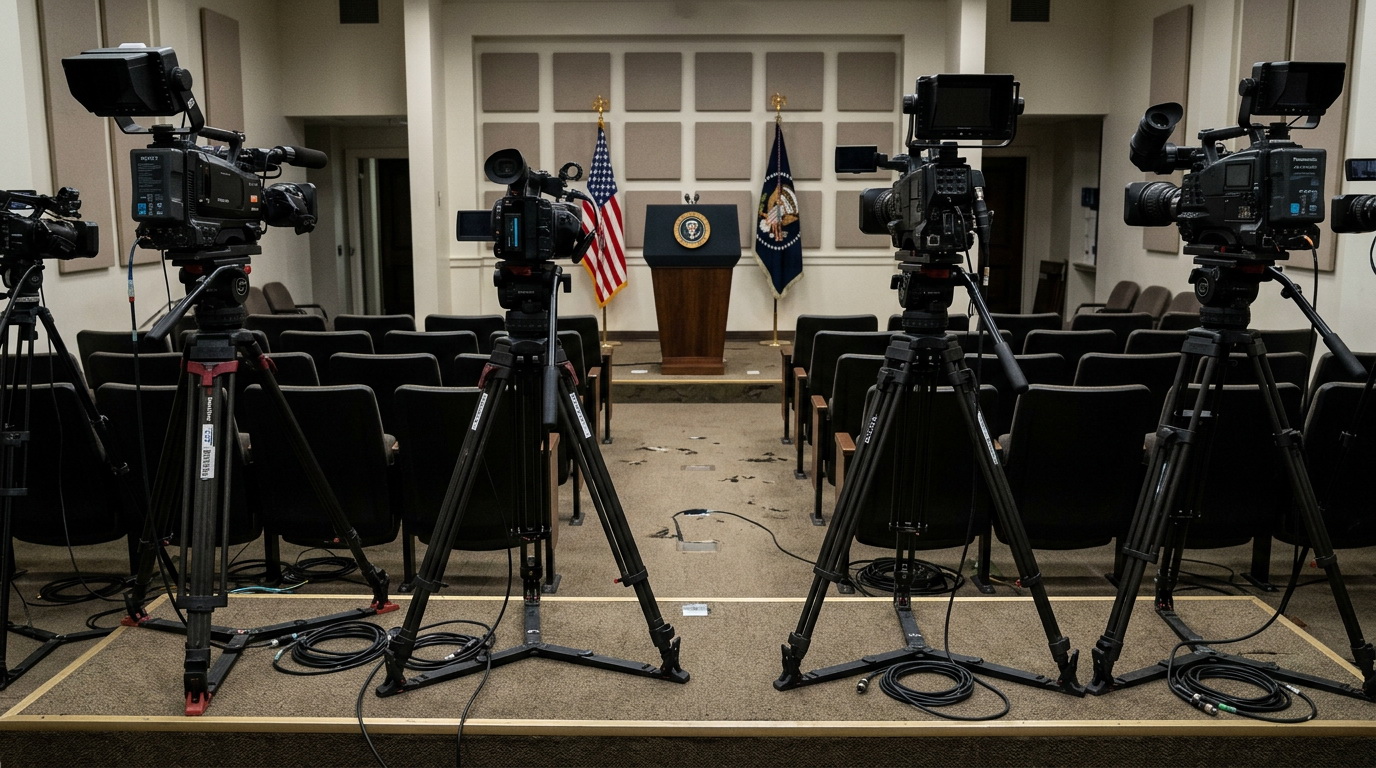
The major television networks that provide pooled video coverage of the president have suspended that coverage after the Trump White House prevented CNN from carrying out its scheduled assignment.
The sequence of events is important because there is little ambiguity about what triggered the confrontation.
Trump announced Friday that CNN, MS NOW and Politico would be barred from the White House. Reporters from those organizations were subsequently denied entry and had their credentials disabled.
On Monday, it was CNN’s scheduled turn to provide television pool coverage of the president.
The White House prevented CNN from doing it.
The rest of the television pool responded by refusing to simply replace CNN.
ABC News, CBS News, NBC News and Fox News joined CNN in suspending pooled television coverage of presidential events. Bryan Boughton, the Fox News Washington bureau chief who chairs the television pool, informed members that there would be no replacement pool.
In other words, the disruption in television coverage did not begin because the networks suddenly decided they did not want to cover the president.
It began because Trump chose to exclude a news organization from the White House because he objected to its reporting.
Trump Made the Decision
Trump has not been vague about why he targeted the three organizations.
He announced the ban himself and accused the outlets of publishing what he calls “fake news.” When questioned Friday, Trump said the decision was not prompted by one particular story but by what he considered years of unfair and negative coverage.
That distinction matters.
This was not a dispute over a security violation by a reporter. Trump has publicly tied the action to his dissatisfaction with the organizations’ journalism.
CNN, MS NOW and Politico responded Monday by filing a federal lawsuit against Trump and members of his administration, arguing that the government cannot revoke journalists’ access because it dislikes their reporting.
The White House maintains that it is targeting what Trump calls false reporting rather than attacking press freedom.
The news organizations argue that punishing particular outlets because of their coverage amounts to unconstitutional viewpoint discrimination. That question will now be fought in federal court.
Even Fox News Refused to Play Along
Perhaps the most striking development is the participation of Fox News.
The television pool consists of CNN, ABC, CBS, NBC and Fox News. The networks rotate responsibility for providing camera coverage and then distribute that footage broadly to other news organizations.
CNN was supposed to handle Monday’s assignment.
After the White House blocked CNN, it could have expected another network to take CNN’s place.
That did not happen.
Instead, the television networks collectively said they would not provide a substitute.
The networks said the public has an interest in receiving independent information about its government and that administrations should not restrict news organizations because they object to their reporting.
That means Trump's fight with CNN has now created a situation in which Fox News — a network whose programming has often been considerably more favorable to Trump — is standing alongside CNN, ABC, CBS and NBC on the principle at issue.
Trump Created a Problem That Did Not Need to Exist
The practical consequences were immediate.
Trump traveled to New York Monday for the United Nations General Assembly without the normal pooled television camera coverage that accompanies presidential travel.
That is not something imposed on Trump by CNN.
It is the result of a chain of events that began with Trump's own decision.
Trump banned CNN, MS NOW and Politico.
The White House enforced that ban.
CNN was prevented from performing its scheduled pool assignment.
The other television networks then declined to replace CNN.
The traditional television pool stopped covering presidential pool events.
Whatever one thinks about CNN or any of the other organizations involved, the cause-and-effect sequence is straightforward.
The White House television pool was functioning before Trump decided to punish news organizations over coverage he considered unfair.
Now it isn't.
A Fight of Trump's Own Making
Trump has spent years attacking journalists and news organizations that report stories he dislikes. During his first presidency, his administration also attempted to revoke White House credentials from individual journalists, prompting court challenges.
But this latest confrontation has escalated beyond another rhetorical fight between Trump and the press.
The president has used control over White House access against specific news organizations. Those organizations have taken him to federal court. And some of America's largest television networks have responded by refusing to participate in a pool system that excludes one of its members because the president objects to its journalism.
Trump may blame CNN.
He may blame the networks.
He may blame what he calls “fake news.”
But the television pool did not disappear because CNN refused to cover the president.
It disappeared after Donald Trump prevented CNN from doing so.
That is the decision that set everything else in motion.