Donald Trump insists the country is doing extraordinarily well.
A growing number of Americans apparently disagree.
With less than a month remaining before the 2026 midterm elections, Trump's approval rating has fallen to some of the lowest levels of his political career, while dissatisfaction with his handling of the economy, cost of living and other major issues threatens to become a significant problem for Republicans trying to maintain control of Congress.
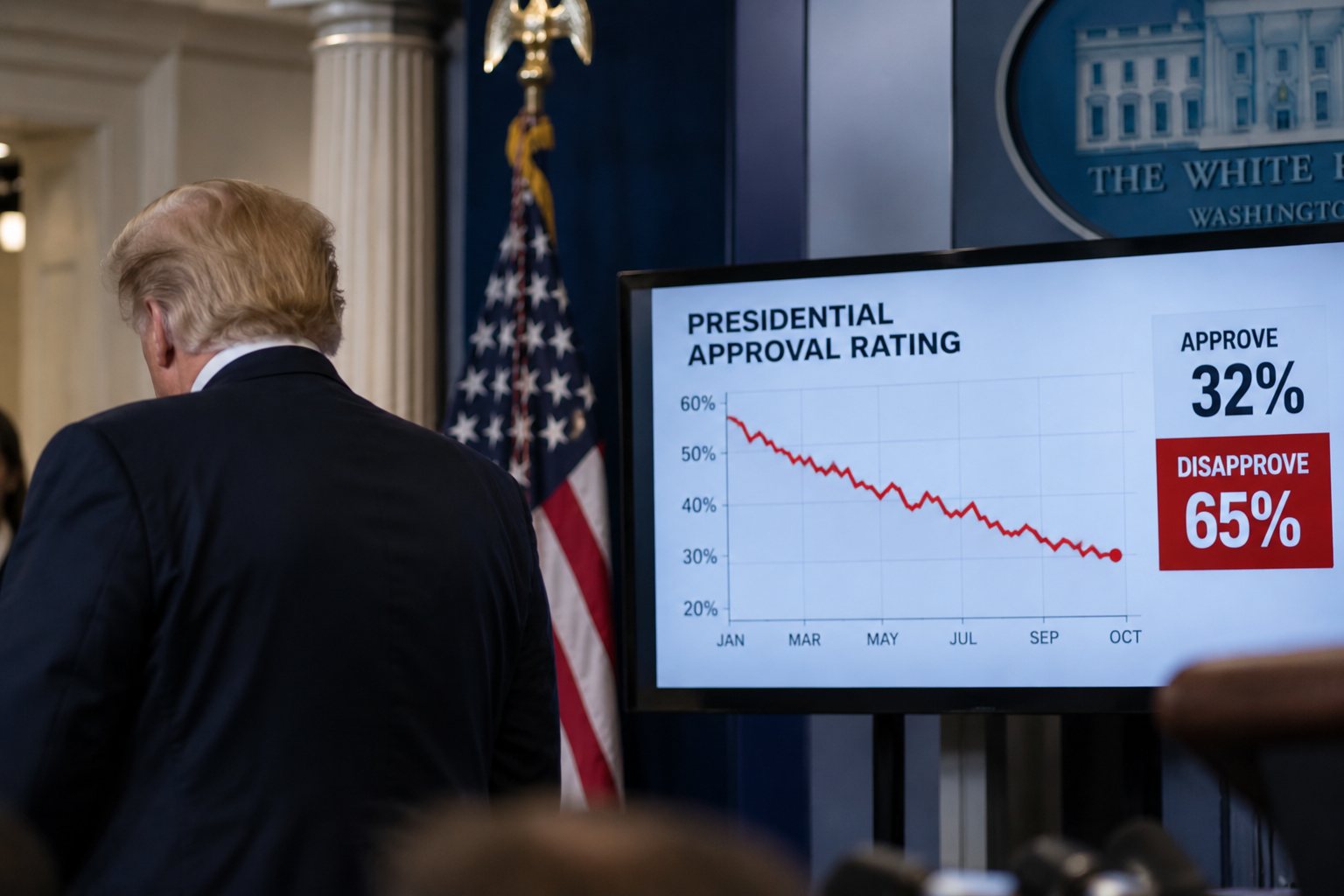
A Reuters/Ipsos poll completed October 5 found that just 32 percent of Americans approve of Trump's performance as president.
Another 65 percent disapprove.
That leaves Trump with a staggering net approval rating of -33 points in the survey.
It also matches the 32 percent approval measured by Reuters/Ipsos in September — the lowest level the polling organization has recorded for Trump during his political career.
And the broader polling picture isn't much better.
Trump Is Deeply Underwater
Different polling organizations use different methodologies, populations and weighting models, so individual numbers vary.
But the overall direction is remarkably consistent.
The Hill and Decision Desk HQ polling average recently put Trump at approximately 38 percent approval and 60 percent disapproval.
CBS News/YouGov measured his approval at 39 percent.
TIPP Insights found 39 percent.
Morning Consult put him somewhat higher, at 41 percent.
Reuters/Ipsos found 32 percent.
The precise number can therefore depend considerably on which poll you examine.
What doesn't change is the fundamental picture:
Far more Americans currently disapprove of Trump's presidency than approve of it.
That is particularly significant because the midterm elections are only weeks away.
Hispanic Support Has Collapsed
Perhaps the most dramatic change is occurring among Hispanic Americans.
Trump made major gains with Hispanic voters during the 2024 presidential election, winning nearly half of their votes according to estimates cited by Reuters.
That represented an enormous improvement over his performance in 2020 and became an important part of the coalition that returned him to the White House.
Less than two years later, much of that support appears to have disappeared.
The latest Reuters/Ipsos survey found that only 24 percent of Hispanic Americans approve of Trump's performance as president.
That is the lowest level Reuters/Ipsos has recorded among Hispanic Americans during either of Trump's presidential terms.
The political consequences extend beyond Trump's personal approval rating.
Among Hispanic registered voters, 52 percent said they planned to vote Democratic in the midterms, compared with just 26 percent who planned to vote Republican.
That is a dramatic reversal for a Republican Party that entered Trump's second term believing its gains among Hispanic voters represented a lasting political realignment.
Republicans Are Losing Ground With Their Own Voters
Trump's problems aren't limited to Democrats, independents or Hispanic voters.
There are signs of erosion within his own party.
Reuters/Ipsos polling in September found Trump's overall approval among Republicans had fallen from 86 percent in January to 73 percent.
The decline was even sharper when Republicans were asked about specific economic issues.
Approval among Republicans for Trump's handling of the economy fell from 80 percent to 56 percent.
On the cost of living, Republican approval dropped from 70 percent to just 44 percent.
That doesn't mean Republican voters have suddenly abandoned Trump.
Most haven't.
But it demonstrates something politically important: dissatisfaction with prices and the economy has penetrated Trump's own political base.
The Cost of Living Is Hurting Him
Americans repeatedly identify prices and the cost of living as major concerns.
An AP-NORC poll released in early October found only 17 percent of Americans approved of Trump's handling of the cost of living.
Just 26 percent approved of his management of the economy overall.
Those numbers are particularly damaging because Trump spent much of the 2024 campaign promising that his policies would lower prices and improve Americans' financial situation.
The economic picture itself is complicated.
Unemployment remains relatively low at 4.2 percent, a level economists would traditionally associate with a healthy labor market.
But voters don't experience the economy through unemployment statistics.
They experience it at grocery stores.
At gas stations.
When paying utility bills.
When paying rent.
And when checking how much money remains in their bank accounts at the end of the month.
Persistent inflation and higher energy costs have continued squeezing household budgets.
The result is an unusual political situation in which traditional economic indicators can look relatively healthy while voters remain deeply dissatisfied.
Trump Says the Problem Is Messaging
Trump has a different explanation.
He argues that his administration is performing well but isn't receiving enough credit for it.
“We're doing an extremely poor job of promotion and an extremely great job of running the country,” Trump recently told a White House gathering.
He has repeated variations of that argument while increasing his campaign appearances ahead of the midterms.
When reporters asked him Monday about his falling approval ratings, Trump dismissed the polling.
“I'm doing great,” he said.
He subsequently blamed unfavorable coverage and the media.
Trump may genuinely believe his administration's biggest problem is communication.
But voters appear to be telling pollsters something different.
Republicans Now Have a Trump Problem
Trump's declining approval numbers matter because he isn't the only Republican appearing on the political scoreboard in November.
Every Republican running for the House and Senate will be campaigning in the same political environment.
And there are signs that Trump's numbers are affecting his party.
The latest Reuters/Ipsos poll found registered voters preferring Democrats over Republicans for Congress by 44 percent to 37 percent.
Among independent registered voters, Democrats led 37 percent to 21 percent, although a substantial 28 percent remained undecided.
Among voters younger than 50, Democrats held an 18-point advantage.
Even Republicans' traditional advantage among voters 50 and older had narrowed to just two points.
None of those numbers guarantee what will happen on Election Day.
Polling can change.
Turnout can differ dramatically from polling models.
And congressional elections are ultimately decided district by district and state by state.
But they help explain something happening across the country.
Republicans are suddenly defending Senate races in places they didn't expect to be fighting.
Texas is competitive.
Alaska is competitive.
Ohio is competitive.
Even Iowa and Kansas have produced surprisingly close polling.
Trump is now traveling around the country trying to energize Republican voters.
He has even urged supporters to approach the midterms as though he personally were on the ballot.
In an important sense, he is.
Trump Can't Blame Just One Poll
Presidents routinely dismiss polls they don't like.
Trump has done so throughout his political career.
And any individual survey deserves scrutiny.
But the current problem isn't a single unfavorable poll.
Reuters/Ipsos has Trump at 32 percent.
Other major surveys put him in the upper 30s or low 40s.
Polling averages place him deeply underwater.
Surveys show dissatisfaction with his handling of prices.
His support among Hispanic Americans has fallen dramatically.
His economic ratings have weakened even among Republicans.
And congressional polling increasingly shows Republicans defending territory Donald Trump carried comfortably just two years ago.
Trump says his administration has a public-relations problem.
The polling suggests something more fundamental.
Millions of Americans know what the administration is doing.
They simply don't approve of it.