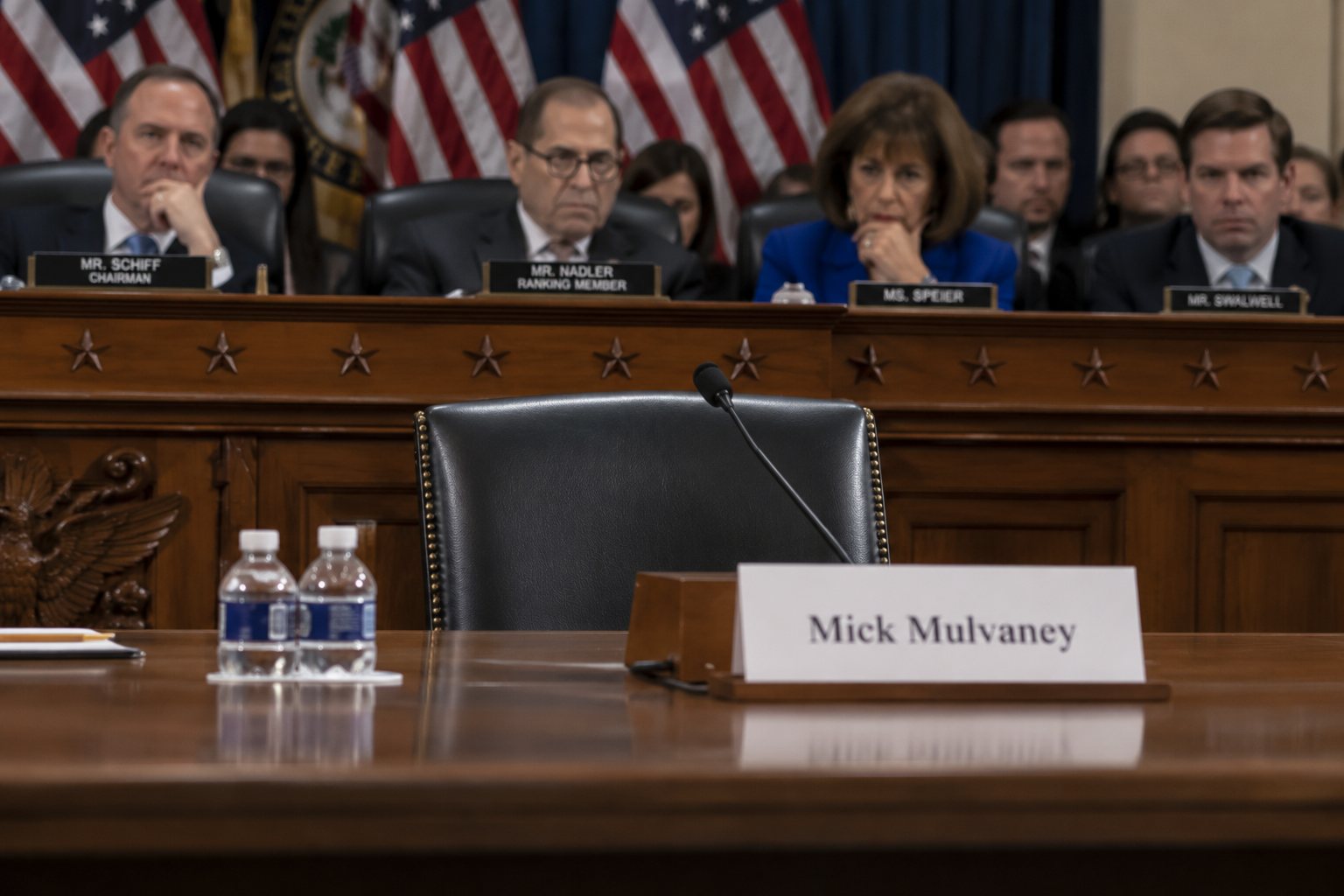
Acting White House Chief of Staff Mick Mulvaney refused to appear before congressional impeachment investigators Friday, defying a subpoena and following President Donald Trump's instructions not to cooperate with the House investigation into his dealings with Ukraine.
Mulvaney was scheduled to testify at 9 a.m. before lawmakers investigating whether Trump withheld military assistance and a White House meeting to pressure Ukrainian President Volodymyr Zelensky into announcing investigations that could benefit Trump's reelection campaign.
Instead, investigators received a message from Mulvaney's attorney just one minute before the scheduled deposition, confirming that he would not appear.
White House Claims Absolute Immunity
The White House maintains that Mulvaney, as a senior presidential adviser, is immune from compelled congressional testimony.
White House Counsel Pat Cipollone instructed Mulvaney not to attend, citing a Justice Department legal opinion asserting that close presidential advisers cannot be forced to testify about their official duties.
House Democrats reject that interpretation, arguing that no administration official is automatically exempt from congressional oversight.
Intelligence Committee Chairman Adam Schiff criticized the refusal, maintaining that the White House had no legitimate legal justification for ignoring the subpoena.
The dispute raises fundamental questions about Congress's authority to investigate presidential conduct and the executive branch's ability to withhold testimony.
Mulvaney's Earlier Admission Raises Questions
Mulvaney's refusal is particularly significant because of statements he made during an October 17 White House press briefing.
Asked about the administration's decision to withhold military assistance from Ukraine, Mulvaney acknowledged that the administration had linked the aid decision to Trump's desire for an investigation involving the 2016 election.
He suggested that such political considerations were a routine part of foreign policy.
His remarks appeared to contradict repeated White House denials that military assistance had been connected to requests for investigations.
Mulvaney subsequently attempted to clarify his comments, denying that he had acknowledged an improper exchange.
Investigators now want to question him under oath about those statements and his role in the decision-making process.
Nearly $400 Million in Military Assistance
At the center of the impeachment inquiry is the administration's decision to temporarily freeze nearly $400 million in congressionally approved security assistance to Ukraine.
The assistance was intended to strengthen Ukraine's defenses against Russian aggression.
Congressional investigators are examining whether Trump used that funding, along with the prospect of a White House meeting, to pressure Zelensky into announcing investigations involving former Vice President Joe Biden and his son Hunter.
Trump denies wrongdoing and maintains that his July telephone conversation with Zelensky was appropriate.
The military assistance was eventually released in September, but investigators continue examining why it was withheld.
Other Officials Provide Damaging Testimony
Mulvaney's absence comes as congressional investigators release additional testimony from officials who have cooperated with the inquiry.
Former National Security Council official Fiona Hill and Army Lieutenant Colonel Alexander Vindman have described concerns about efforts to pressure Ukrainian officials.
Their accounts place additional attention on Mulvaney's possible involvement in coordinating administration policy toward Ukraine.
Unlike Mulvaney, several career diplomats and national security officials have appeared before investigators despite White House opposition.
Their testimony is helping lawmakers reconstruct the events surrounding the suspended assistance.
A Growing Constitutional Confrontation
The House impeachment inquiry is preparing to enter a new phase, with public hearings scheduled to begin next week.
Mulvaney's refusal leaves investigators without testimony from one of the administration's highest-ranking officials and a potentially important firsthand witness.
The White House describes the inquiry as partisan and illegitimate. Congressional Democrats maintain that the president cannot prevent lawmakers from investigating possible abuses of executive power.
For now, Mulvaney's empty chair represents a larger confrontation between Congress and the presidency over accountability, executive authority, and the limits of congressional oversight.