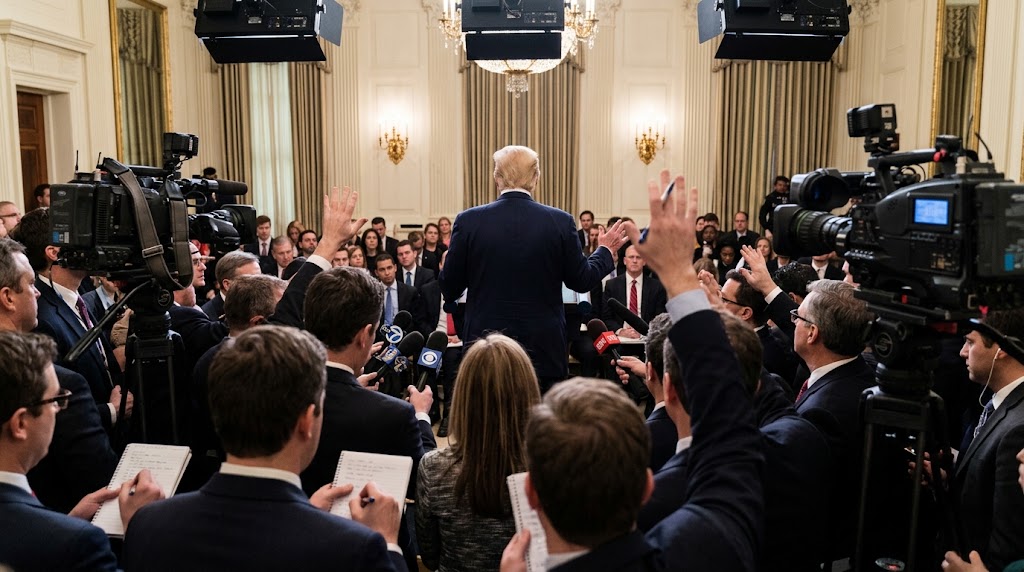
It was supposed to be an announcement about a new nominee for secretary of labor.
Instead, President Donald Trump delivered a remarkable 77-minute press conference that became one of the defining spectacles of the opening weeks of his presidency.
Standing in the East Room of the White House on February 16, Trump bounced between subjects, attacked news organizations, complained about leaks, defended his administration, discussed Russia, revisited his election victory and repeatedly challenged journalists reporting on the turmoil surrounding his young presidency.
At times the event resembled less a traditional presidential press conference than a continuation of Trump's campaign rallies — except now it was occurring inside the White House.
And much of what Trump said did not survive scrutiny.
“This Administration Is Running Like a Fine-Tuned Machine”
Trump had been president for less than four weeks.
Those weeks had already included nationwide protests over his travel ban, multiple court defeats involving that order and the resignation of National Security Adviser Michael Flynn after Flynn acknowledged giving Vice President Mike Pence incomplete information about his conversations with Russia's ambassador.
Reports described disorder and infighting within the new administration.
Trump rejected that portrayal.
“This administration is running like a fine-tuned machine,” he declared.
He repeatedly blamed negative perceptions of his administration on the press.
Trump told reporters that he watched television and read newspapers describing “chaos” inside his administration.
He insisted the opposite was true.
Then he spent much of the next hour confronting the journalists standing in front of him.
Trump Goes After the Press
The president's hostility toward the news media dominated the appearance.
Trump accused news organizations of dishonesty and complained repeatedly about what he called “fake news.”
He said the media's level of dishonesty was “out of control.”
He singled out individual organizations and reporters and disputed stories about turmoil within his administration.
At one point Trump told a reporter:
“I’m not ranting and raving.”
He then added that he was simply telling the journalist that he was a “dishonest person.”
The confrontations weren't incidental to the press conference.
They became the press conference.
A False Claim About His Election Victory
Trump also returned to one of his favorite subjects: the 2016 election.
He claimed that his Electoral College victory was the largest since Ronald Reagan.
It wasn't.
George H.W. Bush, Bill Clinton and Barack Obama had all won larger Electoral College victories after Reagan.
NBC reporter Peter Alexander challenged Trump on the claim during the press conference and provided the correct figures.
Trump responded:
“Well, I don’t know. I was given that information.”
It was an extraordinary exchange because the correction occurred immediately, directly in front of the president, during a nationally televised press conference.
Fact-checkers subsequently identified numerous other inaccurate or misleading statements during the appearance.
Russia Dominates the Questions
The resignation of Michael Flynn ensured that Russia remained another major subject.
Trump insisted that he personally had no meaningful connections to Russia and complained bitterly about leaks concerning his administration.
He described stories about Russian connections as a “ruse.”
Reporters repeatedly pressed him about whether people associated with his campaign had communicated with Russian officials.
Trump responded that “nobody that I know of” had done so during the campaign.
The subject would continue to follow his administration long after the press conference ended.
Trump Defends His Travel Ban
Trump also defended the rollout of his January immigration executive order.
“The rollout was perfect,” he said.
That description conflicted with what had actually occurred.
Implementation of the order had produced confusion at airports, questions involving lawful permanent residents and dual citizens, emergency court challenges and nationwide protests.
Federal courts had already blocked significant portions of the order.
Trump nevertheless defended both the policy and its implementation while attacking the judges involved in the legal fight.
A Different Kind of Presidential Press Conference
Presidents have argued with reporters before.
They have complained about unfavorable coverage, challenged individual stories and accused journalists of unfairness.
What made February 16 different was the scale and intensity of the confrontation.
For 77 minutes, the president of the United States moved through grievances, policy arguments, personal complaints, boasts, factual disputes and attacks on the organizations covering him.
The event was televised nationally.
Americans weren't reading someone's interpretation of Trump.
They were watching him themselves.
That made the press conference particularly revealing.
The Presidency Trump Intended to Run
In retrospect, the February 16 press conference offered an unusually clear preview of the presidency that followed.
The relentless attacks on the press.
The obsession with favorable and unfavorable coverage.
The repeated references to his election victory.
The willingness to make sweeping factual claims and challenge reporters who corrected them.
The rejection of reports describing disorder within his administration.
And the transformation of traditional presidential events into confrontational performances centered heavily on Trump himself.
Only 28 days had passed since his inauguration.
Yet one thing was becoming unmistakable.
Donald Trump was not going to adapt himself to the traditional expectations of the presidency.
He intended to make the presidency adapt to Donald Trump.