Five days earlier, Donald Trump had returned to the White House after spending three nights hospitalized with COVID-19.
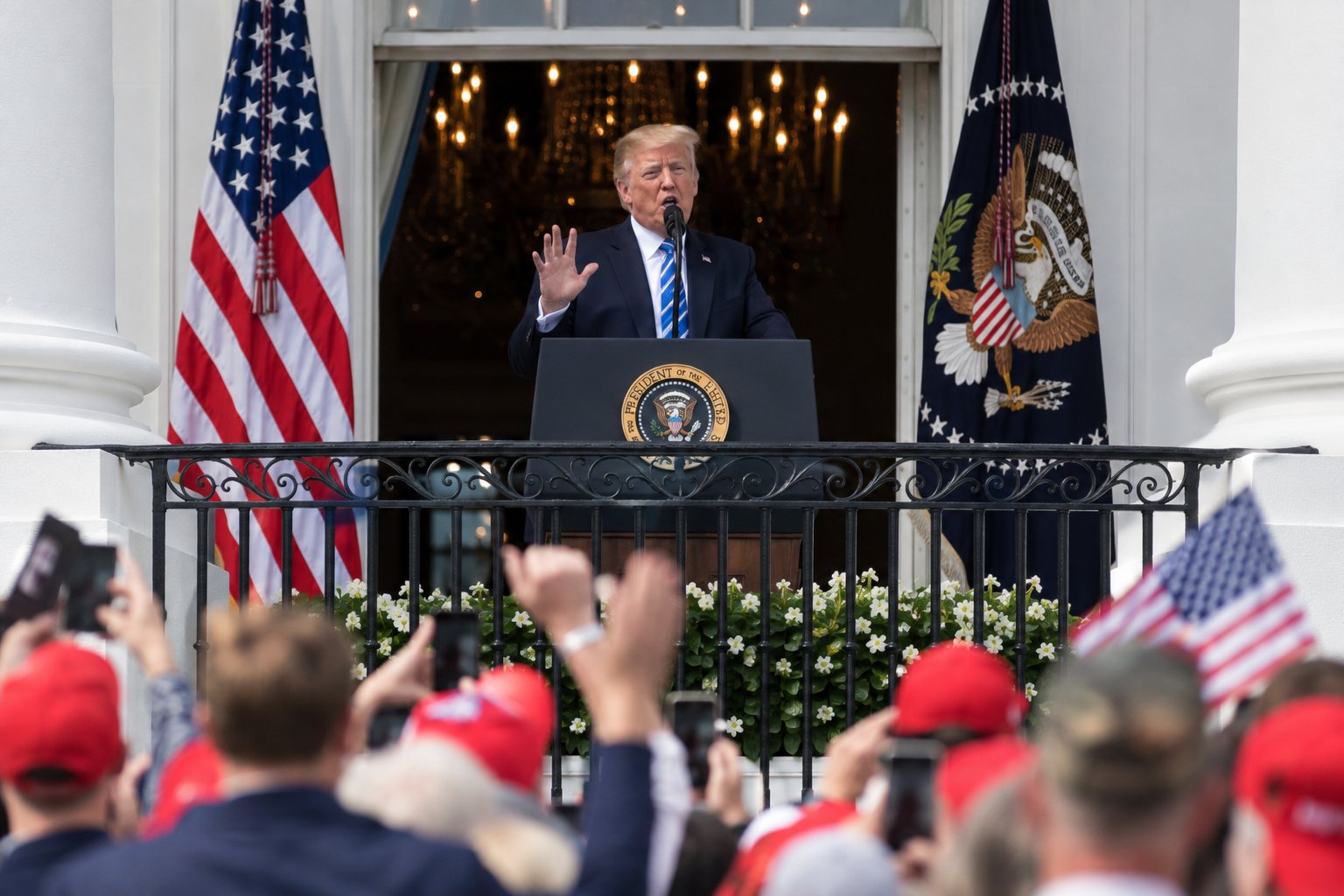
On October 10, the president stepped onto a White House balcony, removed his mask and addressed hundreds of supporters gathered below.
It was Trump's first in-person public event since his COVID-19 diagnosis and hospitalization.
And when the event began, the White House had still not publicly established that the president had tested negative for the virus.
Trump nevertheless returned to something resembling the campaign trail.
Only this time, the campaign-style event was taking place at the White House.
From Walter Reed to the Balcony
Trump announced shortly after midnight on October 2 that he and First Lady Melania Trump had tested positive for COVID-19.
Later that day, his condition became serious enough that he was transported to Walter Reed National Military Medical Center.
Doctors treated the president with several therapies, including the antiviral drug remdesivir, the steroid dexamethasone and an experimental antibody treatment.
Trump remained hospitalized until October 5.
When he returned to the White House that evening, he climbed the steps to the Truman Balcony and removed his mask before entering the building.
“Don't be afraid of Covid,” Trump had written earlier that day.
The message came as the United States was approaching 7.5 million confirmed infections and had already recorded more than 200,000 deaths during the pandemic.
Five days after leaving Walter Reed, Trump was ready to appear before supporters again.
Hundreds Gather at the White House
On the afternoon of October 10, several hundred people gathered on the South Lawn.
Many wore masks.
They were not socially distanced.
Trump emerged onto the Blue Room Balcony wearing a mask.
Then he removed it.
The crowd erupted into chants of “USA! USA! USA!”
Trump told them:
“I'm feeling great.”
The White House officially described the gathering as a “peaceful protest for law and order,” and a White House spokesman said it was an official event rather than a campaign event.
But the gathering carried many of the characteristics of a Trump rally.
Supporters wore MAGA hats and other political apparel.
Trump urged people to vote.
He attacked Democrats.
He promoted his political agenda.
And he told the crowd that voters needed to “vote them into oblivion.”
Was the President Still Contagious?
Hovering over the event was a basic question.
Could Donald Trump still transmit COVID-19?
At the time he walked onto the balcony, the White House had not announced that Trump had tested negative.
The administration had also declined to provide a complete timeline showing when Trump had last tested negative before his infection was announced.
That information could have helped establish when the president was infected and how long he might have been contagious.
Trump's doctors had said his condition had improved sufficiently for him to resume public activity.
But public-health experts questioned the rush to return a recently hospitalized COVID patient to events involving other people.
Trump remained physically separated from the crowd by the balcony, reducing direct contact with supporters below.
But the symbolism was impossible to miss.
The president had recently been hospitalized with the virus.
He appeared before hundreds of people.
And almost immediately, he removed his mask.
The Medical Clearance Came Later
Hours after the White House event, presidential physician Dr. Sean Conley released another update.
Conley said Trump had met Centers for Disease Control and Prevention criteria for safely ending isolation.
He also said diagnostic testing indicated there was no longer evidence of actively replicating virus and that Trump was “no longer considered a transmission risk to others.”
That was significant reassurance.
But the memo still did not say Trump had received a negative COVID-19 test.
Two days later, Conley would announce that Trump had tested negative on consecutive days using a rapid antigen test, without specifying which days those tests had occurred.
So when Trump stood on the White House balcony on October 10, the public did not yet have confirmation of a negative test.
A White House Already Hit by COVID
The event also came against the backdrop of a significant coronavirus outbreak surrounding the president.
Trump was not the only person in his political orbit who had recently become infected.
First Lady Melania Trump tested positive.
White House press secretary Kayleigh McEnany tested positive.
Trump adviser Hope Hicks tested positive.
Former New Jersey Gov. Chris Christie became infected and was hospitalized.
Trump campaign manager Bill Stepien tested positive.
Republican senators Mike Lee and Thom Tillis tested positive.
The outbreak followed a September 26 White House event announcing Amy Coney Barrett's nomination to the Supreme Court, where many attendees had gathered closely together, frequently without masks.
Against that backdrop, the decision to bring hundreds of supporters back onto White House grounds attracted considerable scrutiny.
“Don't Be Afraid”
Trump's behavior was consistent with the message he had delivered after his hospitalization.
He wanted Americans to see him as recovered and returning to normal activity.
COVID-19, he repeatedly argued, should not dominate people's lives.
Critics and public-health experts countered that the president's own experience demonstrated precisely why the disease was dangerous.
Trump had access to immediate medical attention, a presidential medical unit, hospitalization at Walter Reed and treatments that were unavailable to many ordinary Americans.
His case had become serious enough for doctors to administer supplemental oxygen and dexamethasone, a steroid generally associated at the time with patients experiencing more significant illness.
Yet within days of leaving the hospital, Trump was again standing before a crowd.
Back on the Campaign Trail
There was another reason for the rapid return.
Election Day was only 24 days away.
Trump had lost valuable campaign time while hospitalized and recovering at the White House.
His October 10 appearance provided a way to demonstrate publicly that he was returning to political activity.
The event lasted only about 18 minutes.
But it accomplished what Trump wanted politically: the president was visible again, standing before supporters and declaring himself healthy.
Two days later, he would travel to Florida for a campaign rally.
The hospitalization had interrupted Trump's campaign.
It had not fundamentally changed it.
The Image of October 10
The enduring image from that afternoon was simple.
Hundreds of supporters stood on the White House lawn.
Above them stood a president who had announced his COVID-19 diagnosis just eight days earlier and had left the hospital only five days before.
Trump walked onto the balcony wearing a mask.
Then he took it off.
For a country still struggling with a pandemic that had already killed more than 200,000 Americans, the scene captured one of the central conflicts surrounding Trump's handling of COVID-19.
Public-health officials emphasized caution, masks, distancing and reducing unnecessary exposure.
Trump emphasized reopening, returning to normal and projecting confidence.
On October 10, 2020, barely a week after revealing that he had COVID-19 and just five days after leaving Walter Reed, Donald Trump returned to the public stage.
And he did it from the White House balcony, mask removed, with hundreds of supporters cheering below.