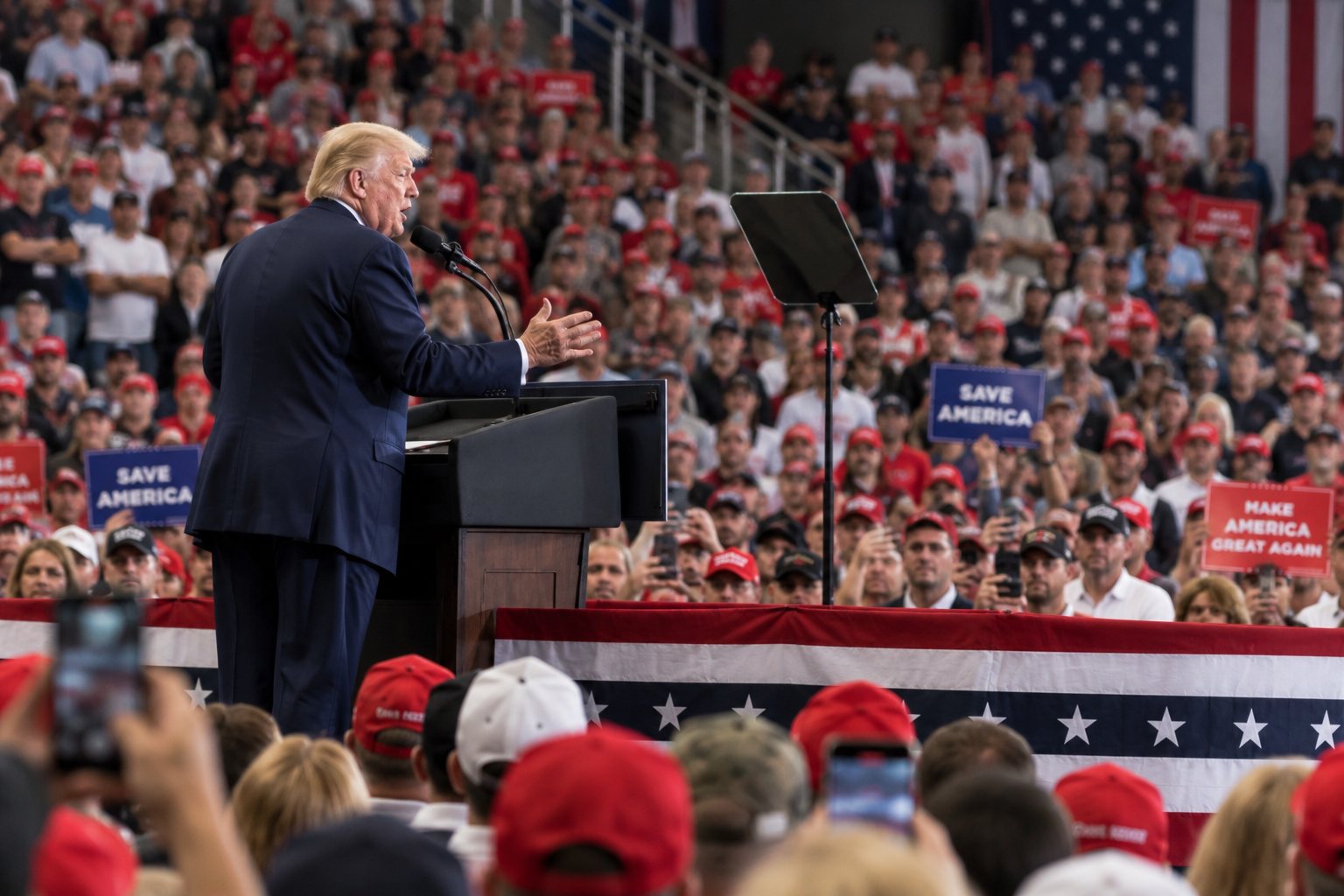
Nearly a year after Americans went to the polls, Donald Trump returned to Iowa with the same extraordinary claim he had been making since his defeat:
The 2020 presidential election had been stolen from him.
Speaking before thousands of supporters at the Iowa State Fairgrounds in Des Moines on the evening of October 9, Trump again declared that the election had been “rigged.”
By the following day, his return to Iowa was national news—not simply because the former president continued insisting that he had actually won, but because prominent Republican officials were standing beside him as he did it.
There was still one enormous problem with Trump's story.
He had never produced evidence proving that widespread fraud changed the result of the 2020 presidential election.
Not in November 2020.
Not during the court challenges.
Not during recounts.
Not during audits.
Not after state election officials investigated allegations.
Not after his own Justice Department investigated allegations.
And not when he returned to Iowa in October 2021.
Trump had accusations.
He had theories.
He had anecdotes.
He had numbers that he repeatedly presented as suspicious.
What he did not have was evidence establishing the massive election-changing fraud he was alleging.
“The Election Was Rigged”
Trump wasted little time returning to the subject in Iowa.
Only minutes into his speech, he told supporters:
“The election was rigged.”
Later, he returned to the accusation.
“They rigged the election,” Trump said.
He portrayed Joe Biden's presidency as the product of a corrupt electoral process and told supporters that Americans had effectively had their country taken away from them.
These were not presented merely as suspicions.
Trump spoke as though the theft of the presidency had been established as fact.
It hadn't.
Joe Biden had won the Electoral College 306-232.
He had also received more than seven million more votes nationally than Trump.
For Trump's claim to be true, enormous numbers of illegitimate votes would have needed to be identified in multiple states—enough to change the Electoral College result.
That evidence never emerged.
Where Was the Proof?
By October 2021, Trump had been claiming for approximately eleven months that the election was stolen.
That was plenty of time to produce evidence.
If hundreds of thousands of fraudulent ballots existed, where were they?
If voting machines had secretly changed votes, where was the evidence demonstrating that?
If election officials had manufactured enough ballots to change the presidency, where was the documentation?
If a coordinated conspiracy had stolen several states simultaneously, where were the participants, records and evidence establishing it?
Trump and his allies had ample opportunities to make their case.
They challenged election results in court.
They demanded recounts.
They demanded audits.
They challenged voting procedures.
They presented allegations to state legislators.
Trump personally pressured election officials to investigate his claims.
Republican officials investigated allegations.
The Justice Department investigated allegations.
Yet none of those processes established the nationwide conspiracy Trump continued describing to his supporters.
Trump's Own Justice Department Didn't Find It
Perhaps one of the most significant contradictions came from Trump's own administration.
Attorney General William Barr had authorized federal prosecutors to investigate substantial allegations of voting irregularities.
Barr was hardly a political adversary of Donald Trump.
He had served as Trump's attorney general and had repeatedly defended the administration during some of its biggest political controversies.
But in December 2020, Barr publicly contradicted the president's claims.
The Justice Department, Barr said, had not uncovered fraud on a scale that could have changed the election's outcome.
That should have been devastating to Trump's argument.
His own Justice Department had looked.
It hadn't found what Trump claimed existed.
Trump continued making the claim anyway.
The Courts Didn't Establish It Either
Trump and his allies also turned to the courts.
Dozens of lawsuits challenged election procedures and results around the country.
Some cases were dismissed for procedural reasons.
Others involved evidentiary issues.
Judges appointed by both Democratic and Republican presidents heard election-related cases.
The litigation did not produce a judicial finding establishing the enormous fraud Trump alleged had deprived him of the presidency.
That distinction matters.
Trump often pointed to the number of lawsuits or complained that courts had refused to adequately consider his allegations.
But filing a lawsuit is not proof that the allegations contained within it are true.
Neither is repeating those allegations at a political rally.
Recounts Didn't Rescue the Claim
There were recounts and reviews as well.
Georgia counted its presidential ballots three times, including a statewide hand audit.
Biden remained the winner.
Wisconsin conducted recounts in its two largest Democratic counties at Trump's request.
The result did not flip.
Arizona became another centerpiece of Trump's allegations.
Republicans in the Arizona Senate commissioned an extensive review of the election in Maricopa County.
Trump repeatedly promoted that effort.
But when the review was completed, it did not show Trump winning Arizona.
In fact, its ballot count still showed Biden ahead in Maricopa County.
That did not stop Trump from using the audit at his Iowa rally as evidence that something had gone terribly wrong.
Trump Points to “Irregularities”
In Iowa, Trump highlighted numbers from the Arizona review that he characterized as suspicious.
He cited alleged problems involving addresses, ballots and voter records.
But suspicious-sounding numbers are not the same thing as fraudulent votes.
Election officials and fact-checkers repeatedly found that many of the supposed irregularities promoted by Trump and his allies had ordinary explanations or resulted from misunderstandings of election records and procedures.
More importantly, none established enough illegal votes to overturn Arizona's result.
Trump nevertheless continued presenting such claims as evidence that the broader election had been corrupted.
Even Actual Fraud Was Nowhere Near Enough
Individual cases of voter fraud do occur in American elections.
That was never seriously disputed.
The question was whether fraud occurred on a scale capable of changing the 2020 presidential election.
Later investigations illustrated the enormous difference.
An Associated Press review of six battleground states identified fewer than 475 potential cases of voter fraud among more than 25 million ballots cast.
Even if every one of those ballots had been improperly cast for Biden—which was not the case—the number would have been nowhere near enough to change the presidential result.
Trump wasn't alleging a few hundred improper votes.
He was alleging that an American presidential election had effectively been stolen.
That required evidence on an entirely different scale.
He did not produce it.
“We're Going to Take America Back”
Yet the lack of proof did little to change the message Trump delivered to his supporters.
He presented himself not as a defeated former president but as the leader of a political movement preparing its return.
“We're going to take America back,” Trump told the crowd.
The language pointed toward the future.
So did the political figures standing alongside him.
Among them was one of Iowa's most established Republican politicians: Senator Chuck Grassley.
Chuck Grassley Takes Trump's Endorsement
Grassley had served in the United States Senate since 1981.
By 2021, he was one of the longest-serving senators in American history and was preparing to seek another term.
Trump called Grassley onto the stage.
Then he gave him his “complete and total endorsement.”
Grassley accepted.
His explanation was revealing.
Grassley pointed to Trump's enormous popularity among Iowa Republican voters and said that refusing the endorsement would not be politically smart.
It demonstrated something larger about the Republican Party in October 2021.
Trump had lost the presidency.
He had spent months claiming without sufficient evidence that the election had been stolen.
Yet Republican candidates still wanted his endorsement.
Republican politicians still appeared at his rallies.
And Republican voters remained overwhelmingly supportive of him.
Trump no longer occupied the White House.
But he remained a dominant force inside the Republican Party.
Repetition Was Replacing Evidence
By October 10, 2021, Trump's stolen-election narrative had developed an unusual characteristic.
The longer it survived, the less it depended upon producing new proof.
The allegation itself had become the message.
Trump said the election was rigged.
Supporters repeated that it was rigged.
Political allies demanded additional investigations because people believed it was rigged.
Trump then pointed to those investigations as evidence that questions existed about the election.
When investigations failed to overturn the result, he moved to another allegation.
What never appeared was the evidence necessary to establish his central claim:
That enough fraudulent votes had been cast or counted to make Donald Trump the legitimate winner of the 2020 presidential election.
Eleven Months Later, Still No Proof
Trump had every opportunity to prove what he was saying.
He had lawyers.
He had campaign money.
He had political allies.
He had Republican state legislators willing to investigate.
He had recounts.
He had audits.
He had access to the Justice Department while he was still president.
He had months to gather evidence.
And he had an enormous national platform from which to present it.
Yet when Donald Trump returned to Iowa in October 2021, he was still doing essentially what he had done immediately after Election Day.
Making the accusation.
“The election was rigged.”
By then, however, Americans had nearly a year of evidence with which to evaluate that claim.
The votes had been counted.
Critical states had certified their results.
Recounts had been conducted.
Audits and reviews had taken place.
Courts had considered election challenges.
Trump's own attorney general had said the Justice Department had not found fraud sufficient to change the result.
Joe Biden had been inaugurated president.
And Donald Trump still had not produced evidence establishing the massive, coordinated election theft he continued describing to his supporters.
That did not stop the claims.
And judging by the Republican leaders standing beside him in Iowa, it had not ended Trump's political influence either.